




Volume 192 - Issue 7
Surgery for stress urinary incontinence in Australia: current trends from Medicare data
Authors: Joseph K Lee and Peter L Dwyer
Med J Aust 2010; 192 (7): 422. || doi: 10.5694/j.1326-5377.2010.tb03572.x
Published online: 5 April 2010
Published online: 5 April 2010
To the Editor: The advent of midurethral slings (MUSs) has revolutionised surgery for female stress urinary incontinence. An MUS is a narrow, synthetic (usually polypropylene) tape that is surgically placed beneath the middle part of the urethra, traversing either the retropubic space or the obturator foramina to provide dynamic support in order to restore urinary continence.
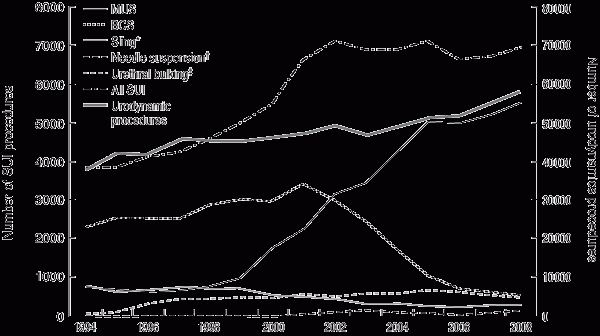
Medicare Australia data from 1994 to 2008 (Box) show that there was a 75% increase in surgery for stress urinary incontinence over this period, from 4000 to nearly 7000 cases a year, reflecting the increasing popularity of MUSs as a result of lower morbidity and shorter hospitalisation (day surgery). The rapid uptake of MUSs since 1999 has been matched with a rapid decline, since 2001, in use of the Burch colposuspension procedure. Colposuspension is an open abdominal or laparoscopic procedure in which the bladder neck is supported by elevating the paravaginal fascia using sutures to the ipsilateral iliopectineal ligament on both sides. This operation is done via an abdominal incision or through operative laparoscopy. There has also been a decline in the use of pubovaginal fascial slings and a small increase in urethral bulking procedures. Very few needle suspensions are performed in Australia. There has been a significant increase in the number of urodynamic procedures performed (including uroflow, cystometry and urethral pressure profiles), which may also be a reflection of an increased number of women presenting for treatment. It should be noted that these Medicare data reflect trends within the private sector only, and our data are not age- or sex-specific. Nor do they distinguish between the specialties of gynaecology or urology in their use of MUSs or between different midurethral slings used in Australia.
Although Burch colposuspension and autologous pubovaginal slings were for many years considered the “gold standard” operations for stress incontinence,1 recent systematic reviews have shown MUSs to be just as efficacious2,3 and possibly more cost-effective.4 Regardless of debate about which operation may be best,5 MUS surgery has become the most common operation performed for stress urinary incontinence in Australia. Data from the National Health Service in the United Kingdom show a similar trend.6
However, changes in MUS use in Australia and internationally have not always been driven by good science. The remarkable popularity of the newer single-incision slings in the United States, despite very limited availability of clinical evaluation information, is of concern. Their popularity has been attributed anecdotally to the fact that insertion of a single-incision sling is an “office” procedure that attracts greater insurance reimbursement than procedures that are performed under anaesthesia or require hospital stays.
Surgery for stress urinary incontinence has moved rapidly towards a minimally invasive approach, making it more appealing to all patients, especially those who are older or medically unfit. At present, new devices to treat stress incontinence and other pelvic floor problems are being introduced and extensively used without adequate clinical evaluation by good prospective randomised trials.7 Changes in surgical practice should be driven by good scientific evidence of safety and effectiveness, rather than commercial interests or government budgets.
Competing interests
Peter Dwyer is principal investigator of several randomised controlled trials of procedures for alleviating stress urinary incontinence, including pubovaginal slings, Burch colposuspension, urethral bulking and MUSs. He is also principal investigator of an ongoing randomised controlled trial involving a minisling, for which he has received a research grant from American Medical Systems.
References
- Lapitan MC, Cody JD, Grant A. Open retropubic colposuspension for urinary incontinence in women: a short version Cochrane review. Neurourol Urodyn 2009; 28: 472-480. 0_CBBGDHIJ
- Novara G, Ficarra V, Boscolo-Berto R, et al. Tension-free midurethral slings in the treatment of female stress urinary incontinence: a systematic review and meta-analysis of randomized controlled trials of effectiveness. Eur Urol 2007; 52: 663-678. 0_i1091873
- Ogah J, Cody JD, Rogerson L. Minimally invasive synthetic suburethral sling operations for stress urinary incontinence in women. Cochrane Database Syst Rev 2009; (4): CD006375. 0_i1091875
- Cody J, Wyness L, Wallace S, et al. Systematic review of the clinical effectiveness and cost-effectiveness of tension-free vaginal tape for treatment of urinary stress incontinence. Health Technol Assess 2003; 7 (21): iii, 1-189. 0_i1091877
- Serati M, Salvatore S, Uccella S, et al. Surgical treatment for female stress urinary incontinence: what is the gold-standard procedure? Int Urogynecol J Pelvic Floor Dysfunct 2009; 20: 619-621. 0_i1091879
- Hilton P. Long-term follow-up studies in pelvic floor dysfunction: the Holy Grail or a realistic aim? BJOG 2008; 115: 135-143. 0_i1091881
- Dwyer PL. Minimally invasive surgery in urogynecology. Int Urogynecol J Pelvic Floor Dysfunct 2009; 20: 485-486. 0_i1091884
Forty Years in the Making: Reporting on the Co-Creation of a National Roadmap for Birthing on Country Services for the Best Start to Life
Res McCalman, Anneka J. Bowman, Roianne West, Kristie Watego, Jyai Allen, Claire Clack, Sue Kildea, Sue Kruske, Melanie Briggs, Cleone Wellington, Rebecca Coddington, Yu Gao, Isabella Garti, Sascha Kowalenko, Sarah Ireland, Catherine Austin, John D. Boffa, Marah Prior, Kelsie Kahl, Bettina Chaseling, Sarah Khaw, Emily Armstrong, Donna Hartz, Yvette Roe
Temporal Trends in Preterm Birth Associated With Hypertensive Disorders of Pregnancy in Victoria, Australia: A Population-Based Interrupted Time-Series Study
Melvin Marzan, Heng Jiang, Daniel Lorber Rolnik, Joanne M. Said, Lisa Hui
Linguistic Manoeuvres: Obstetric Violence Camouflages Harm and Loss of Consent From Birth
Liz Sutton, Harsha Ananthram, Rebecca Matthews
Linguistic Manoeuvres: Obstetric Violence Camouflages Harm and Loss of Consent From Birth
Bashi Kumar-Hazard, Andrew M. Bisits, Sharon L. Settecasse, Jenny Gamble, Hazel Keedle, Hannah G. Dahlen
Linguistic Manoeuvres: Obstetric Violence Camouflages Harm and Loss of Consent From Birth
Wendy Pollock, Alissa Fleming, Ensieh Fooladi, Joy Kloester, Anne Tremayne, Yasmin Zisin, Bethany Carr, Kym Davey, Suzanne Willey, Jenny Gamble
Getting on the Same Page: Why Australia Needs a National Maternity Early Warning System (MEWS) Chart
Briony A. Cutts, Lucy Bowyer, Nisha Khot, Sandra Lowe, Stefan C. Kane