




Volume 192 - Issue 11
The ABC breast cancer cluster: the bad news about a good outcome
Author: Bernard W Stewart
Med J Aust 2010; 192 (11): 629-631. || doi: 10.5694/j.1326-5377.2010.tb03659.x
Published online: 7 June 2010
Published online: 7 June 2010
New data bring to a close Australia’s most intensive cancer cluster investigation
Though only a small proportion of cancer clusters are reported in the peer-reviewed literature, a consistent picture emerges from those reports. The term “cancer cluster” refers to health authorities being alerted to a perceived increased incidence of cancer, involving 15 cases or fewer in the first instance, within a particular community or group. Aware of the anxiety generated by the prospect of a cancer cluster, cluster investigators focus on local circumstances that might account for increased risk, and if they fail to identify any such factors, the matter rests.1
The report by Sitas and colleagues in this issue 2 is a rare example of the implications of a cluster investigation being rigorously pursued. In this case, the implication was that a cluster among staff of the Australian Broadcasting Corporation (ABC) studios in Toowong, Brisbane, might reflect a higher-than-average risk of breast cancer among female employees of the ABC throughout Australia, due to some common cause.3 In terms of identifying causative agents, notification of an individual cluster can be likened to a case report. Nothing can be immediately proved; everything depends on a subsequent, more broadly based study.
Cancer clusters, and their investigation, are distinguished from infectious disease clusters by, among other things, the longer time frame involved and the fact that cancer is the most feared disease in Australia and similar countries. Demands made in respect of cancer cluster investigations centre on whether the cluster is explicable by chance and, if not, what caused it. The Toowong cluster came to national attention via a television program entitled “One in a million”, an epithet derived from the cluster investigators’ initial assessment of the likelihood that the increased incidence of breast cancer might be attributable to chance.4 Calculation of the probability that a cluster is attributable to chance is limited, if not precluded, by a posteriori definition of the study population — often illustrated by reference to the Texas sharpshooter who was in the habit of firing at the side of a barn, locating the bullet hole and painting a target round it.5 But the community wants answers, not technicalities. In the case of Toowong, the difficulty inherent in making such a determination is illustrated by revision of the initial estimate, specified in the summary of the final report as follows:
[T]he likelihood of this event occurring by chance is about one in a million. This, however, may oversimplify the situation and, when further analyses are performed, adjustment of the P-value for implied multiple comparisons increased its estimated value to 0.04. That potentially increases the likelihood of the cluster occurring by chance to one in 25.3
Whether cluster investigations have ever revealed a new carcinogen is debated. Though vinyl chloride and diethylstilboestrol are sometimes cited in this context, the carcinogenicity of these compounds was implicated from multiple case reports involving alert physicians rather than from the perceptions of people in the affected group. Indeed, diethylstilboestrol was initially investigated because a lift malfunction in Boston resulted in a gynaecologist and a pathologist exchanging experiences.6 Otherwise, increased numbers of cancer cases within communities located adjacent to point-source pollution may implicate particular carcinogens. However, assessments of lung cancer near steelworks or smelting operations, mesothelioma near asbestos mines, thyroid cancer near a failed reactor, or haematopoietic malignancy in the vicinity of toxic waste dumps7 are readily distinguished from cluster studies, the latter being prompted by increased incidence rather than any attempt to determine whether an increase exists in light of a specific exposure. Novel exposure to carcinogens may also be investigated following spatial aggregation studies, which typically involve hundreds or thousands of cases — for example, the investigation of exposure to pesticides or other agents in relation to increased breast cancer incidence on Long Island, New York.8
Once cluster investigations are distinguished from case reports, point-source pollution investigations and spatial aggregation studies, it is arguable that clusters have rarely, if ever, resulted in the discovery of a specific cause of cancer, much less revealed a new carcinogen. Accordingly, the result of the Toowong cluster investigation was typical. In Toowong, all plausible causes of the cluster, including radiofrequency and extremely low frequency electromagnetic fields, ionising radiation and chemical contamination of the site or its water supply, were excluded.3
The findings of Sitas and colleagues2 are a good outcome for women employed by the ABC, and for those who worked in Toowong specifically. The absence of increased risk of breast cancer among ABC employees Australia-wide, together with a failure to identify any agent that could account for increased risk in Toowong and the 1 in 25 probability that the situation may have arisen by chance,3 mean the case is closed. However frustrating it may be, chance emerges as the most likely explanation. ABC staff at Toowong and elsewhere have no reason to be apprehensive about being at increased risk. There are no reasonable medical or scientific grounds for such women to undergo more rigorous clinical examination or more frequent mammographic screening than is recommended for women in Australia generally. These considerations critically depend on the findings of Sitas et al.2 Likewise, any notion that the building or site at Toowong presents a toxic hazard is now little short of absurd. Hopefully, ABC staff will be so advised.
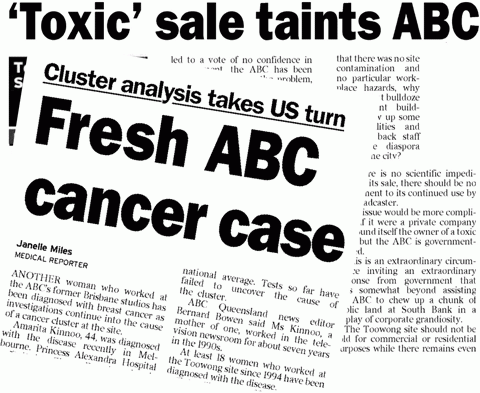
Beyond that, however, this good news might be shouted from the top of Uluru for all the likelihood it has of reaching the wider community, whose perceptions about cancer causation now include the “one in a million” scenario. The media in Australia respond to an insatiable demand for news of unsuspected exposure to carcinogens. Overwhelmingly, reports about possible cancer causation refer to consumer products and food contamination.9 Apart from a correct appreciation of carcinogens in tobacco, perceived causes of cancer range from pesticide residues in food to deodorants, from artificial sweeteners to mobile phones.7 For each such agent, there exists evidence of potential harm — but the relevant risks are either vanishingly small or simply not established. Maintaining speculation about Toowong comes a recent report of another breast cancer case and related matters connected with Toowong (Box). In point of fact, more and more cases of breast cancer will occur among women who once worked at ABC Toowong, in the same way that more and more cases of breast cancer will occur among any cohort of Australian women initially identified as aged 30–50 years. Tragically, one Australian woman in nine will develop breast cancer by the age of 85 years.10 About 60 cases must be anticipated within the Toowong cohort of 550, taking account of no other risk factor than being a woman in Australia. The prospect, however, is that each such case will be reported as involving another Toowong employee, fuelling anxiety about a common cause of harm, with no mention being made of the work of Sitas et al.2 Reference to a lack of risk hardly contributes to the momentum of a great story. But there is a price. People who misunderstand cancer causation are less likely to engage in practices known to reduce the risk of disease.11 Any unwarranted anxiety about insidious exposure to carcinogens seems likely to impede adoption of evidence-based measures to prevent cancer. That, together with any needless burden of anxiety, is bad news.
References
- Westley-Wise VJ, Stewart BW, Kreis I, et al. Investigation of a cluster of leukaemia in the Illawarra region of New South Wales, 1989–1996. Med J Aust 1999; 171: 178-183. 0_i1091908
- Sitas F, O’Connell DL, van Kemenade C, et al. Breast cancer risk among female employees of the Australian Broadcasting Corporation in Australia. Med J Aust 2010; 192: 651-654. 0_i1091910
- Armstrong B, Aitken J, Sim M, Swan N. Breast cancer at the ABC Toowong Queensland. Final report of the Independent Review and Scientific Investigation Panel. 2007. http://www.abc.net.au/corp/pubs/documents/Breast_Cancer_Toowong_Final_Report.pdf (accessed Feb 2010).
- Stewart BW. “There will be no more!”: the legacy of the Toowong breast cancer cluster. Med J Aust 2007; 187: 178-180. 0_i1091914
- Rothman KJ. A sobering start for the cluster busters’ conference. Am J Epidemiol 1990; 132 (1 Suppl): S6-S13. 0_i1091916
- Doll R. Strategy for detection of cancer hazards to man. Nature 1977; 265: 589-596. 0_i1091918
- Stewart BW. Banding carcinogenic risks in developed countries: a procedural basis for qualitative assessment. Mutat Res 2008; 658: 124-151. 0_i1091920
- Winn DM. The Long Island Breast Cancer Study Project. Nat Rev Cancer 2005; 5: 986-994. 0_i1091922
- Stewart BW. Confusion and anxiety about reported causes of cancer [abstract]. Asia Pac J Clin Oncol 2009; 5 Suppl 2: A153. 0_i1091925
- Australian Institute of Health and Welfare and Australasian Association of Cancer Registries. Cancer in Australia: an overview. Canberra: AIHW, 2008. (AIHW Cat. No. CAN 42; Cancer Series No. 46.) 0_i1091927
- Niederdeppe J, Levy AG. Fatalistic beliefs about cancer prevention and three prevention behaviors. Cancer Epidemiol Biomarkers Prev 2007; 16: 998-1003. 0_i1091929
From Ambition to Action: Closing Policy, Equity and Implementation Gaps in the Australian Cancer Plan's ‘Enhanced Consumer Experience’
Carla Thamm, Elise Button, Oluwaseyifunmi A. Agbejule, Reegan Knowles, Karen van Gorp, Mark B. Pinkham, Meinir Krishnasamy, Alexandra L. McCarthy, Raymond J. Chan
Sovereignty and Survival: Understanding Lung Cancer Outcomes for Aboriginal and Torres Strait Islander People in Australia, a Case–Control Study
Alice R. T. Bergin, Luc te Marvelde, Roger L. Milne, Benjamin J. Solomon, Kris Ivanova, Peter Savas, Stephen J. Luen, Jay Hamann, Andrea Casey, Nicole Watt, Sue M. Evans, Gail Garvey, Sherene Loi
The Changing Indications for Adult Liver Transplantation in Australia: A Narrative Review
Fadak Mohammadi, Alan J. Wigg, Ken Liu, Simone I. Strasser
Uneven Ground: Survival Differences Among Victorian Lung Cancer Patients by Location of Residence (2011–2023): A Retrospective Cohort Study
Evangeline Samuel, Eldho Paul, Mike Lloyd, Sanuki Tissera, Craig Underhill, Sagun Parakh, Phillip Parente, Inger Olesen, Javier Torres, Katharine See, Gavin M. Wright, David Langton, Thomas John, Matthew Conron, James Bartlett, Nicola Atkin, Nikolajs Zeps, Susan V. Harden, Wasek Faisal, John R. Zalcberg, Rob G. Stirling
Early-Onset Colorectal Cancer With Liver-Only Metastases: A Retrospective Cohort Study Integrating Prospectively Collected Real-World Clinical and Molecular Data From an Australian National Database (2009–2024) to Guide Treatment Planning
Savio G. Barreto, Christos S. Karapetis, Shahid Ullah, Matthew Burge, Susan Caird, Angus Campbell, Azim Jalali, Ross Jennens, Muhammad A. Khattak, Belinda Lee, Stephanie H. Lim, Shehara Mendis, Louise Nott, Timothy J. Price, Jeremy D. Shapiro, Jeanne Tie, Javier Torres, Colin Williams, Rachel Wong, Vanessa Wong, Peter Gibbs
Australian Pathways for Specialist Pain Management and Early Palliative Care for People With Pancreatic Cancer: Developed Using a Community Consensus Approach
Jennifer Philip, Melanie R. Lovell, Kylee Bellingham, Gail Garvey, Gregory B. Crawford, Nicole M. Rankin, Kara Burns, Isabel Young, Vivienne Milch, Dorothy Keefe, Katrina Anderson, James Lawson, Meinir Krishnasamy