




Volume 191 - Issue 11
Out of my depth in East Timor
Author: Geoffrey C Mullins
Med J Aust 2009; 191 (11): 664-665. || doi: 10.5694/j.1326-5377.2009.tb03372.x
Published online: 7 December 2009
Published online: 7 December 2009
“I vont to do an emergency caesar, quick!” Andre’s voice crackled into my heavy, hand-held emergency telephone, which I had not yet mastered. Andre was a tall, good-natured Dutch general practitioner who had been working at Dili National Hospital for over a year and did much of the obstetrics when the hospital lacked a specialist obstetrician (a frequent occurrence). I had warmed to him immediately; he was one of the very few people employed in the hospital who spoke English, and he had an air of confidence that was reassuring. He told me that the operating room was already preparing for the procedure, he would be there in 30 minutes, and he hoped I could have the patient anaesthetised and ready by that time.
It was my second day as the only anaesthetist at the only tertiary referral hospital in East Timor, and I had just discovered that, at that time (August 2001), I was the only specialty trained anaesthetist in the country. I was already finding my job challenging.
Dili National Hospital (formerly, the Indonesian State Hospital) had had an eventful recent history. After the referendum supervised by the United Nations in August 1999, when the people of East Timor voted overwhelmingly for independence from Indonesia, the Indonesian army and its local militia withdrew — burning, looting and killing as they went. When the International Committee of the Red Cross took over temporary management of the hospital in September 1999, they found that the buildings were intact but much of the equipment had been looted or damaged, and only 10 nurses remained caring for 37 patients. With the support of the Red Cross and the local population, the hospital was re-established and handed over to the new Government of East Timor on 30 June 2001.
The hospital’s bed capacity was 226, and it was greatly in need of external support, especially specialty medical staff, technical assistance, equipment and drugs.
The challenges for an anaesthetist at this time in East Timor have been well described.1 The limited facilities for anaesthesia, the minimal laboratory and radiological investigations available, the lack of drugs, and the scarcity of blood for transfusion were major daily concerns.
However, by far the greatest difficulty I faced was the language barrier. The languages spoken in East Timor are Indonesian, Tetum and Portuguese. Apart from a few expatriate medical practitioners, very few of the more than 300 East Timorese hospital staff spoke any English, and it was rare to find a patient with any understanding of English. In particular, none of the staff working in the operating room spoke or appeared to understand English.
My initial approach was that commonly used by English speakers when faced with people who don’t speak English. I would speak very slowly, opening my mouth wide and carefully enunciating my words, which of course they didn’t understand. Next, I would raise my voice in the hope that loud English words would penetrate further into the brain of the listener, perhaps to a part of the brain that somehow understood English. Failing this, I would add some crude improvised hand and arm movements in an attempt at sign language. Finally, if my listener still had that gentle, bemused look that I was becoming very familiar with, I would reach into my pocket for my Indonesian–English dictionary. I would find the appropriate word and point at it repeatedly, while staring at my listener hoping for some indication that all was now clear and that he or she understood what in the hell I was talking about. This was a slow process to be sure and, as I was to discover, fraught with risks.
Part of my responsibility was to instruct the East Timorese male nurse anaesthetists when they were in the operating room. So, on my first day, when confronted with a patient who developed tachycardia during anaesthesia, I decided this was an excellent opportunity to begin my teaching sessions.
Applying the communication techniques described above, I soon had the attention of the entire operating room staff. With a raised voice, I slowly and loudly enunciated the words “too fast”. I then repeatedly pointed at the rapid electrocardiogram trace on the patient monitor, saying “too fast”. Unconvinced that I was being fully understood, I took out my dictionary, found the word “fast” and pointed at the word and then at the monitor. Suddenly, to my delight, the two nurse anaesthetists both smiled knowingly, but then strangely began to make blowing noises through their pursed lips, much to the amusement of the rest of the operating room staff. Somewhat bemused, I finally looked down at the dictionary and found that my finger had inadvertently been pointing at the word “fart”, not the word “fast”. This early incident, although highlighting the difficulties I would face in communicating easily and effectively, also paradoxically helped me rapidly establish a casual rapport with the staff that lasted for my stay at the hospital!
Responding to Andre’s request for my anaesthesia services, I hurried to the maternity ward to see my first obstetrical patient in Dili. Neither the patient nor the staff spoke or understood English but, by observing the patient and looking up her records, I did glean some important clinical details. She was a distressed 32-year-old multigravida with severe pre-eclampsia. She was in strong labour with ruptured membranes and meconium-stained liquor. Her eyes were puffy, she was photophobic, her blood pressure was between 180/140 and 240/170 mmHg, and there was protein in her urine.
There were no antihypertensive drugs on the ward; in fact, there were none in the entire hospital. This was indeed an emergency situation. There was no time for me to practise my communicating skills, so I hurried to the operating room, trusting that Andre and the nursing staff had explained the need for a caesarean section to the patient.
I arrived in the operating room closely followed by the patient on a trolley. Two male nurses were present. They were scrubbed and gowned and busily preparing instruments as I moved the patient onto the operating table and positioned her on her side in preparation for a spinal anaesthetic. I was about to place monitors and insert an intravenous line when she suddenly had a strong, painful contraction. I stopped my preparation and began massaging her lumbar region, while murmuring quiet, reassuring English words (gibberish to her ears) and waited for the end of the contraction. Without warning, there was a sudden thud and a loud cry. Looking down at my feet, I saw a wailing, meconium-stained baby on the floor. I looked at the mother and saw, emerging from between her legs, an umbilical cord that had obviously broken off as the baby fell to the floor. The two nurses standing behind their instrument trays were wide-eyed and aghast and appeared unable to move. I picked up the now screaming, slippery baby boy and was holding him in my arms when a midwife entered the theatre. I immediately tried to communicate to her that the baby had fallen on the floor, and probably on his head. This I did by repeatedly hitting my head with my free hand, as I held the baby in my other arm. At the same time I was imploring the scrub nurses, who still seemed unable to move, to “Get Andre! Get Andre!” Meanwhile, the mother had now rolled onto her back and was staring in disbelief at the long umbilical cord between her legs and then at my antics with the baby.
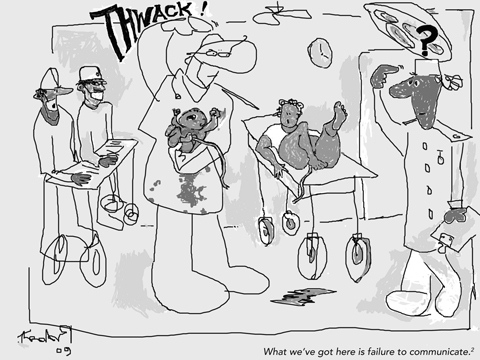
I felt completely out of my depth and very far from home. Here I was in a foreign country, in an operating room full of people who didn’t understand a word I was saying, holding a baby in one arm and repeatedly banging my head with my other hand, while talking excitedly to a midwife who was looking at me as though I was crazy. Flashing through my mind were visions of my O and G professor from medical school days. I kept thinking of the delight he would have taken in reprimanding me in his usual aggressive, sarcastic manner for this utterly inept performance.
I eventually recovered some degree of composure and handed the screaming baby over to the bemused midwife, so I could turn my attention to the mother who seemed completely overwhelmed by these events. I placed monitors, gave her some intravenous syntocinon, and then massaged her lower abdomen while gently pulling on the umbilical cord. To my astonishment and relief the placenta delivered with ease.
Five minutes later Andre arrived to smiles all around. The mother was now holding her new baby boy, and was obviously relieved at not having to have an operation. The baby appeared well and unaffected by his precipitous birth. The staff were talking excitedly, presumably about the events they had just witnessed, but I had no idea what they were saying about the strange behaviour of the doctor from Australia. I had settled somewhat, although I still had visions of the out-of-control events and was eager to change out of my operating theatre garb.
During my 3 weeks in East Timor, I continued to have many communication difficulties and frustrations, but my saving grace was the East Timorese people. They are a gentle, kind, fun-loving people and their response to my pathetic attempts at communication was always tolerant and often accompanied by a bemused smile, if not gentle laughter.
The East Timorese have suffered much in their long history of invasions, civil war and interactions with foreigners. Perhaps, out of necessity, they have developed a resilient and tolerant attitude to the presence of foreigners. They have been invaded in the distant past by the Portuguese and, in World War II, by the Japanese. In more recent times, there have been invasions by the Indonesians, followed by United Nations peacekeepers, and now most recently by the most subtle of invaders — the aid worker.
I learnt to greatly respect and admire the courage of the East Timorese people, especially the way they coped with their tragic past, the uncertainty of their everyday life, and the sad events that we faced at times in Dili National Hospital. As with my other sojourns in developing countries on “aid missions”, I have learnt much more from the people I met than they have from me. The gentle, tolerant and bemused smiles of the East Timorese remain with me still.
Acknowledgements
Thanks to Mr Robert Dougall for the illustration.
References
- Bennett EJ. Anaesthesia in the Dili General Hospital, East Timor. Anaesth Intensive Care 2001; 29: 530-534. 0_i1091861
- Rosenberg S, director. Cool hand Luke [motion picture]. United States: Warner Bros, 1967. 0_i1091863
Prisoner of war pathology in Changi, 1942–1945
Kate Ariotti, Elizabeth Roberts‐Pedersen
Should medical eponyms continue to be used in everyday practice?
Leya Nedumannil, Diana Lewis
100 years on: the first use of insulin in Australia
Sophie Templer
Reflections on the life and career of Professor Dame Valerie Beral AC DBE FRS FRCOG FMedSci (1943–2022)
Karen Canfell, Bette Liu, Emily Banks
The Honourable Dr Donald James Grimes AO
Michael Kirby, Patti Warn
From wipeout to drill out: a history of exostosis management and Australian surfing
Alon Taylor, Hannah North, Narinder P Singh, Paul A Fagan