




Volume 191 - Issue 11
Needlestick injury with smallpox vaccine
Author: Sanjaya N Senanayake
Med J Aust 2009; 191 (11): 657. || doi: 10.5694/j.1326-5377.2009.tb03368.x
Published online: 7 December 2009
Published online: 7 December 2009
Vaccinia vaccine is used to immunise against smallpox, which is caused by the orthopoxvirus, variola. A 26-year-old laboratory worker was inoculating mice with vaccinia vaccine as part of research into cross-reactivity among poxviruses. This particular vaccine contained a live attenuated strain of vaccinia (Western Reserve). The laboratory worker had himself received vaccinia vaccine in 2004 because of the nature of his work. On this occasion, after inoculating two mice, he suffered a needlestick injury to the left index finger.
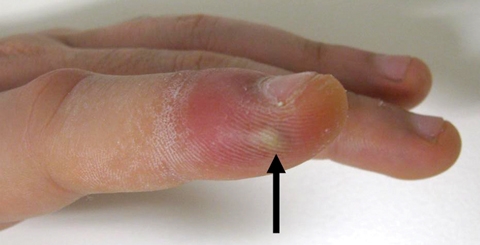
Two days later, a cloudy vesicle, typical of vaccinia virus,1 appeared at the inoculation site (Figure, arrow). After 3 more days, the finger became acutely inflamed, with secondary lymphangitis and axillary lymphadenitis. After antibacterial therapy, the lymphangitis and lymphadenitis rapidly resolved and the vesicle disappeared within 10 days. The man remains well.
Infection with vaccinia usually follows vaccination or needlestick injuries. Although this is usually mild and self-limiting, certain conditions (eg, immunocompromise, pregnancy, eczema) predispose to more severe and even fatal illness. Prior immunisation with the vaccinia vaccine is thought to prevent or reduce the severity of such infections, and it is recommended that people working with vaccinia or related orthopoxviruses be vaccinated every 10 years.1 Vaccinia immunoglobulin and certain antiviral agents have been used to treat severe infections.2
Given the potential dangers from accidental exposure and the fact that the last documented case of smallpox (in 1978) was related to a laboratory incident,3 strict infection control measures are paramount, including disinfection after injury, prompt reporting, urgent medical review, and measures to minimise secondary spread to contacts.1
References
- Centers for Disease Control and Prevention. Laboratory-acquired vaccinia exposures and infections — United States, 2005–2007. MMWR Morb Mortal Wkly Rep 2008; 57: 401-404.
- Cono J, Casey CG, Bell DM; Centers for Disease Control and Prevention. Smallpox vaccination and adverse reactions. Guidance for clinicians. MMWR Recomm Rep 2003; 52: 1-28. 0_i1091853
- Smallpox in Birmingham. BMJ 1978; 2: 837. 0_i1091856
Costs of Delivering the Hep B PAST Model of Care in Remote Australia: A Retrospective Pre–Post Study
Hoa Nguyen, Anh Le Tuan Nguyen, Paula Binks, Melita McKinnon, Emily Vintour-Cesar, Karen Wills, Nicola Stephens, Benjamin Cowie, Joshua S. Davis, Yuejen Zhao, Peter Nihill, Julie A. Campbell, Andrew J. Palmer, Jane Davies, Barbara de Graaff
Buruli Ulcer Acquired From Ringtail Possum Rescue
Daniel P. O'Brien, Naomi Clarke, Sara Bonnici, Mohammad A. Hussain
Q Fever Visceral Abscesses After Contact With Native Australian Marsupials
Samantha J. Laws, Enzo Binotto, James Stewart, Jennifer Ho, Trent Yarwood, Josh Hanson, Simon Smith
Hospital-Admitted Injection-Related Infections Among Incarcerated People Who Inject Drugs in Australia: A Retrospective Cohort Study
Andrew Palmer, Matthew Carter, Jeremy Yeo, Cecilia Shim, Jason Connor, Jeremy Hayllar, Gerald Holtmann, Naomi Moy, Elliott G. Playford, Naomi Runnegar, Paul J. Clark
The Live Attenuated Influenza Vaccine in Australia: An Additional Tool for Influenza Prevention
Cyra Patel, Alexis Pillsbury, Tran Nguyen, Xia Wang, Helen E. Quinn, Clayton K. Chiu, Allen C. Cheng, Katie L. Flanagan, Zhicheng Wang
Reflex Testing for Hepatitis D Infection: A Unique Opportunity to Reduce Hepatitis D-Related Chronic Liver Disease Deaths in Australia
Jessica Howell, Lauren Andersson, Miriam T. Levy, James O'Beirne, Leon Adams, Katharine Irvine, Avik Majumdar, Golo Ahlenstiel, Kathy Jackson, Krispin Hajkowicz, Joseph Doyle, Jane Davies, Sarah Cherian, Wayne Dimech, Alexander J. Thompson