




Volume 190 - Issue 3
Invasive pneumococcal disease in Western Australia: emergence of serotype 19A
Authors: Carolien M Giele, Anthony D Keil, Deborah Lehmann and Paul G Van Buynder
Med J Aust 2009; 190 (3): 166. || doi: 10.5694/j.1326-5377.2009.tb02332.x
Published online: 2 February 2009
Published online: 2 February 2009
To the Editor: The pattern of invasive pneumococcal disease (IPD) in Western Australia varies from that described in northern Queensland in a recent article by Hanna and colleagues.1 Their study showed a decline in IPD caused by serotypes included in the 7-valent pneumococcal conjugate vaccine (7vPCV) among Indigenous children and adults after the introduction of the vaccine in north Queensland. Over the same period, there was an increase among Indigenous adults in cases of IPD caused by serotypes not covered by the vaccine. However, the authors reported that there had been no increase in IPD caused by serotype 19A, a non-7vPCV serotype that has been increasingly predominant in other populations.2,3 In contrast to the disease pattern in north Queensland, serotype 19A has become the predominant disease-causing serotype in Western Australia, particularly among non-Indigenous people.
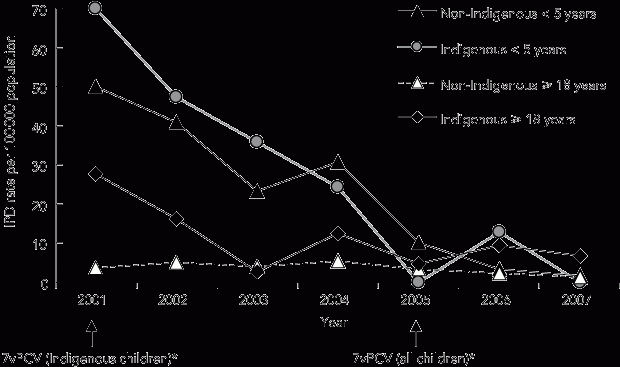
Data from the WA Notifiable Infectious Diseases Database show that the incidence of IPD in WA fell from 10.7/100 000 in 2001 (n = 203) to 6.3/100 000 in 2007 (n = 132). In children aged < 5 years, there was a significant drop in overall IPD rate, attributable to the decline in disease caused by 7vPCV serotypes, among both Indigenous children (from 70/100 000 to zero) and non-Indigenous children (from 50/100 000 to 1.6/100 000) (Box). The rate of IPD caused by 7vPCV serotypes also declined among Indigenous and non-Indigenous adults, suggesting a herd immunity effect.
From 2001 to 2007, the proportion of IPD cases caused by non-7vPCV serotypes increased among children aged < 5 years (from 19% to 91%) and children ≥ 5 years (from 33% to 72%). Serotype 19A was the only serotype that became more predominant, being responsible for 11 (8%), 14 (10%) and 26 (20%) cases of ICD in 2005, 2006 and 2007, respectively. In 2001, it accounted for 2.5% of cases in children < 5 years (1.6/100 000) and 0.8% of cases in children ≥ 5 years (0.1/100 000). By 2007, these figures had increased significantly to 34% of cases in children < 5 years (7.8/100 000) and 25% of cases in children ≥ 5 years (0.8/100 000). Interestingly, the increase in serotype 19A cases was seen only in non-Indigenous people (particularly children), with the number of cases remaining stable among Indigenous adults and children. Although numerous reports describe increasing prevalence of penicillin-resistant 19A strains,3,4 none of the WA isolates were penicillin-resistant.
In summary, after the introduction of the 7vPCV, the rate of IPD caused by 7vPCV serotypes decreased significantly in WA. However, the rate of IPD caused by serotype 19A, a non-7vPCV serotype, increased in non-Indigenous people and in the population overall.
These early trends have significant public health implications for vaccine policy. State and territory vaccination programs exist within the framework of the national immunisation program. However, jurisdictional expert advisory groups need local ongoing post-marketing surveillance, coupled with an understanding of historical trends and emerging serotypes, when formulating vaccine recommendations for their populations.
References
- Hanna JN, Humphreys JL, Murphy DM. Invasive pneumococcal disease in Indigenous people in north Queensland: an update, 2005–2007. Med J Aust 2008; 189: 43-46. <eMJA full text>
- Singleton RJ, Hennessy TW, Bulkow LR, et al. Invasive pneumococcal disease caused by nonvaccine serotypes among Alaska Native children with high levels of 7-valent pneumococcal conjugate vaccine coverage. JAMA 2007; 297: 1784-1792. 0_BEIEBIDG
- Moore MR, Gertz RE Jr, Woodbury RL, et al. Population snapshot of emergent Streptococcus pneumoniae serotype 19A in the United States, 2005. J Infect Dis 2008; 197: 1016-1027. 0_CBBHACIH
- Centers for Disease Control and Prevention (CDC). Emergence of antimicrobial resistant serotype 19A Streptococcus pneumoniae — Massachusetts, 2001–2006. MMWR Morb Mortal Wkly Rep 2007; 56: 1077-1080. 0_CBBGHCGI
Costs of Delivering the Hep B PAST Model of Care in Remote Australia: A Retrospective Pre–Post Study
Hoa Nguyen, Anh Le Tuan Nguyen, Paula Binks, Melita McKinnon, Emily Vintour-Cesar, Karen Wills, Nicola Stephens, Benjamin Cowie, Joshua S. Davis, Yuejen Zhao, Peter Nihill, Julie A. Campbell, Andrew J. Palmer, Jane Davies, Barbara de Graaff
Buruli Ulcer Acquired From Ringtail Possum Rescue
Daniel P. O'Brien, Naomi Clarke, Sara Bonnici, Mohammad A. Hussain
Q Fever Visceral Abscesses After Contact With Native Australian Marsupials
Samantha J. Laws, Enzo Binotto, James Stewart, Jennifer Ho, Trent Yarwood, Josh Hanson, Simon Smith
Hospital-Admitted Injection-Related Infections Among Incarcerated People Who Inject Drugs in Australia: A Retrospective Cohort Study
Andrew Palmer, Matthew Carter, Jeremy Yeo, Cecilia Shim, Jason Connor, Jeremy Hayllar, Gerald Holtmann, Naomi Moy, Elliott G. Playford, Naomi Runnegar, Paul J. Clark
The Live Attenuated Influenza Vaccine in Australia: An Additional Tool for Influenza Prevention
Cyra Patel, Alexis Pillsbury, Tran Nguyen, Xia Wang, Helen E. Quinn, Clayton K. Chiu, Allen C. Cheng, Katie L. Flanagan, Zhicheng Wang
Reflex Testing for Hepatitis D Infection: A Unique Opportunity to Reduce Hepatitis D-Related Chronic Liver Disease Deaths in Australia
Jessica Howell, Lauren Andersson, Miriam T. Levy, James O'Beirne, Leon Adams, Katharine Irvine, Avik Majumdar, Golo Ahlenstiel, Kathy Jackson, Krispin Hajkowicz, Joseph Doyle, Jane Davies, Sarah Cherian, Wayne Dimech, Alexander J. Thompson