




Volume 190 - Issue 3
Decrease in breast cancer incidence following a rapid fall in use of hormone replacement therapy in Australia
Authors: Karen Canfell, Emily Banks, Mark Clements, Yoon J Kang and Valerie Beral
Med J Aust 2009; 190 (3): 164-165. || doi: 10.5694/j.1326-5377.2009.tb02330.x
Published online: 2 February 2009
Published online: 2 February 2009
In reply: In saying that our work on the effect of hormone replacement therapy (HRT) on the development of breast cancer is “at best an hypothesis-generating exercise”, Giles and colleagues ignore both the preceding literature and the fact that our analysis of Australian data explicitly tested the hypothesis raised by an analysis of United States data. Both the US and Australian analyses showed falling breast cancer incidence from 2001 in women aged ≥ 50 years, but not in younger women, following large reductions in HRT use.1,2
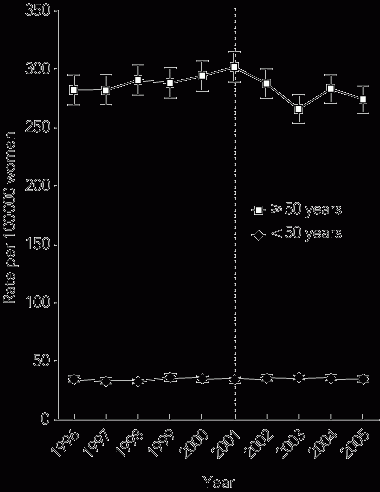
The logic, methodology and statistics presented by Giles et al are unsound. They present data on incident breast cancers for women in Victoria only, a subset of the national data included in our analysis. Not only is it invalid to use a subset of data to retest a hypothesis previously tested on the larger dataset (unless complex statistics are applied3-5), but Giles et al misrepresent Victorian trends. It is clear that in Victorian women aged ≥ 50 years, breast cancer incidence rates fell substantially and significantly by 11.5% between 2001 and 2003 (95% CI, 6.0%–16.6%; P < 0.0001), with no significant change among women aged 20–49 years (P = 0.3) (Box).
Giles et al present no data on HRT use. The largest drop in HRT use in Australia occurred between 2001 and 2003, and thereafter use began to plateau.6 It is therefore statistically inappropriate to calculate an “average annual decline” in breast cancer incidence from 2001 to 2005 because changes in HRT use over this time were not linear. In addition, their claim that the “trend was reversed in 2004–2005” is not supported by statistical testing, which shows no significant change in breast cancer incidence in women aged ≥ 50 years in Victoria from 2003 to 2005 (P = 0.4).
US data showed that the fall in breast cancer incidence following the drop in HRT use was seen particularly in oestrogen receptor-positive (ER+) tumours.1 As we pointed out,2 the lack of reliable Australian data on ER status means that no conclusions can be drawn about Australian trends in ER+ tumours. Giles et al acknowledge that the Victorian ER data are incomplete and that the completeness has increased over time. This, together with the possibility of differential ascertainment of ER status in women who used HRT over the period of interest, render the trends they present on ER+ breast cancers uninterpretable.
Overall, trends in breast cancer incidence in the subgroup of Victorian women cannot be said to differ materially from the national trends. A recent editorial in the Lancet draws attention to the fact that trends in HRT use and breast cancer incidence similar to those we reported have now been observed in many countries.7 The Australian findings add to the accumulating worldwide evidence that, in settings where HRT use was common and breast cancer screening rates relatively stable, a rapid decline in HRT use after 2001 was followed by a fall in breast cancer incidence.
References
- Ravdin PM, Cronin KA, Howlader N, et al. The decrease in breast-cancer incidence in 2003 in the United States. N Engl J Med 2007; 356: 1670-1674. 1
- Canfell K, Banks E, Moa AM, Beral V. Decrease in breast cancer incidence following a rapid fall in use of hormone replacement therapy in Australia. Med J Aust 2008; 188: 641-644.
- Peto R. Misleading subgroup analyses in GISSI. Am J Cardiol 1990; 66: 771-772.
- Gail M, Simon R. Testing for qualitative interactions between treatment effects and patient subsets. Biometrics 1985; 41: 361-372. 4
- Efron B, Morris C. Stein’s paradox in statistics. Sci Am 1977; 236: 119-127. 5
- Medicare Australia. Pharmaceutical Benefits Scheme Statistics. 2007. http://www.medicareaustralia.gov.au/providers/health_statistics/statistical_reporting/pbs.htm (accessed Dec 2007).
- Kumle M. Declining breast cancer incidence and decreased HRT use [editorial]. Lancet 2008; 372: 608-610. 7
Forty Years in the Making: Reporting on the Co-Creation of a National Roadmap for Birthing on Country Services for the Best Start to Life
Res McCalman, Anneka J. Bowman, Roianne West, Kristie Watego, Jyai Allen, Claire Clack, Sue Kildea, Sue Kruske, Melanie Briggs, Cleone Wellington, Rebecca Coddington, Yu Gao, Isabella Garti, Sascha Kowalenko, Sarah Ireland, Catherine Austin, John D. Boffa, Marah Prior, Kelsie Kahl, Bettina Chaseling, Sarah Khaw, Emily Armstrong, Donna Hartz, Yvette Roe
Temporal Trends in Preterm Birth Associated With Hypertensive Disorders of Pregnancy in Victoria, Australia: A Population-Based Interrupted Time-Series Study
Melvin Marzan, Heng Jiang, Daniel Lorber Rolnik, Joanne M. Said, Lisa Hui
Linguistic Manoeuvres: Obstetric Violence Camouflages Harm and Loss of Consent From Birth
Liz Sutton, Harsha Ananthram, Rebecca Matthews
Linguistic Manoeuvres: Obstetric Violence Camouflages Harm and Loss of Consent From Birth
Bashi Kumar-Hazard, Andrew M. Bisits, Sharon L. Settecasse, Jenny Gamble, Hazel Keedle, Hannah G. Dahlen
Linguistic Manoeuvres: Obstetric Violence Camouflages Harm and Loss of Consent From Birth
Wendy Pollock, Alissa Fleming, Ensieh Fooladi, Joy Kloester, Anne Tremayne, Yasmin Zisin, Bethany Carr, Kym Davey, Suzanne Willey, Jenny Gamble
Getting on the Same Page: Why Australia Needs a National Maternity Early Warning System (MEWS) Chart
Briony A. Cutts, Lucy Bowyer, Nisha Khot, Sandra Lowe, Stefan C. Kane