




Volume 190 - Issue 3
Decrease in breast cancer incidence following a rapid fall in use of hormone replacement therapy in Australia
Authors: Graham G Giles, Richard Bell, Helen Farrugia and Vicky Thursfield
Med J Aust 2009; 190 (3): 164-165. || doi: 10.5694/j.1326-5377.2009.tb02329.x
Published online: 2 February 2009
Published online: 2 February 2009
To the Editor: We question the conclusions drawn by Canfell and colleagues1 from their analysis of trends in hormone replacement therapy (HRT) prevalence and breast cancer incidence for Australian women aged 50 years or older. Their ecological analysis lacks individual-level information on HRT use and information on tumour oestrogen receptor (ER) status, and captures only 2 years following the decline in HRT prevalence. This is an inadequate design within which to judge issues of causality; it is at best an hypothesis-generating exercise.2
The examination of only 2 years of breast cancer incidence after the decline in HRT use is unsound because of substantial unexplained annual variability in national breast cancer incidence. This is evidenced, for example, by the graph in Canfell et al’s Box 2, which identifies a fall in 1998–1999 that was not ascribed to changes in HRT prevalence. The lack of data on tumour ER status is another weakness. HRT use increases the risk of ER+ tumours, so any decline in HRT prevalence would be expected specifically to reduce ER+ tumour incidence.
We analysed Victorian Cancer Registry data for women aged 50 years or older for the period 2001–2005 — 2 years past the cut-off in Canfell et al’s analysis. Tumour ER status was available for 87% of breast cancer cases in 2001, rising to 90% in 2005. The demographic characteristics of the women for whom these data were available did not change between 2001 and 2005. Over this period, the proportion of all breast cancers that were ER+ increased from 65% to 71%, and the proportion of tumours with known ER status that were ER+ increased from 74% to 79%.
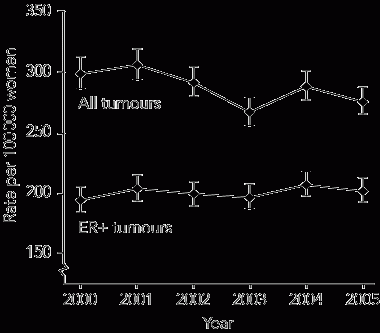
Poisson regression analysis of the age-specific incidence rates for both total and ER+ breast cancer for women aged 50 years or older estimated an average annual decline of 1.7% in the total incidence rate (P = 0.0009) and an annual increase of 0.2% in the ER+ incidence rate (P = 0.7). Our findings are illustrated in the Box. Although there was an apparent small decline in total breast cancer incidence in 2001–2003, this trend was reversed in 2004–2005. More importantly, the trend in ER+ tumour incidence was stable across the entire period.
Age-standardised incidence* of invasive breast cancer in women in Victoria aged ≥ 50 years, 2000–2005
 | |||||||||||||||
|
Vertical bars represent 95% confidence intervals. ER+ = oestrogen receptor-positive. | |||||||||||||||
These Victorian trends, covering a longer time period and including information on the tumour type most likely to be affected by changes in HRT use, provide no support for the hypothesis of Canfell and colleagues.
References
- Canfell K, Banks E, Moa AM, Beral V. Decrease in breast cancer incidence following a rapid fall in use of hormone replacement therapy in Australia. Med J Aust 2008; 188: 641-644. <eMJA full text>
- Paul C. Hormone therapy and breast cancer incidence: did epidemiologists miss an effect on national trends [commentary]? Int J Epidemiol 2008; 37: 638-640. 0_i1091846
Forty Years in the Making: Reporting on the Co-Creation of a National Roadmap for Birthing on Country Services for the Best Start to Life
Res McCalman, Anneka J. Bowman, Roianne West, Kristie Watego, Jyai Allen, Claire Clack, Sue Kildea, Sue Kruske, Melanie Briggs, Cleone Wellington, Rebecca Coddington, Yu Gao, Isabella Garti, Sascha Kowalenko, Sarah Ireland, Catherine Austin, John D. Boffa, Marah Prior, Kelsie Kahl, Bettina Chaseling, Sarah Khaw, Emily Armstrong, Donna Hartz, Yvette Roe
Temporal Trends in Preterm Birth Associated With Hypertensive Disorders of Pregnancy in Victoria, Australia: A Population-Based Interrupted Time-Series Study
Melvin Marzan, Heng Jiang, Daniel Lorber Rolnik, Joanne M. Said, Lisa Hui
Linguistic Manoeuvres: Obstetric Violence Camouflages Harm and Loss of Consent From Birth
Liz Sutton, Harsha Ananthram, Rebecca Matthews
Linguistic Manoeuvres: Obstetric Violence Camouflages Harm and Loss of Consent From Birth
Bashi Kumar-Hazard, Andrew M. Bisits, Sharon L. Settecasse, Jenny Gamble, Hazel Keedle, Hannah G. Dahlen
Linguistic Manoeuvres: Obstetric Violence Camouflages Harm and Loss of Consent From Birth
Wendy Pollock, Alissa Fleming, Ensieh Fooladi, Joy Kloester, Anne Tremayne, Yasmin Zisin, Bethany Carr, Kym Davey, Suzanne Willey, Jenny Gamble
Getting on the Same Page: Why Australia Needs a National Maternity Early Warning System (MEWS) Chart
Briony A. Cutts, Lucy Bowyer, Nisha Khot, Sandra Lowe, Stefan C. Kane