




Volume 190 - Issue 2
Ingestion of magnets in children: a growing concern
Authors: Manjunath B Siddaiah-Subramanya and Peter Borzi
Med J Aust 2009; 190 (2): 98. || doi: 10.5694/j.1326-5377.2009.tb02291.x
Published online: 19 January 2009
Published online: 19 January 2009
To the Editor: Accidental ingestion of foreign bodies is common in children. Most pass through the gastrointestinal tract spontaneously,1 but some, such as magnets and batteries, can cause serious problems. We treated three children, aged 4–11 years, who ingested magnets that caused multiple bowel perforations.
All three children presented with abdominal pain and vomiting, and were initially treated for gastroenteritis as the history of ingestion was not available. Plain abdominal films were subsequently used to make the diagnosis of foreign body ingestion. The ingested objects were later found to be pieces from magnetic construction toy sets.
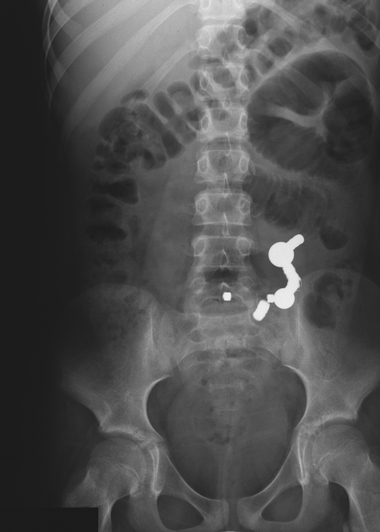
The first patient was an 11-year-old child with autism. An initial laparoscopy revealed marked dilatation of the small bowel and interloop adhesions. Subsequent laparotomy revealed several magnets (rods, rings and balls) in adjacent loops of the small bowel (Box, A), as well as necrosis and 13 perforations of the small bowel. Segmental resection was performed with a defunctioning ileostomy. During surgery, radiography was performed to ensure that all foreign bodies were removed before closure of the abdomen. The child made a good recovery, and the ileostomy was closed 3 weeks later.
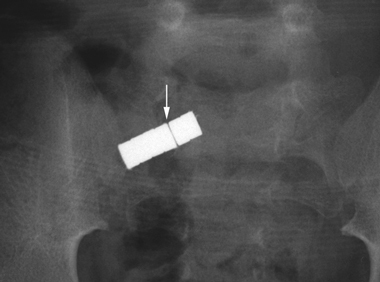
The second patient was 4 years of age. An abdominal x-ray revealed a cluster of foreign bodies in the right lower quadrant of the abdomen, with a small gap between the fourth and fifth foreign bodies. A laparoscopy revealed a cluster of magnetic rings (Box, B) perforating the small bowel and the caecum. Two of the rings were on the caecal side and four were on the small bowel side, with an intervening fold of mesentery — the gap on the x-ray. The magnets were retrieved through a minilaparotomy, and the caecal perforation was oversewn.
The third patient was a 5-year-old who presented with similar symptoms and x-ray findings. Laparotomy revealed an area of pressure necrosis underlying the magnet and causing perforation of the jejunum, which was repaired by segmental resection and primary anastomosis.
As ingestion of foreign bodies is usually not witnessed, a high index of suspicion is required for correct diagnosis.2 Of confirmed cases, 50% of patients remain asymptomatic.3 Fewer than 10% of cases require intervention, and about 1% require surgery.4,5 Ingestion of multiple magnetic objects in children is particularly serious, because of their tendency to aggregate in the bowel and compress intervening tissue, and should be treated aggressively.
These cases demonstrate the harmful consequences of magnets in toys. More stringent regulations on the use of magnets in toys — especially in toys for children younger than 5 years — and measures to increase public awareness of this issue are needed.
References
- Nagaraj HS, Sunil I. Multiple foreign body ingestion and ileal perforation. Pediatr Surg Int 2005; 21: 718-720. 0_CBBEJFJJ
- Uyemura MC. Foreign body ingestion in children. Am Fam Physician 2005; 72: 287-291. 0_CBBIIBAD
- Arana A, Hauser B, Hachimi-Idrissi S, Vandenplas Y. Management of ingested foreign bodies in childhood and review of the literature. Eur J Pediatr 2001; 160: 468-472. 0_i1091854
- Webb WA. Management of foreign bodies of the upper gastrointestinal tract: update. Gastrointest Endosc 1995; 41: 39-51. 0_i1091856
- Nandi P, Ong GB. Foreign body in the esophagus: review of 2394 cases. Br J Surg 1978; 65: 5-9. 0_CBBEIGBF
Barriers and Facilitators to Timely Detection and Optimal Management of Chronic Wet Cough in Aboriginal Children Across Australia From the Perspectives of Carers of Aboriginal Children: A Qualitative Study
Gloria T. Y. Lau, Pam Laird, Robyn Aitken, Melanie Barwick, Liam Bedford, Emily R. Bowden, Jamie Everingham, Angela Fuery, Reece Griffin, Neha Jain, Mina Kinghorn, Renae Knapp, Gabrielle B. McCallum, Peter Morris, Richard Norman, Peter C. Richmond, Aarti Saiganesh, Slade Sibosado, Cameron Taylor, Maree Toombs, Roz Walker, Joan Wilson, Anne B. Chang, André Schultz
Barriers and Facilitators to Timely Detection and Optimal Management of Chronic Wet Cough in Aboriginal Children Across Australia From the Perspective of Health Care Providers: A Qualitative Study
Gloria T. Y. Lau, Pamela Laird, Robyn Aitken, Melanie Barwick, Liam Bedford, Emily R. Bowden, Corey Dalton, Jamie Everingham, Angela Fuery, Reece Griffin, Neha Jain, Mina Kinghorn, Renae Knapp, Gabrielle B. McCallum, Peter Morris, Richard Norman, Peter C. Richmond, Aarti Saiganesh, Slade Sibosado, Maree Toombs, Roz Walker, Joan Wilson, Anne B. Chang, André Schultz
Short-Term Safety of Concomitant Meningococcal B and National Immunisation Program Vaccines in Infants Aged < 15 Months: A Survey-Based Surveillance Study
Thuy Nguyen, Evelyn C. S. Tay, Michael Dymock, Thomas L. Snelling, Lucy Dawes, Julie Marsh, Yue Wu, Alan Leeb, Nicholas Wood, Lucy Deng
The GenV Biobank: Enabling Biological Research in a Large Longitudinal Population-Representative Cohort of Australian Newborns and Their Parents
Katherine Lange, Kim L. Powell, Yeukai Mangwiro, Tony Frugier, Donna T. Geddes, Melissa Wake, Richard Saffery
Watchful Waiting Compared With Immediate Antibiotics for Urban Aboriginal and Torres Strait Islander Children With Uncomplicated Acute Otitis Media (WATCH): A Non-Inferiority Randomised Controlled Trial
Jennifer S. Reath, Hasantha Gunasekera, Sanja Lujic, Amanda J. Leach, Letitia Campbell, Robyn Walsh, Tim Usherwood, Geoffrey K. Spurling, Claudette A. Tyson, Deborah A. Askew, Kelvin Kong, Chelsea J. Watego, Peter Morris, Wendy Hu, Penelope A. Abbott
A Rare Case of Storage Mite Anaphylaxis in Infancy
Eliza Kluckow, Katie Frith