




Volume 190 - Issue 2
Inappropriate implantable defibrillator discharges from lead failure
Authors: Chin V Hiew and James W Leitch
Med J Aust 2009; 190 (2): 97-98. || doi: 10.5694/j.1326-5377.2009.tb02290.x
Published online: 19 January 2009
Published online: 19 January 2009
To the Editor: A 77-year-old woman with a history of idiopathic long-QT syndrome (presumed genetic) presented to hospital with a storm of defibrillator shocks from her implantable cardioverter defibrillator (ICD). She had a single-chamber Guidant Ventak Prizm VR, model 1850, and a Guidant ventricular lead, model 0148 (Guidant Corporation, Indianapolis, Ind, USA) implanted 12 months earlier after an episode of syncope. The lead had been implanted by left subclavian venous access. The patient’s postoperative course and responses to routine questioning indicated that the device was functioning normally.
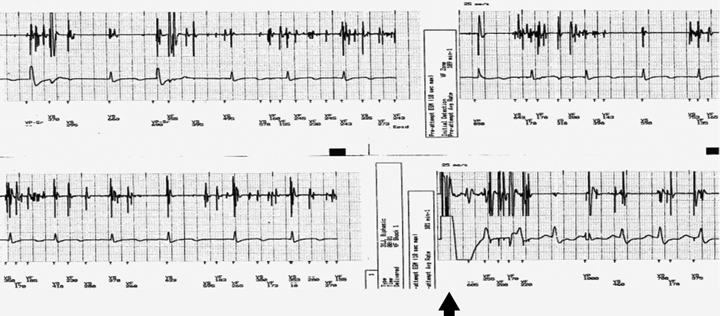
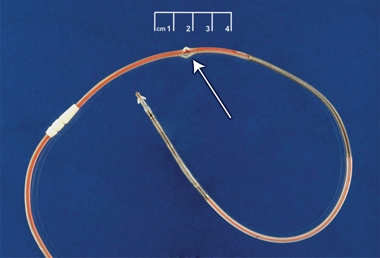
After presenting with device discharges, a 12-lead electrocardiogram showed oversensing suggestive of lead dysfunction. Stored electrograms from the defibrillator showed artifactual signals that were typical of lead disruption. These signals had triggered inappropriate detection of ventricular arrhythmia and subsequent device shocks (Box 1). The pacing threshold and lead impedance were normal. On close examination of the patient’s chest x-ray, a line of radiolucency was detected within the lead between the first rib and clavicle. At reoperation, the lead was extracted with minimum difficulty and the site of the insulation break was detected (Box 2). A new lead was implanted and the patient was discharged home well. Subsequent follow-up was uneventful.
Lead failure can occur any time after implantation of an ICD, and should be suspected when patients present with inappropriate ICD discharges.1 This case illustrates oversensing as a result of the lead’s insulation being disrupted by crush compression between the first rib and clavicle. Alternative implantation techniques, such as cephalic vein cut-down or extrathoracic axillary vein puncture, have been suggested for venous access to avoid this complication.2
References
- Roelke M, O’Nunain SS, Osswald S, et al. Subclavian crush syndrome complicating transvenous cardioverter defibrillator systems. Pacing Clin Electrophysiol 1995; 18: 973-980.
- Belott P. How to access the axillary vein. Heart Rhythm 2006; 3: 366-369. 0_i1091831
Fatty Liver Disease in Australia: A Narrative Review on the Epidemiology, Natural History, Prognostication and Management in People With Metabolic Dysfunction
Karl Vaz, Daniel Clayton-Chubb, William W. Kemp, Stuart K. Roberts, Ammar Majeed
Sex Differences in Management and Outcomes of People With ST-Elevation Myocardial Infarction, New South Wales, 2011–2020: A Retrospective Cohort Study
Adam C. Livori, Jedidiah I. Morton, Dianna J. Magliano, Jonathan E. Shaw
Rethinking Rheumatic Fever Diagnosis: Progress, Pitfalls and the Path Towards a Definitive Test
Anna P. Ralph, Rachel Webb, Tom Parks, Nicole J. Moreland, Asha C. Bowen, Benjamin Jones, Emma Ndagire, Andrea Z. Beaton
Sex Differences in Management and Outcomes of People With ST-Elevation Myocardial Infarction, New South Wales, 2011–2020: A Retrospective Cohort Study
Samia Kazi, Simone Marschner, Clara K. Chow
Distribution of Cardiovascular Disease Risk Based on the Updated 2023 Guideline-Recommended Australian Cardiovascular Disease Risk Algorithm and Comparison With the 2012 Algorithm: An Observational Study
Nina Lazarevic, Meghana Bhat, Grace Joshy, Danielle C. Butler, Mark Woodward, Anushka Patel, Rod T. Jackson, Garry Jennings, Rosemary Wyber, Ellie Paige, Emily Banks
They Brought the Hospital to Me
Hugh N. Burrill