




Volume 190 - Issue 12
A maggoty scalp
Authors: John S Whitehall, Richard Speare, Heidi E Best, Philippa J Price and Deborah J Mills
Med J Aust 2009; 190 (12): 717-718. || doi: 10.5694/j.1326-5377.2009.tb02655.x
Published online: 15 June 2009
Published online: 15 June 2009
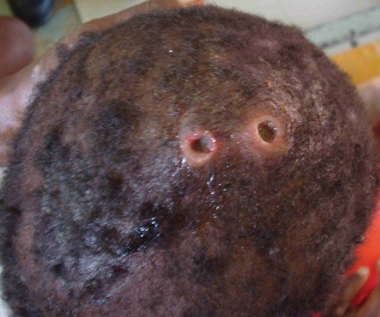
To the Editor: A 4-year-old girl presented with a flyblown scalp to a district aid post outside Madang, Papua New Guinea (PNG). Coincidentally, we were present at the aid post in our capacity as students and lecturers in the tropical paediatrics module of the James Cook University Masters in Public Health and Tropical Medicine course. The child was otherwise healthy, and her scalp had been normal until about 2 days previously, when her mother noticed two developing “sores”. These had deteriorated into circular, foul-smelling ulcers about 1.5 cm in diameter and 2 cm apart on the crown of her head (Box, A), in which live maggots could be seen squirming.
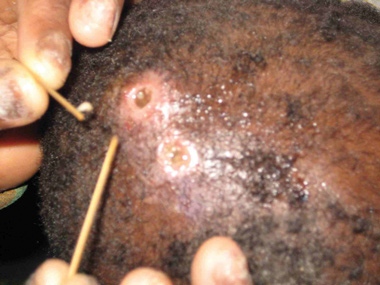
The child’s mother had extracted some maggots with a pair of toothpicks (Box, B), and about 10 more were removed at the aid post with tweezers. When no further movement was apparent in the wounds, they were covered with petroleum jelly to suffocate any “stragglers”. No dead larvae were seen the following morning, and the wounds healed rapidly.
We believe the most likely culprit was Chrysomya bezziana, or Old World screw-worm fly, although we were unable to preserve a larva for formal identification (by “curing” in very hot water and transporting in 70% ethanol). Old World screw-worm fly is an obligate myiasis-producing fly endemic in PNG. Its larvae are found only in living vertebrate tissues. The child’s mother had not noticed a prior lesion, and we assumed entry was through a graze on the scalp.
Although screw-worm fly is endemic throughout tropical and subtropical regions of Asia and Africa, it is not found in Australia. If it became established here, it could devastate the livestock industry, particularly by striking the umbilical region of newborn calves and infesting their abdominal contents.1 The fly is known to be able to travel 100 km,2 further than the distance between the islands of Torres Strait, but has not yet migrated from PNG to Australia.
It could also be introduced in livestock vessels returning from Asia or the Middle East; the Australian Quarantine and Inspection Service has strict regulations to prevent this, with all returning vessels thoroughly cleaned before reaching Australian waters. This is justified as it has been documented that sheep shipped from Australia arrived in Bahrain with fly infestation. Presumably, flies were attracted to the ship as it passed the coast of Oman or the United Arab Emirates.3 Infestation is self-promoting, as ovipositing females are particularly attracted to the odour of an existing myiasis, resulting in expansion of the lesion. In our patient, the application of petroleum jelly to the lesions fortuitously covered the odour, reducing the likelihood of reinfestation.
Ivermectin is useful in treating affected animals,4 as well as humans5 when the larvae cannot be physically extracted.
Acknowledgements
Acknowledgement: We gratefully acknowledge the help of Dr Rod Mahon (CSIRO Entomology, Canberra, ACT).
References
- Australian Government Department of Agriculture, Fisheries and Forestry. Screw-worm fly. http://www.daff.gov.au/animal-plant-health/pests-diseases-weeds/animal/screw-worm-fly (accessed Jul 2008).
- Spradbery JP, Mahon RJ, Morton R. Dispersal of the Old World screw-worm fly Chrysomya bezziana. Med Vet Entomol 1995; 9: 161-168. 0_i1091861
- Kloft WJ, Noll GF, Kloft ES. Introduction of Chrysomya bezziana Villeneuve (Dipt., Calliphoridae) into new geographic regions by transit infestation. Mitt Dtsch Ges Allg Angew Entomol 1981; 3: 151-154. 0_i1091863
- Spradbery JP, Tozer RS, Drewett N, Lindsey MJ. The efficacy of ivermectin against larvae of the screw-worm fly (Chrysomya bezziana). Aust Vet J 1985; 62: 311-314. 0_i1091865
- Shinohara EH. Treatment of oral myiasis with ivermectin [letter]. Br J Oral Maxillofac Surg 2003; 41: 421-422. 0_i1091867
Costs of Delivering the Hep B PAST Model of Care in Remote Australia: A Retrospective Pre–Post Study
Hoa Nguyen, Anh Le Tuan Nguyen, Paula Binks, Melita McKinnon, Emily Vintour-Cesar, Karen Wills, Nicola Stephens, Benjamin Cowie, Joshua S. Davis, Yuejen Zhao, Peter Nihill, Julie A. Campbell, Andrew J. Palmer, Jane Davies, Barbara de Graaff
Buruli Ulcer Acquired From Ringtail Possum Rescue
Daniel P. O'Brien, Naomi Clarke, Sara Bonnici, Mohammad A. Hussain
Q Fever Visceral Abscesses After Contact With Native Australian Marsupials
Samantha J. Laws, Enzo Binotto, James Stewart, Jennifer Ho, Trent Yarwood, Josh Hanson, Simon Smith
Hospital-Admitted Injection-Related Infections Among Incarcerated People Who Inject Drugs in Australia: A Retrospective Cohort Study
Andrew Palmer, Matthew Carter, Jeremy Yeo, Cecilia Shim, Jason Connor, Jeremy Hayllar, Gerald Holtmann, Naomi Moy, Elliott G. Playford, Naomi Runnegar, Paul J. Clark
The Live Attenuated Influenza Vaccine in Australia: An Additional Tool for Influenza Prevention
Cyra Patel, Alexis Pillsbury, Tran Nguyen, Xia Wang, Helen E. Quinn, Clayton K. Chiu, Allen C. Cheng, Katie L. Flanagan, Zhicheng Wang
Reflex Testing for Hepatitis D Infection: A Unique Opportunity to Reduce Hepatitis D-Related Chronic Liver Disease Deaths in Australia
Jessica Howell, Lauren Andersson, Miriam T. Levy, James O'Beirne, Leon Adams, Katharine Irvine, Avik Majumdar, Golo Ahlenstiel, Kathy Jackson, Krispin Hajkowicz, Joseph Doyle, Jane Davies, Sarah Cherian, Wayne Dimech, Alexander J. Thompson