




Volume 190 - Issue 11
Dealing with disasters
Author: Alexander C McFarlane
Med J Aust 2009; 190 (11): 647. || doi: 10.5694/j.1326-5377.2009.tb02597.x
Published online: 1 June 2009
Published online: 1 June 2009
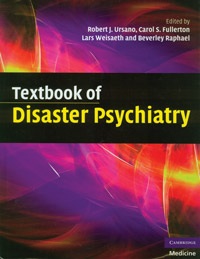
Textbook of disaster psychiatry.
Robert J Ursano, Carol S Fullerton, Lars Weisaeth, Beverley Raphael, editors. Cambridge: Cambridge University Press, 2007 (xii + 346 pp). ISBN 978 0 521 85235 7.
Disasters, by their nature, are unexpected and often occur when services are least able to respond, such as the tsunami on Boxing Day in 2004. Therefore, the ready availability of resource material is particularly important in disaster management. Due to recognition of the importance of well coordinated and planned recovery programs, there is also growing interest in providing structured academic courses in the disaster field. For these activities, the Textbook of disaster psychiatry is a high-quality, welcomed edition to an already competitive stable.
The editors are doyens of the field and bring together a richness of experience, knowledge, and anecdote that combine to provide a text of unusual depth. They focus not only on the challenges facing clinicians, but also on the obstacles the broader systems confront in the face of disasters. A text providing an integrative methodology for a broader public health approach is a valuable tool to ensure optimal long-term outcomes. This is not simply a disguised textbook on post-traumatic stress disorder; it has relevance beyond mental health practitioners.
Despite the fact that individuals’ adaptive behaviour determines the success or otherwise of physical disaster relief programs, mental health programs are often seen as a low priority in disaster management. As a consequence, this text will be valuable to coordinators of medical services and those involved in community and social reconstruction.
While the editors are truly an international group, the authors of the text are all, bar one, from the United States. Nevertheless, this does not detract from the international applicability of the content and approaches that it espouses. This is a book to have on the shelf for the day when the sky falls in.
‘Once Bitten’: A Case of Tetanus Following Snakebite in Australia
Adrian A. S. Doherty, Naomi N. E. Clarke, Sarah Fletcher, Sarah Huffam, Camille V. Awburn, Eugene Athan
Epidemiology and Quality of Care for Aboriginal and Torres Strait Islander Peoples Treated by Emergency Medical Services for Stroke in Victoria, Australia: Retrospective Analysis of Linked Data
Candice Menezes, Ziad Nehme, Luke J. Burchill, Tegwyn McManamny, Angela Dos Santos, Michelle Crilly, Luke P. Dawson, Benjamin Clissold, David Anderson, Emily Nehme
Intranasal Adrenaline Use for the Management of Insect Venom-Induced Anaphylaxis
Thomas J. Young, Wilhelmina R. F. Johnson, Braydon L. Pennington, Troy Wanandy, Wun Y. Lau, Thanh-Thao A. Le
Gabapentinoid Poisoning Presentations to Victorian Emergency Departments: A 15-Year Trend Analysis
Bishaal Tej Gurung, Amy McNeilage, Angus Skeen, Tina Lam, Joanna F. Dipnall, Jane Hayman, Suzanne Nielsen, Ting Xia
They Brought the Hospital to Me
Hugh N. Burrill
Predictors of Ambulance Transport to Hospital for Older People Living in Tasmanian Aged Care Facilities: A Retrospective Cohort Study
Sharon Andrews, Pieter F. Fouche, Belinda Flanagan, Michael McDermott, Melanie Greenwood