




Volume 189 - Issue 5
Inappropriate use of computed tomography chest scanning in hospital patients
Authors: Askin Gunes, Lloyd J Ridley and Graham Simpson
Med J Aust 2008; 189 (5): 292. || doi: 10.5694/j.1326-5377.2008.tb02033.x
Published online: 1 September 2008
Published online: 1 September 2008
To the Editor: Computed tomography (CT) of the chest is superior to chest x-ray as an imaging modality of the lungs, mediastinum, pleura and the chest wall,1 and its use is increasing for a range of diagnostic and therapeutic applications.2 There are clear indications for the appropriate use of chest CT, and adherence to these can reduce cost, workload, procedure-related complications and radiation exposure. Our group recently analysed referrals for chest CT from general practice, and found that the scan was clinically helpful in only 12%, and inappropriate in 68%.3 We thus examined the indications for ordering CT of the chest, and the associated outcomes in hospital inpatients, who had been referred for chest CT by general physicians.
Two respiratory physicians retrospectively reviewed the clinical files, the CT request form, and previous and current imaging of 47 consecutive non-surgical patients admitted to Cairns Base Hospital between 1 January and 1 July 2005. One illustrative patient’s case is described in the Box. The impact of the chest CT on the patient’s clinical outcome was assessed. We used the imaging guidelines of the Royal Australian and New Zealand College of Radiologists (RANZCR) as the standard for evaluating appropriate ordering of chest CT.4
Overall, chest CT was appropriately ordered in 26 of 47 patients (55%). The correct type of scan (contrast, non-contrast or high resolution) was requested for 38 of the 47 patients (81%). In 25 of the 26 appropriately ordered scans (96%), the patient’s physicians had compared the CT scan with previous chest x-rays and recorded this in the file; this was done for only 11 of the 21 inappropriately ordered scans (52%; P = 0.001).
Further useful information that had not been detected by other means was obtained from the CT scan (compared with chest x-ray alone) in 26 of 47 patients (55%, comprising 25 of 37 [68%] in the subgroup in whom the CT had been ordered appropriately and one of 10 [10%] in the group ordered inappropriately; P = 0.01). Management was changed as a result of CT scanning in 19 of 47 patients (40%): 18/26 (69%) in the appropriately ordered CT group and 1/21 (5%) in the inappropriately ordered CT group (P = 0.001). The correct type of CT scan led to a higher incidence of change in management (18 of 38 patients; 47%; P = 0.046).
We encourage all doctors to use the RANZCR guidelines, or web-based imaging pathways such as those developed by Royal Perth Hospital <www.imagingpathways.health.wa.gov.au> to ensure better clinical practice.
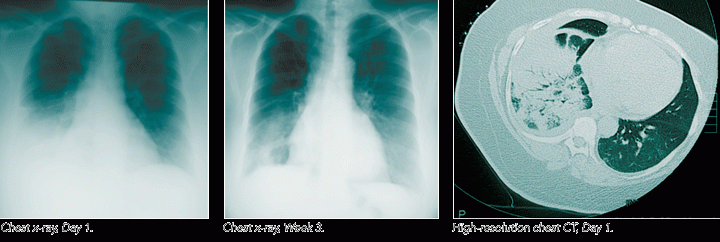
An illustrative case of acute respiratory illness from the study
A 41-year-old woman with a past history of asthma was admitted to hospital with moderately severe right-lower-lobe pneumonia. She responded to antibiotic and bronchodilator therapy and was discharged on Day 6 with no complications. During her admission she had five chest x-rays and high-resolution computed tomography (HRCT) of the chest to rule out empyema; all of these showed consolidation with a small effusion. In outpatient follow-up, she had two further chest x-rays and HRCT of the chest repeated once during Week 3 because of “slowly resolving” shadows.
The imaging guidelines of the Royal Australian and New Zealand College of Radiologists4 recommend that further imaging is indicated for clinical deterioration, complications, or slow recovery. Thus, this patient did not need computed tomography (CT) scanning, as none of these criteria were met. Had CT been indicated, conventional CT, and not HRCT, would have been the correct choice. A repeat chest x-ray with a lateral view at discharge and at 6 weeks would have been the appropriate management in this patient.
Acknowledgements
We thank the staff of Cairns Base Hospital Radiology Department and Rabia Khan, Tropical Public Health Unit Network, Queensland Health, for her guidance with the statistical analysis.
References
- Wells AU. Thoracic imaging. Semin Respir Crit Care Med 2003; 24: 331-332.
- Mettler FA Jr, Wiest PW, Locken JA, Kelsey CA. CT scanning: patterns of use and dose. J Radiol Prot 2000; 20: 353-359. 0_CBBHCAIB
- Simpson G, Hartrick GS. Use of thoracic tomography by general practitioners. Med J Aust 2007; 187: 43-46. 0_i1091863
- Lau L, editor. Imaging guidelines. 4th ed. Sydney: Royal Australian and New Zealand College of Radiologists, 2001. 0_i1091865
Decolonising Indigenous Health Research Requires Redefining Sex, Sexuality and Gender
Shakara Liddelow-Hunt, James H. L. Hill, Kate Daglas, Kaiwarr Clancy, Madi Day, Alistair Ott
Reducing Nitrous Oxide Emissions Across the Melbourne Biomedical Precinct
Ross Robertson, Andrew Downey, Daryl Williams, Bjorn Makein, Ben Dunne, Tugce Ozturk, Ying Gu, Rebecca McIntyre
Multimorbidity Clusters Among People Aged 65 Years and Over in Australia: A Nationwide Cross-Sectional Data Linkage Study
Weisi Chen, Christine Y. Lu, Sarah N. Hilmer, Alice A. Gibson, Edwin C. K. Tan
When ‘Liver Enzymes’ Are Not Hepatic: Late-Onset Pompe Disease
Shauna Madigan, Georgina England, Wayne Rankin
West Nile virus Kunjin subtype in rural NSW
Emily Gibson, Megan Whitley, Peter Murray, Linda Hueston, Jane Bennett, Raguharan Kathiresu, David N Durrheim
The impact of the Breast Screen NSW transition from film to digital mammography, 2002–2016: a linked population health data analysis
Rachel Farber, Nehmat Houssami, Katy J L Bell