




Volume 189 - Issue 11
Q fever. Was Edward Derrick’s contribution undervalued?
Author: Robin A Cooke
Med J Aust 2008; 189 (11): 660-662. || doi: 10.5694/j.1326-5377.2008.tb02233.x
Published online: 1 December 2008
Published online: 1 December 2008
The 21 August 1937 issue of the Medical Journal of Australia contained two articles on a hitherto unknown disease affecting abattoir workers and farmers — Q fever (with the “Q” standing for query).The first of these was by Edward Holbrook Derrick, Director of the Laboratory of Microbiology and Pathology, Queensland Health Department, Brisbane, and comprised his meticulous clinical descriptions and subsequent experiments to isolate the causative organism.1 During his research, Derrick sought the help of Frank Macfarlane Burnet, and the second article by Burnet and Mavis Freeman from the Walter and Eliza Hall Institute of Medical Research in Melbourne described their identification of the causative agent.2
Research breakthroughs frequently involve scientific collaboration, and attributing credit for the results of such collaborations can be difficult. In the light of some new information about Derrick’s experiments, I believe that he may not have received sufficient credit for his contribution to the discovery of the organism responsible for Q fever.
When the MJA articles were published, Q fever appeared to be a disease localised to a small area of south-eastern Queensland. However, within a decade or so, it was shown to be of worldwide significance.
Edward Derrick’s laboratory notes rediscovered
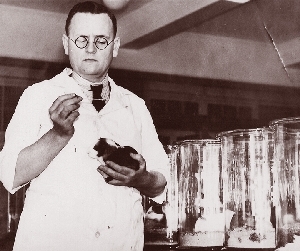
Edward Derrick in his laboratory in 1937 taking rectal temperatures of guinea pigs. The guinea pigs were housed in second-hand battery jars, with two to a jar.
In January 1994, I was asked by Professor L W Powell, Director of the Queensland Institute of Medical Research, to examine some cardboard boxes containing books and papers packed by Derrick before he died in 1976, to see whether there was anything important that should be kept. The boxes contained out-of-date textbooks, letters, photographs, notes of experiments and other memorabilia. One small package wrapped in newspaper contained an old exercise book cover, 13.2 × 21.2 cm, in which there were seven files of brown paper. Each file was stapled with a split-staple in the top left-hand corner, and on the top right-hand corner they were labelled Q1 to Q7 and they were in numerical order. Further examination of these notes revealed that they were laboratory notes comprising case histories and the results of guinea pig experiments. Correlation with Derrick’s MJA article of 1937 revealed that they were the laboratory notes relating to seven of the nine patients on which the article was based, and it was apparent that these notes had not been read by previous biographers. (A more detailed account of my findings, together with more than 300 digital images of the original documents, has been lodged in the Library of the Queensland Institute of Medical Research, and the Herston Medical Library, Brisbane.)
Who was Edward Derrick?
When Derrick was appointed to the position of Director of the Queensland Health Department Laboratory of Microbiology and Pathology in Brisbane in mid 1935, his previous experience included a year at the Walter and Eliza Hall Institute of Medical Research in Melbourne as a cancer research scholar in 1921 and a year as a pathology assistant at London Hospital in 1923. In the intervening period, he had survived a bout of tuberculosis and worked mostly as a country general practitioner in Australia. The laboratory he was in charge of was primitive even by standards of the time. It had a small staff of four, none of whom had tertiary qualifications. However, as Box 1 shows, Derrick’s appointment as Director of this laboratory was the beginning of a long and distinguished career as a research scientist and administrator.
It was only a month after his appointment that Derrick was asked to investigate the cause of an obscure fever affecting meatworkers in a Brisbane abattoir processing dairy cattle (workers at a nearby abattoir processing steers for the international market had not been affected). He immediately set to work questioning the clinicians who had been treating the patients.
Edward Derrick’s Q fever investigations
The patients Derrick described in his MJA article presented between September 1935 and November 1936. Five were abattoir workers, another two were dairy farmers, and another worked in sewage construction. By examining the patients almost daily, and visiting some of them at their place of work, Derrick was able to make meticulous descriptions of their illnesses.
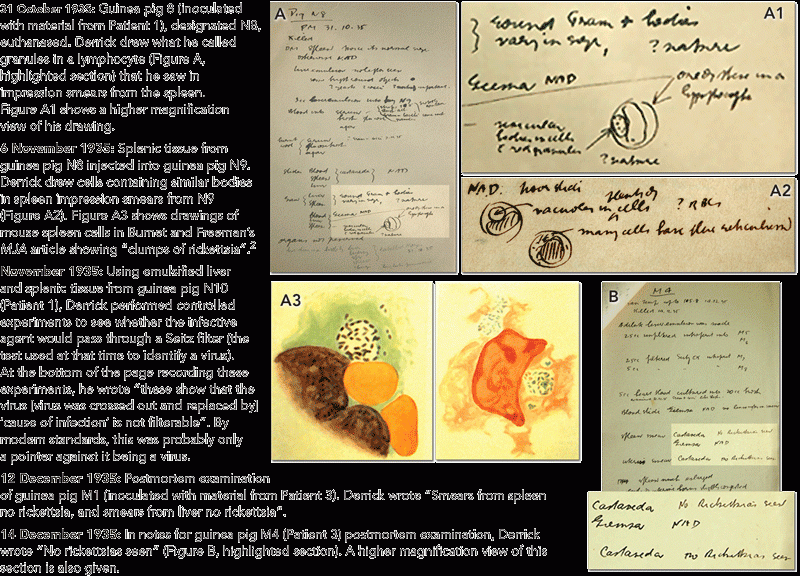
He began by excluding other known causes of fever common in coastal Queensland. His working hypothesis was that it was likely to be a rickettsial infection, although it differed from the known rickettsias in that the patients did not have a skin rash or a positive Weil–Felix reaction. To isolate the causative organism, he began inoculating guinea pigs with patients’ acute-phase blood and urine samples with the aplomb of an experienced researcher. The inoculated guinea pigs became febrile and developed enlarged spleens, and he recorded their febrile response. His studies were done during the Depression, which explains Derrick’s use of second-hand battery jars (the casing of early batteries), and his method of recording his laboratory results on the cheapest paper available. Some extracts from the laboratory notes I discovered are described and illustrated in Box 2.
He transmitted the infection serially in guinea pigs, investigated its properties in relation to heat, cold, and filterability, and studied the effect of dilution on its potency. He showed, by challenge and cross challenge, that the “strains” isolated from different patients were the same. This led to the development of a diagnostic test, albeit a cumbersome one, based on guinea pig immunity.
Derrick also tried to identify the source of the infection and the manner of its transmission to patients. He visited Patient 3, a dairy farmer, at his farm where he looked for ticks or sick animals. He inoculated milk and cream (both raw and diluted) from the dairy into guinea pigs (they died from sepsis, but did not develop fever).
He thought the infection might be transmitted by a biting vector, because he could only transmit it from one guinea pig to another by injection of infected liver and spleen. He attempted to infect other laboratory animals, mice and a few rabbits, without success, and rats with limited success.
Overall, the results were compatible with Derrick’s hypothesis that a rickettsia-like organism, rather that a virus, was responsible for Q fever.
Collaboration with Frank Macfarlane Burnet
At this stage, Derrick sent material from his patients and his guinea pig experiments to Frank Macfarlane Burnet at the Walter and Eliza Hall Institute of Medical Research in Melbourne. Burnet was one of the most prominent medical researchers in Australia at that time, and he already had an international reputation. Derrick was an unknown researcher working in an obscure peripheral laboratory, and he needed assistance from someone with an up-to-date, well staffed laboratory who had scientific support in the international arena.
At a follow-up of Patient 5 on 17 September 1936, Derrick took a blood sample and sent half the serum to Burnet. Burnet’s laboratory notes (courtesy of Mr Gavan McCarthy, Director, Australian Science and Technology Heritage Centre, University of Melbourne) on 1 October 1936 read “abattoirs fever apparently successful early passage but now appears to have been lost”.3
On 5 October 1936, Derrick sent serum from Patient 7 to Burnet, and on 12 October he sent spleen and kidney from guinea pig D6 (Patient 7). Burnet’s laboratory notes on 30 November 1936 read “Abattoirs fever. Virus grown consistently. No spirochaetes or rickettsia seen”.
After studying Derrick’s notes and drawings (see Box 2), I have wondered whether this comment could be interpreted as the report of a “consultant” to a “referring doctor” who has asked, “Could you please examine this material. I think that it contains a living organism. I have looked for many organisms, but I think it is likely to be a rickettsia”. (I could not find any correspondence that might shed light on this speculation either in Derrick’s or in Burnet’s papers that refer to this period of time.)
On 1 January 1937 after further testing on D6 material, Burnet recorded, “Abattoirs fever: positive transmission to rats and mice. Enlargement of liver and spleen. In a rather variable proportion of mice numerous rickettsia seen. Sub inoculation to guinea pigs gives typical fever with immunity. Rickettsia seen.” In later communications, Burnet said that on this day he was confident that he had positively identified the organism causing Q fever.
Interestingly, Burnet sent samples of D6 material to Rolla Dyer, head of the Rickettsia section at the National Institutes of Health in Washington, DC,4 and it was this strain that made it possible to show that it was identical to the organism that Herald Cox from Rocky Mountain Laboratory, Montana, USA, had isolated from ticks.
Box 3 gives a summary of the current understanding of Q fever.
A self-effacing scientist
We may never know whether Derrick should have received more recognition for his part in the identification of a rickettsia-like organism as the cause of Q fever. We do know that Derrick was responsible for having the organism named Rickettsia burneti5 (later changed to Coxiella burnetii as a result of Herald Cox’s contribution), and it is interesting to speculate as to why he did not ask for his own name to be included. Derrick was known for his retiring and self-deprecating nature, so it is quite possible that he shrank from taking the credit. He also knew (or guessed) that he had to act quickly to get a name in print because the group from Montana was about to publish its results on the “Nine Mile agent” in ticks. Rather than entering an argument with the more forceful Burnet, he may have decided to name it after him so that the answer would be a quick “yes” to his suggestion.
It is interesting that Q or Query fever still bears the name given to it by Derrick when he was investigating its cause, and strangely it is a disease that continues to puzzle researchers. However, there has been a proposal for a name change. A seminar presentation in French, published in 1951, argued strongly that Q fever should be renamed Derrick–Burnet fever,6 and a Google search reveals that the use of this name is not uncommon. I would support this name change.
1 Edward Holbrook Derrick, CBE, MB BS, MD (1898–1976)
1921–23: Sir John Grice cancer research scholar, Walter and Eliza Hall Institute of Medical Research, Melbourne. Pathology assistant, London Hospital
1924: Contracted tuberculosis and, abandoning plans to become a medical missionary, returned to Australia to fight the disease (his brother had died of TB), hoping the climate would be curative
1925–34: Locum general practitioner, mostly in small country towns in the eastern states of Australia. With his health restored, he began private practice in Brisbane in 1934
1935–46: Director of the Laboratory of Microbiology and Pathology, Queensland Health Department, Brisbane. Conducted the first research on Q fever, collaborating with Frank Macfarlane Burnet to identify the causative organism. Studied other infectious diseases in Queensland, being the first to isolate Leptospira pomona. Suggested the establishment of a research institute to focus on Queensland diseases, and chaired an advisory committee that set up the Queensland Institute of Medical Research (QIMR)
1947–66: Deputy Director, QIMR, and in 1961 became Director. Continued investigations of leptospirosis and scrub typhus, and set up a virology unit. Conducted studies on asthma incidence
1966–73: Director of the Queensland Asthma Foundation’s Research Bureau
Awards include: CBE; the Commonwealth Department of Health’s Cilento Medal (shared with Burnet); Britannica Australia Award for Medicine; Medal of the Australian and New Zealand Association for the Advancement of Science; Honorary Doctorate of Science (University of Queensland)
Publications: Almost half of his 128 scientific publications were published in the Medical Journal of Australia, which also published a Festschrift issue in his honour in 1967
Source: Doherty RL. Derrick, Edward Holbrook. Australian dictionary of biography. Vol 13. Melbourne: Melbourne University Press: 620-621.
3 Q fever
Q fever is a zoonosis, the causative organism Coxiella burnetii occurring worldwide (except in New Zealand) in mammals, birds and ticks.
C. burnetii is an obligate intracellular organism, first classified as a rickettsia. Recent studies and genome sequencing suggest that it is a γ-Proteobacteria, order Legionellales, but with characteristics in common with bacteria in the genus Rickettsia.
Q fever infection in humans may be asymptomatic; or it may cause an acute illness (usually a flu-like illness, pneumonia, or hepatitis), or a potentially fatal chronic illness (predominantly endocarditis).
C. burnetii is disseminated mostly as aerosols or fomites from animals, particularly parturient animals. It is highly infectious, affecting abattoir workers and farmers, as well as researchers and laboratory technicians. Australia is the only country with a Q fever vaccine.
C. burnetii also forms spores (0.2 × 0.5 μm) that resist heat and desiccation, and persist for long periods.
Competing interests
None identified.
Acknowledgements
The illustrations are published with the approval of the Director of the Queensland Institute of Medical Research. The coloured drawing of the organism seen by Burnet is reproduced from the original article with the permission of the Editor of the MJA. Professor Barrie Marmion, Adelaide, assisted with the preparation of the manuscript.
References
- Derrick EH. “Q” fever, a new fever entity: clinical features, diagnosis and laboratory investigation. Med J Aust 1937; 2: 281-299. 0_CHDDGEDA
- Burnet FM, Freeman M. Experimental studies on the virus of “Q” fever. Med J Aust 1937; 2: 299-305. 0_CHDCCIFJ
- McCarthy G, Manhal O, O’Sullivan L, et al. A guide to the records of Frank Macfarlane Burnet. Australian Science and Technology Heritage Centre. Australian Science Archives Project on ASAPWeb, 1995. http://www.austehc.unimelb.edu.au/guides/burn/burn.htm (accessed Sep 2008).
- McDade JE. Historical aspects of Q fever. In: Marrie TJ, editor. Q fever. Vol 1. The disease. Boca Raton, Fla: CRC Press, 1990: 5-21. 0_CHDJJFBF
- Mackerras IM. Australian Academy of Science. Biographical memoirs of deceased fellows. Edward Holbrook Derrick 18981976. http://www.asap.unimelb.edu.au/bsparcs/aasmemoirs/derrick.htm#mac (accessed Sep 2008).
- Monnerot-Dumaine M. [Q fever should be called Derrick–Burnet fever] [French]. Bull Soc Pathol Exot Filiales 1951; 44 (11-12): 734-736. 0_i1091911
Prisoner of war pathology in Changi, 1942–1945
Kate Ariotti, Elizabeth Roberts‐Pedersen
Should medical eponyms continue to be used in everyday practice?
Leya Nedumannil, Diana Lewis
100 years on: the first use of insulin in Australia
Sophie Templer
Reflections on the life and career of Professor Dame Valerie Beral AC DBE FRS FRCOG FMedSci (1943–2022)
Karen Canfell, Bette Liu, Emily Banks
The Honourable Dr Donald James Grimes AO
Michael Kirby, Patti Warn
From wipeout to drill out: a history of exostosis management and Australian surfing
Alon Taylor, Hannah North, Narinder P Singh, Paul A Fagan