




Volume 188 - Issue 7
Haemopericardium in blue rubber bleb naevus syndrome (Bean syndrome)
Authors: Pankaj Malhotra, Madhav C Menon, Subramaniyan S Anand, Arshjyot Narula and Subhash Varma
Med J Aust 2008; 188 (7): 416. || doi: 10.5694/j.1326-5377.2008.tb01688.x
Published online: 7 April 2008
Published online: 7 April 2008
A 14-year-old boy was admitted with a 2-week history of increasing breathlessness and fatigue. He had a pulse rate of 130 beats/min and blood pressure of 100/66 mmHg with 16 mm paradox. Jugular venous pressure was raised 10 cm above the sternal angle, and heart sounds were faint. He had been diagnosed with refractory iron-deficiency anaemia in early childhood, for which he had been receiving blood transfusions. He denied any history of epistaxis, haemoptysis, malaena, haematuria or overt bleeding from any other site.
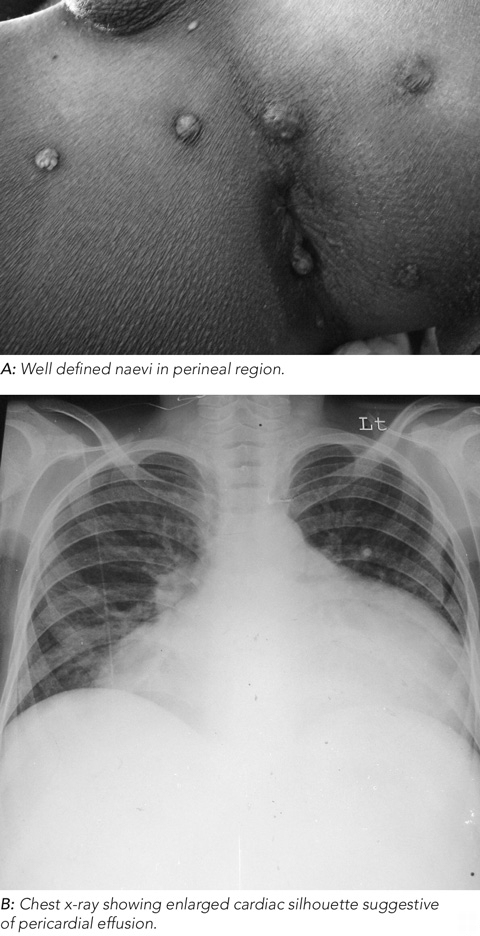
On examination, the patient had multiple, blue-black, papular and nodular, compressible, non-pulsatile, vascular skin lesions, ranging in size from a few millimetres to 1–2 cm, distributed over the trunk and limbs, including the soles of the feet, perineal region (Figure A) and lips. A chest x-ray showed an enlarged cardiac silhouette suggestive of pericardial effusion (Figure B). This was confirmed by transthoracic echocardiography. Therapeutic pericardiocentesis showed haemopericardium.
Blue rubber bleb naevus syndrome (Bean syndrome) is diagnosed in the presence of distinctive venous malformations on the skin, in the gastrointestinal tract and, less often, in other organs, leading to occult or overt gastrointestinal bleeding and chronic anaemia.1-3
References
- Nahm WK, Moise S, Eichenfield LF, et al. Venous malformations in blue rubber bleb nevus syndrome: variable onset of presentation. J Am Acad Dermatol 2004 ; 50 (5 Suppl): S101- S106.
- Ertem D, Acar Y, Kotiloglu E, et al. Blue rubber bleb nevus syndrome. Pediatrics 2001; 107: 418-420. 0_pgfId-1096804
- Langleben D, Wolkove N, Srolovitz H, et al. Hemothorax and hemopericardium in a patient with Bean’s blue rubber bleb nevus syndrome. Chest 1989; 95: 1352-1353. 0_i1091835
Fatty Liver Disease in Australia: A Narrative Review on the Epidemiology, Natural History, Prognostication and Management in People With Metabolic Dysfunction
Karl Vaz, Daniel Clayton-Chubb, William W. Kemp, Stuart K. Roberts, Ammar Majeed
Sex Differences in Management and Outcomes of People With ST-Elevation Myocardial Infarction, New South Wales, 2011–2020: A Retrospective Cohort Study
Adam C. Livori, Jedidiah I. Morton, Dianna J. Magliano, Jonathan E. Shaw
Rethinking Rheumatic Fever Diagnosis: Progress, Pitfalls and the Path Towards a Definitive Test
Anna P. Ralph, Rachel Webb, Tom Parks, Nicole J. Moreland, Asha C. Bowen, Benjamin Jones, Emma Ndagire, Andrea Z. Beaton
Sex Differences in Management and Outcomes of People With ST-Elevation Myocardial Infarction, New South Wales, 2011–2020: A Retrospective Cohort Study
Samia Kazi, Simone Marschner, Clara K. Chow
Distribution of Cardiovascular Disease Risk Based on the Updated 2023 Guideline-Recommended Australian Cardiovascular Disease Risk Algorithm and Comparison With the 2012 Algorithm: An Observational Study
Nina Lazarevic, Meghana Bhat, Grace Joshy, Danielle C. Butler, Mark Woodward, Anushka Patel, Rod T. Jackson, Garry Jennings, Rosemary Wyber, Ellie Paige, Emily Banks
They Brought the Hospital to Me
Hugh N. Burrill