




Volume 187 - Issue 2
Better care for respiratory infections
Author: Nigel P Stocks
Med J Aust 2007; 187 (2): 114. || doi: 10.5694/j.1326-5377.2007.tb01155.x
Published online: 16 July 2007
Published online: 16 July 2007
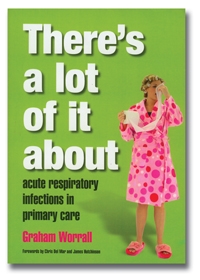
There’s a lot of it about: acute respiratory infections in primary care
Graham Worrall. Oxford: Radcliffe Publishing, 2006 (136 pp). ISBN 1 84619 084 3.
Worrall does not waste any time on trying to distinguish between upper and lower respiratory tract infections but discusses each condition in a separate chapter, starting with “The common cold” and ending with “Bronchiolitis”. Each chapter is a concise summary of the available literature and, despite now being an academic in Canada after many years as a GP in the United Kingdom, he limits the number of references he uses. However, as succinct as he may be in conveying the evidence in the text, it will be the summary boxes “Epidemiology and aetiology”, “Clinical course and diagnosis” and “Treatment” that many readers will be drawn to. This is a pity because a real understanding of the topic can only be drawn from the studies themselves and a discussion of their strengths and weaknesses; something the author does very well. The chapter on croup demonstrates this; summary boxes provide simple treatment details, but the text highlights the need for primary care-based randomised controlled trials to determine the best form of management for mild and moderate croup in the community.
The final three chapters highlight the importance of clinical assessment and the lack of decision rules for the majority of ARIs, the relentless battle between bacteria and antibiotics and the potential role inappropriate prescribing of antibiotics in the community has had on emerging bacterial resistance, and finally, evidence-based strategies that GPs can use to change their own and their patients’ behaviour for the better (eg, delayed prescribing to reduce antibiotic use being one of the simplest and best).
This textbook offers established GPs an opportunity to revisit and improve their current management of ARIs, and general practice registrars a chance to get it right from the start.
Shifting focus to adolescent wellbeing and inclusive participation in the digital age
Allyson R Todd, Elena Wang, Stephanie R Partridge
The clinical presentation, investigation, and management of women diagnosed with endometriosis in Australian general practices, 2011–2021: an open cohort study
Danielle Mazza, Kailash Thapaliya, Sharinne B Crawford, Alissia Hui, Maryam Moradi, Luke E Grzeskowiak
The impact of the Breast Screen NSW transition from film to digital mammography, 2002–2016: a linked population health data analysis
Rachel Farber, Nehmat Houssami, Katy J L Bell
Non‐technical errors associated with deaths in surgical care, Australia, 2012–2019, by surgical specialty (Australian and New Zealand Audit of Surgical Mortality): a retrospective cohort study
Jesse Ey, Victoria Kollias, Octavia Lee, Kelly Hou, Matheesha Herath, John B North, Ellie Treloar, Suzanne Edwards, Martin Bruening, Adam J Wells, Guy J Maddern
The CURE Asthma roadmap
Gary P Anderson, Anthony Flynn, Phil G Bardin, John D Blakey, Shyamali C Dharmage, Paul Foster, Peter G Gibson, Adam Jaffe, Alan James, Christine R Jenkins, Sundram Sivamalai, Peter D Sly, Guy B Marks, Vanessa M McDonald, Judy Wetttenhall
Evidence from Australian cohort studies about asthma trajectories and transitions across the life course: a narrative review
Caroline Lodge, Xin Dai, Ingrid A. Laing, Michael P Menden, Anthony Flynn, Gary P Anderson, Sarath Ranganathan, Shyamali C Dharmage