




Volume 187 - Issue 11
Health care down the drain
Authors: Andrew A Mahony and Stephen F Wilson
Med J Aust 2007; 187 (11): 636. || doi: 10.5694/j.1326-5377.2007.tb01454.x
Published online: 3 December 2007
Published online: 3 December 2007
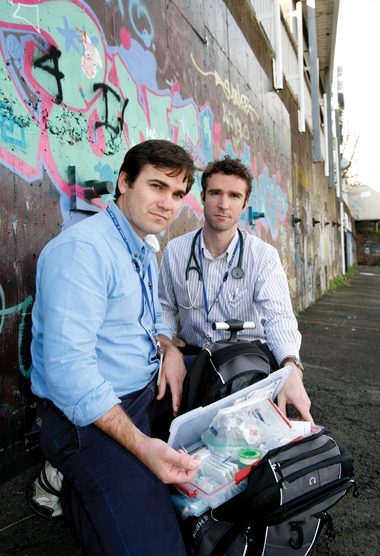
To the Editor: Sydney’s St Vincent’s Hospital, like many other hospitals, experiences a high occupancy rate which sometimes exceeds 100%, because of continual presentations to the emergency department (ED). NSW Health has recently encouraged new models of community acute/post-acute care (CAPAC) which allow patients to be managed in their homes, thus easing ED overcrowding and avoiding unnecessary presentations.1 However, those presenting most frequently to the ED at St Vincent’s Hospital are homeless. In response, this hospital has sent an outreach team consisting of a medical registrar and a community nurse to the streets of Sydney to deliver a “Backpack” CAPAC service (Figure).
The outreach team provides diagnostic support to homeless people in shelters and crisis centres in the inner City of Sydney area. The team has successfully directed appropriate subacute cases to other health services, without the necessity for attendance at the ED.
Extended episodes of treatment have also been given, including courses of intravenous antibiotics for a range of infections — even subacute bacterial endocarditis has been treated using portable infusion devices.
Inclement weather causes some homeless people to seek refuge in stormwater drains around Sydney. One such patient, with a community-acquired methicillin-resistant Staphylococcus aureus cellulitis, was visited daily in a stormwater drain — his place of residence.
Linkages have also been created with mental health services and non-government organisations.
The Backpack CAPAC service continues St Vincent’s Hospital’s 150-year tradition of providing acute health care to the vulnerable and needy in our community. As this service was initiated with community donations, it has also reduced the drain on health resources.
References
- Australian Resource Centre for Healthcare Innovations. Community acute/post acute care (CAPAC). http://www.archi.net.au/e-library/build/moc/capac (accessed Oct 2007).
Medical Colleges Have an Obligation to Ensure Full Participation in Clinical Quality Registries
Thomas J. Hugh
Getting on the Same Page: Why Australia Needs a National Maternity Early Warning System (MEWS) Chart
Briony A. Cutts, Lucy Bowyer, Nisha Khot, Sandra Lowe, Stefan C. Kane
Data for Equity: Can Linked Administrative Data Inform Pathways to More Equitable Child Health?
Sarah Gray, Shuaijun Guo, Meredith O'Connor, Elodie O'Connor, Katrina Williams, Hannah Badland, Susan Woolfenden, Josie Dickerson, Gerry Redmond, Marnie Downes, Sharon R. Goldfeld
Specialty College Selection: Why Change is Critical to Support a Future Rural Workforce
Matthew R. McGrail, Jenny May AM, Katherine Logan
Differentiated and simplified oral HIV pre‐exposure prophylaxis (PrEP) models hold the key to virtually eliminating HIV transmission in Australia by 2030
Tyson Arapali, Sarah Warzywoda, Anthony K J Smith, Curtis Chan, Timothy R Broady, Erin Sullivan, Catherine MacPhail, Mohamed A Hammoud, Alexander Dowell‐Day, Benjamin R Bavinton
The number of cancer‐related deaths that could be attributable to spatial disparities in survival in Australia, 2010–2019: a retrospective population‐based cohort study
Charlotte K Bainomugisa, Jessica Cameron, Paramita Dasgupta, Peter Baade