




Volume 187 - Issue 1
eMJA: A much-needed handbook on motor neurone disease
Author: John King
Med J Aust 2007; 187 (1): 50. || doi: 10.5694/j.1326-5377.2007.tb01118.x
Published online: 2 July 2007
Published online: 2 July 2007
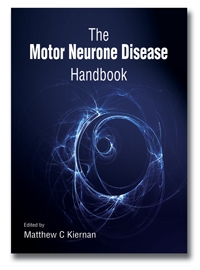
The motor neurone disease handbook
Matthew C Kiernan, editor. Sydney: MJA Books, 2007 (vii + 230 pp). ISBN 978 0 9775786 3 4
The diagnosis and management of a patient with motor neurone disease (MND) is, in my opinion, the hardest task in clinical neurology. The patient and family often want an early diagnosis at a time when it is not wise to be too dogmatic. When the diagnosis is finally given and the prognosis discussed, there is an understandable period of despair, which the neurologist tries to ease with regular follow-up visits. Despite the lack of a truly effective therapy, there have been significant advances in the ongoing care of patients with MND, which have been greatly facilitated by the concept of the multidisciplinary team.
Matthew Kiernan runs a multidisciplinary MND clinic at the Prince of Wales Hospital in Sydney and has been involved in the development of the Australian MND Registry. He is well qualified to edit this handbook and has assembled a distinguished group of local and international contributors who have provided a comprehensive account of the current status of research and clinical care of patients with MND.
All chapters are of a uniformly high standard and the style and content are reader-friendly. As a neurologist I found the chapter by Rod Mackenzie, a colleague with MND, not only very instructive but particularly inspiring.
This is a much-needed handbook for neurologists, general practitioners, allied health professionals, and patients and their families. To my knowledge there is no comparable publication and it comes at an important time for those in the MND field. The advent of riluzole, which in controlled trials has shown a capacity to prolong survival, has not only provided some hope for patients and their families, but has focused the attention of neurologists on the need to improve overall care in this disease, similar to the effect of interferon-β in multiple sclerosis more than a decade ago.
Motor Neuron Disease Mortality Trends in Australia From 1986 to 2023: A Population-Based Study
Carol M. Y. Lee, Rupendra N. Shrestha, Julian Gold, Mark Stevenson, Kelly L. Williams, Lyndal Henden, Sandrine K. K. Chan Moi Fat, Zoe Zussa, Amanda Wright, Martin Jude, Mark A. S. Laidlaw, Willem J. R. Fokkink, Dominic B. Rowe
Mild traumatic brain injury and concussion and persisting post‐concussion symptoms: new guidelines to support evidence‐based assessment and management in Australia and Aotearoa New Zealand
Karen M Barlow, Jennie L Ponsford, Alice Theodom, Gill Cowen, Gavin A Davis, Vicki Anderson, Franz E Babl, David Cole, Jennifer Cullen, Stuart R Dalziel, Melinda Fitzgerald, Howard Flavell, Caroline Yates, Rebecca Kimble, John H Olver, Rhonda Orr, Mark Ralfe, Michael Rose, Nick Rushworth, Julia Treleaven, Gary Browne, Nathan Delang, Sarah Harris, Gary Mitchell, Sean Tweedy
The prevalence of and variation in indicators of the quality and safety of long term aged care in Australia, 2019: a cross‐sectional population‐based study
Tesfahun C Eshetie, Gillian E Caughey, Catherine Lang, Olivia Ryan, Renuka Visvanathan, Craig Whitehead, Keith Evans, Janet K Sluggett, Jyoti Khadka, Carolyn Dawkins, Helena Williams, Miranda Starke, Sara Blunt, Anne Liddell, Megan Corlis, Anna Sheppeard, Penelope Lello, Marilyn Thien, Steven L Wesselingh, Maria C Inacio
Health and economic benefits of improving pre‐hospital identification of stroke in Australian women: a modelling study
Thomas Gadsden, Lei Si, Emily R Atkins, Cheryl Carcel, Xia Wang, Stephen Jan, Mark Woodward, Laura E Downey
Symptom burden, quality of life, and diagnostic journey of people with postural orthostatic tachycardia syndrome, Australia, 2021–24: a descriptive patient registry data study
Marie‐Claire Seeley, Gemma Wilson, Eric Ong, Amy Langdon, Jonathan Chieng, Danielle Bailey, Kristina Comacchio, Amanda Page, Dennis H Lau, Celine Gallagher
The intersection of rurality and dementia prevalence in Australia for Aboriginal and Torres Strait Islander and non‐Indigenous peoples
Antonia J Clarke, Marwan Ahmed, Judith M Katzenellenbogen, John Towney (Wiradjuri), Anna H Balabanski, Adrienne Withall (Dharawal Yuin), Kylie Radford, Amy Brodtmann