




Volume 186 - Issue 8
Pseudomonas chloronychia in a patient with nail psoriasis
Authors: Shinichiro Sakata and Anne Howard
Med J Aust 2007; 186 (8): 424. || doi: 10.5694/j.1326-5377.2007.tb00979.x
Published online: 16 April 2007
Published online: 16 April 2007
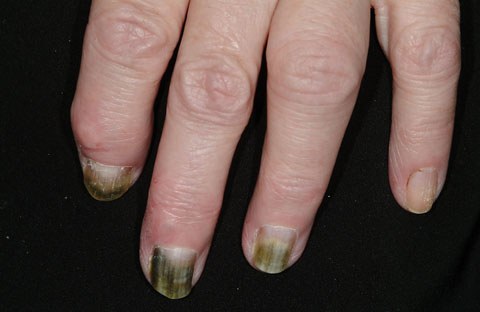
A 75-year-old woman had a 2-year history of severe onycholysis and chloronychia (olive green discolouration) of most of her fingernails (Figure). Fungal infection had been excluded by microscopy and culture of nail scrapings. Some nails had superficial ridges and pits, as well as translucent orange-brown discolouration of the nail beds (the “oil drop” sign). This, along with a well defined, red, scaly plaque over her right elbow, led to a diagnosis of limited plaque psoriasis.
The green discolouration was a classic sign of a secondary bacterial infection caused by Pseudomonas aeruginosa. Treatment was to consist of vinegar soaks (10 parts water and 1 part white vinegar applied topically for 5–10 minutes twice daily for 5 days) for the Pseudomonas infection, followed by a course of dexamethasone iontophoresis to treat the psoriatic onycholysis. (In the latter process, the fingers are held in contact with a dexamethasone solution and a low electrical current stimulates the transdermal migration of dexamethasone ions into the nail beds.)
Diagnosing Acute Kava Dermopathy: A Case Report of a Characteristic Cutaneous Eruption
Ali Abid, Nicholas Allen, Abeer Hagelamin, Christopher Henderson, Artiene Tatian
Localised Herpes Simplex Following Midline Laparotomy
Jessica S. Bulluss, Paul Chee, Matthew J. Verheyden
No silver lining with health misinformation: argyria caused by intentional silver consumption
Luke Collins, Logesh Palanikumar, Stephen Bacchi
Lingual Raynaud phenomenon
Michael Taggart, Mina John
Melasma in the male: a less well recognised entity
Tim Aung, Rowland Noakes
Age group‐specific changes in keratinocyte cancer treatment rates in Australia, 2012–2021: a retrospective cohort study based on MBS claims data
Catherine M Olsen, Nirmala Pandeya, Rachel E Neale, David C Whiteman