




Volume 186 - Issue 4
A chest wall swelling in a young girl
Authors: Parvaiz A Koul, Abdul Wahid, Ghulam N Lone and Tariq A Bhat
Med J Aust 2007; 186 (4): 213. || doi: 10.5694/j.1326-5377.2007.tb00866.x
Published online: 19 February 2007
Published online: 19 February 2007
To the Editor: Humans may serve as intermediate hosts in hydatid disease, a parasitic infection caused by the tapeworm Echinococcus granulosus. They are infected through contact with infected dogs or by ingestion of tapeworm eggs in contaminated food, water, or soil.1 The larvae form cysts in body organs. Although the liver is the most common site, lung cysts are seen in up to 30% of cases of hydatid disease. Lung cysts are generally asymptomatic, but symptoms occur if the cysts rupture.2 Here, we describe an adolescent girl with a lung cyst that ruptured across the thoracic cage into the subcutaneous fascia, presenting as a breast swelling.
A 14-year-old girl had had left-sided pleuritic chest pain, a high-grade fever, and marked swelling of the left breast for 10 days, which did not respond to antibiotics (oral amoxycillin and parenteral amikacin). Clinical examination revealed a slender, febrile and tachy-pnoeic patient with a tender swelling of the left mammary region. The swelling had a tense cystic feel, and transmitted impulses were felt when she coughed. A diffuse pleural rub was heard anteriorly, with reduced air entry.
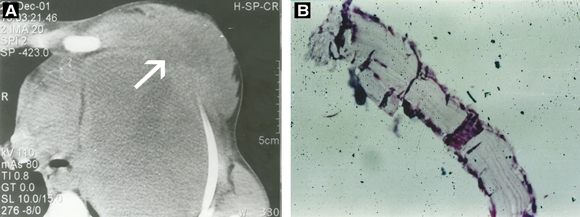
Investigations revealed a neutrophilic leukocytosis of 12.7 × 10⁹/L. Chest x-ray showed diffuse opacification of the left hemithorax, and a computed tomography scan revealed a cystic, low-attenuation lesion in the left hemithorax extending into the submammary region (Figure A). On anterolateral thoracotomy, an infected ruptured cyst was seen in the left upper lobe of the lung, with degenerated membranes and pus extending across the chest wall into the submammary space. The cyst was removed, capitonnage of the residual cavity was performed, and pus and laminated membranes were removed from the submammary space. Small communications seen between the pus cavity and the bronchi were closed. After the operation, parenteral anti-biotics (vancomycin and amikacin) were administered for 10 days and albendazole for 4 weeks. Casoni’s skin test was positive and antihydatid antibodies were detected in serum. Surgically obtained pus revealed non-viable scolices of E. granulosus (many degenerated), and the histopathology of the surgical specimen was consistent with hydatid membrane (Figure B).
Pulmonary hydatid cysts can rupture; however, rupture into the pleural cavity is rare.1-3 Although spontaneous rupture of a cyst into the pleural cavity, or rupture after trauma, has been reported,4,5 a rupture across the pleural cavity into the submammary fascial tissues has, to our knowledge, not been reported previously.
References
- Kammerer WS, Schantz PM. Echinococcal disease. Infect Dis Clin North Am 1993; 7: 605-618.
- Jerray M, Benzarti M, Garrouche A, et al. Hydatid disease of the lungs. Study of 386 cases. Am Rev Respir Dis 1992; 146: 185-189. i1091803
- Lewall DB, McCorkell SJ. Rupture of echinococcal cysts: diagnosis, classification, and clinical implications. AJR Am J Roentgenol 1986; 146: 391-394. i1091805
- Agrawal RL, Jain SK, Gupta SC, et al. Hydropneumothorax secondary to hydatid lung disease. Indian J Chest Dis Allied Sci 1993; 35: 93-96. i1091807
- von Sinner W. Pleural complications of hydatid disease (Echinococcus granulosus). Rofo 1990; 152: 718-722. i1091810
Costs of Delivering the Hep B PAST Model of Care in Remote Australia: A Retrospective Pre–Post Study
Hoa Nguyen, Anh Le Tuan Nguyen, Paula Binks, Melita McKinnon, Emily Vintour-Cesar, Karen Wills, Nicola Stephens, Benjamin Cowie, Joshua S. Davis, Yuejen Zhao, Peter Nihill, Julie A. Campbell, Andrew J. Palmer, Jane Davies, Barbara de Graaff
Buruli Ulcer Acquired From Ringtail Possum Rescue
Daniel P. O'Brien, Naomi Clarke, Sara Bonnici, Mohammad A. Hussain
Q Fever Visceral Abscesses After Contact With Native Australian Marsupials
Samantha J. Laws, Enzo Binotto, James Stewart, Jennifer Ho, Trent Yarwood, Josh Hanson, Simon Smith
Hospital-Admitted Injection-Related Infections Among Incarcerated People Who Inject Drugs in Australia: A Retrospective Cohort Study
Andrew Palmer, Matthew Carter, Jeremy Yeo, Cecilia Shim, Jason Connor, Jeremy Hayllar, Gerald Holtmann, Naomi Moy, Elliott G. Playford, Naomi Runnegar, Paul J. Clark
The Live Attenuated Influenza Vaccine in Australia: An Additional Tool for Influenza Prevention
Cyra Patel, Alexis Pillsbury, Tran Nguyen, Xia Wang, Helen E. Quinn, Clayton K. Chiu, Allen C. Cheng, Katie L. Flanagan, Zhicheng Wang
Reflex Testing for Hepatitis D Infection: A Unique Opportunity to Reduce Hepatitis D-Related Chronic Liver Disease Deaths in Australia
Jessica Howell, Lauren Andersson, Miriam T. Levy, James O'Beirne, Leon Adams, Katharine Irvine, Avik Majumdar, Golo Ahlenstiel, Kathy Jackson, Krispin Hajkowicz, Joseph Doyle, Jane Davies, Sarah Cherian, Wayne Dimech, Alexander J. Thompson