




Volume 185 - Issue 8
Men who have sex with men (MSM): how much to assume and what to ask?
Authors: Marian K Pitts, Murray A Couch and Anthony M A Smith
Med J Aust 2006; 185 (8): 450-452. || doi: 10.5694/j.1326-5377.2006.tb00645.x
Published online: 16 October 2006
Published online: 16 October 2006
In Australia, about 150 000 men aged 16–59 years identify as gay or bisexual, while a similar number identify as heterosexual but have some history of same-sex sexual contact. Pitts, Couch and Smith advise that the clinical implications for these men include more than sexual health concerns. They suggest several consultation skills that can help doctors to recognise these men and better meet their needs.
Human sexual practice is diverse. In response to the need to better understand that diversity in the face of the HIV epidemic, a fact became widely known that had previously been understood by few: a significant population of men who do not self-identify as “gay” or “bisexual” sometimes have sexual contact with other men. It was recognised that a descriptor for behaviour, rather than an assertion of social identity, was needed, and the term “men who have sex with men”, and its acronym MSM, came into being.
We believe there are “definitional” challenges associated with this term, as well as clinical and practical implications when working with men to whom such a descriptor might be applied.
What's in a definition?
It is rare for medical journals to include sexuality and sexual behaviour as important components of men’s health and wellbeing. It is even more unusual to acknowledge MSM outside the context of HIV. Use of this acronym in a men’s health context both illuminates and challenges. MSM is a behavioural definition; it does not imply an identity, and it does not consider sexual attraction.
We prefer the term “male-to-male sexual practices” (MMSP), as it explicitly acknowledges that the sexual practices, rather than the person, are at issue. The choice of “practices” in the plural also signals that male-to-male sex may incorporate a range of sexual behaviours which may, or may not, include oral and anal sex.
How many men fit the definition?
The Australian Study of Health and Relationships in 2001 surveyed a nationally representative sample of 19 307 Australians aged 16–59 years. These included 10 173 men, of whom 97.4% identified as heterosexual, 1.6% as homosexual or gay, and 0.9% as bisexual, while 0.1% were undecided or “other”. A lifetime history of sexual attraction that included other men was reported by 6.8%, and sexual experience with other men by 6.0%. Of the men who identified as heterosexual, 2.7% reported having had sex with at least one other man. By extrapolation to the general Australian population, this suggests that there are about 158 000 men aged 16–59 years who identify as heterosexual but have some history of same-sex sexual contact. This is in addition to the 148 000 men who identify as gay or bisexual.1
What are the clinical implications?
Sex, risk and MSM
What does it matter that the patient, whatever his sense of identity, has anal sex with men, and perhaps also has penetrative sex with women? The international medical literature on MSM builds a picture of a risk-taking and at-risk group. They are particularly, if not exclusively, considered in the context of HIV risk, and to a much lesser extent are known to be at risk of other sexually transmitted infections (STIs).
We recently completed a study of the knowledge and attitudes of gay men towards anal cancer and human papilloma virus (HPV).2 We know that anal sex carries a high risk of HPV transmission, particularly for men who are HIV-positive, but our study showed that very few gay men had even heard of HPV, and most were not aware of its association with sexual practices. In this regard, they differ little from women, who are at similarly high risk — of cervical cancer — through HPV exposure.
MSM are at greater risk of gonorrhoea or syphilis than are other men. However, most consultations with MSM are for issues other than STIs and reflect the profile of health conditions experienced by Australian men.
Substance use
Certainly, if a category or group is defined only in terms of sexual activity, it is unsurprising that STIs feature large. However, there is some evidence of health risks other than sexual health risks in MSM, which nevertheless derives from HIV studies. These indicate a higher than expected rate among some MSM subcultures of alcohol use, and injecting and other illegal drug use. Men in the Australian Study of Health and Relationships who identified as bisexual were eight times more likely to report a history of injecting drug use, and gay men were twice as likely, as those who identified as heterosexual.3 However, they were no more or less likely than other men reporting a history of injecting drug use to report sharing needles or injecting paraphernalia.
In Private lives, our national online survey of health and wellbeing among gay, lesbian, bisexual, transgender and intersex Australians, we found that 38.3% of gay-identifying men reported tobacco use on more than five occasions in the previous month,4 which compares with 26% for Australian men in general.5
Mental health
Findings about MSM are mixed in the area of mental health. Numerous studies have indicated higher rates of depression and anxiety in gay men. A 5-year study in South Australia reported 30% of homosexually active men met the criteria for a major depressive episode, as measured by the Primary Care Evaluation of Mental Disorders screening tool.6 Twenty-seven per cent of the men in the survey were diagnosed with dysthymic disorder on enrolment, while the survey indicated a lifetime prevalence of a depressive disorder of 48%. This is five times the rate for all men reported from primary health care clinics in the United States where the survey instrument was validated.7
In Private lives, which involved 3429 gay men from all Australian states and territories, we found that the prevalence of depressive disorders was high, with 48.7% of men scoring on at least one of the two criteria for a major depressive episode. Nearly a quarter of respondents (23.8%) met the criteria for a major depressive episode, with a similar proportion reporting experiencing depression (24.2%). It is of particular concern that 15.7% of gay men indicated suicidal ideation in the 2 weeks before completing the survey. While the causes are not easily identified, it is probable that living in a society characterised by homophobia is a contributing factor.4
What are the practical implications?
Recognition of MSM
How does one recognise MSM? Would the behavioural question be: “Have you ever had sex with a man?” or “Have you had sex with a man in the past year?” and/or “Have you also had sex with a woman?” And how would the word “sex” be interpreted?
Presumably, the narrowest definition of MSM would be a man who has experienced anal sex (insertive or receptive) on at least one occasion in his life. However, it is not surprising that publications on MSM almost never offer a definition or, if they do, proceed to bundle MSM with gay, bisexual and other homosexually active men into a single analysis.
MSM and their health needs are most likely to evade recognition because of the heteronormative nature of most clinical practice — based on the assumptions that, until proven otherwise, all people have a simple sexual identity, and that it is heterosexual. A gay man who is “out” about his sexuality to his doctor (67.2% of men in the Private lives survey had told their doctors) may find his general health concerns sometimes overshadowed by concerns about sexual health. This may be understandable, given the relatively high rates of HIV and other STIs among these men. However, STIs or any other single issue should not become an overriding focus of any clinician–patient relationship.
When, how, and what to ask a man about sex?
Simply put, when and if you consider it matters, avoiding a default assumption that the man is heterosexual, even if he is married, partnered with a woman or has children. MSM have wives and children too! In most cases, the need to ask is determined by the presenting condition, and it may not matter so much to whom a man is attracted, or what he identifies as his sexual identity, as what his recent sexual practices have been. So, ask questions about the sex he does, rather than about what he is. Of course, if the presenting problem has to do with a complicated life course perhaps including mental health issues, then questions about sexual attraction and identity could well be the important ones. The case scenarios (Box) show the differing process and outcomes when a doctor recognises, or fails to recognise, the possibilities.
For new patients, it may be easy to indicate that a full sexual history is a usual part of an initial consultation, whatever the presentation. For existing patients, sexual history may be best approached indirectly. A statement that hepatitis B vaccination is freely available and recommended for all men who have had sex with another man can be mentioned in the context of reminding all male patients of vaccination schedules. If a clinician (or a practice) takes a “no default assumptions” approach to sex, then the move into questions of sexual attraction, identity and practice will happen when, and if, they matter.
Finally, we are confident that it is rare that health articles define the population in terms of a single behavioural characteristic. To think analogously, would we not shrink from referring to WWR (women who reproduce), PWJ (people who jog), or indeed MSW (men who have sex with women)? Is it so surprising that we would prefer the term “male-to-male sexual practices” or MMSP?
Case scenarios
Scenario 1 — MSM not recognised
Rob is a 36-year-old man who lives in a regional town. He is married with three young children and is feeling guilty and highly anxious following an unsafe sexual episode with another man a while ago. He feels he will be able to relieve his anxiety only by having an HIV test. He goes to a local doctor he does not know, as he does not want to use his family doctor, who also treats his wife and children. On the information form, he states that he is married.
In the consultation, Doctor A invites him to discuss his presenting problem, and Rob leads into it by saying he is very embarrassed because he has been unfaithful to his wife. Doctor A, sensing his embarrassment, tries to help by asking whether the woman is someone he is having an ongoing affair with and whether he feels she might have had an STI. Not knowing how to get round this, Rob says that he is worried about STIs. Doctor A ends the discussion, which is clearly becoming more uncomfortable, by ordering a series of STI checks and suggesting the affair has been a bad idea and should end. The tests do not include an HIV test. Rob has gained nothing from the visit; he does not return for the test results.
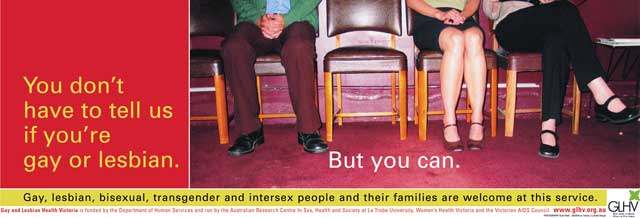
Rob, still anxious, goes to another doctor in the town to try to have an HIV test. This time he notices a health promotion poster for same-sex attracted people (Figure*) in the waiting room and so feels more confident. He completes the information form again to say he is married but notes an option for “same sex relationship”. These signals lead him to feel safer about discussing his concerns.
Doctor B asks why he has come, and he says he has had unsafe sex with someone other than his wife. “Was that with a male or a female partner?” asks Doctor B. He then asks what Rob actually did with that partner. Rob and Doctor B agree that an HIV test is necessary and discuss other STI tests as well. Hepatitis B vaccine is also discussed, along with the levels of anxiety Rob has been feeling. Doctor B takes the opportunity for a reminder about the importance of practising safe sex in the kind of situation Rob describes, but acknowledges that is not always easy. He will see Rob again for his test results, and makes sure he will return by telling Rob he is pleased to have met him and that he would be happy to see him any time he needs to talk about things.
When his test results come back negative, Rob and Doctor B use the feeling of relief to talk through some of his health risks and to plan strategies to avoid anxiety in the future. After the consultation, Rob feels less guilty and more in control of his life, and less likely to take risks with his own health and the health of his wife in the future.
* This poster and other useful resources are available at http://www.glhv.org.au/
MSM = men who have sex with men. STI = sexually transmitted infection.
Competing interests
None identified.
References
- Smith AMA, Rissel CE, Richters J, et al. Sex in Australia: sexual identity, sexual attraction and sexual experience among a representative sample of adults. Aust N Z J Public Health 2003; 27: 138-145. 0_i1091834
- Pitts MK, Fox C, Willis J, Anderson J. What do gay men know about HPV? Australian gay men's knowledge and experience of anal cancer screening and human papilloma virus. Sex Transm Dis 2006 Jul 6; [Epub ahead of print]. 0_i1091836
- Grulich AE, de Visser RO, Smith AMA, et al. Sex in Australia: injecting and sexual risk behaviour in a representative sample of adults. Aust N Z J Public Health 2003; 27: 242-250. 0_i1091838
- Pitts MK, Smith AMA, Mitchell A, Patel S. Private lives: a report on the health and wellbeing of GLBTI Australians. Monograph series No. 57. Melbourne: Australian Research Centre in Sex, Health and Society, La Trobe University, 2006. 0_i1091840
- Australian Bureau of Statistics. Social trends 2005. Canberra: ABS, 2005. (Catalogue No. 4102.0.) 0_i1091842
- Rogers G, Curry M, Oddy J, et al. Depressive disorders and unprotected casual anal sex among Australian homosexually active men in primary care. HIV Med 2003; 4: 271-275. 0_i1091844
- Linzer M, Spitzer R, Kroenke K, et al. Gender, quality of life and mental disorders in primary care: results from the PRIME-MD 1000 study. Am J Med 1996; 101: 526-533. 0_i1091847
The first Australian evidence‐based guidelines on male infertility
Darren J Katz, Liza O’Donnell, Robert I McLachlan, Tim J Moss, Clare V Boothroyd, Veena Jayadev, Sarah R Catford
The public health impacts of mining in Australia
Javier Cortes‐Ramirez, Ruby N Michael, Leisa‐Maree Toms, Melissa Haswell
Who smokes in Australia? Cross‐sectional analysis of Australian Bureau of Statistics survey data, 2017–19
Jessica Yi Han Aw, Christina Heris, Raglan Maddox, Grace Joshy, Emily Banks AM
Dual‐energy x‐ray absorptiometry assessment of bone health in Australian men with prostate cancer commencing androgen deprivation therapy
Mariya F Hamid, Amy Hayden, Tania Moujaber, Sandra Turner, Howard Gurney, Mathis Grossmann, Peter Wong
Modern paradigms for prostate cancer detection and management
Isabella SC Williams, Aoife McVey, Sachin Perera, Jonathan S O’Brien, Louise Kostos, Kenneth Chen, Shankar Siva, Arun A Azad, Declan G Murphy, Veeru Kasivisvanathan, Nathan Lawrentschuk, Mark Frydenberg
Urological Society of Australia and New Zealand (USANZ) and Australasian Chapter of Sexual Health Medicine (AChSHM) for the Royal Australasian College of Physicians (RACP) clinical guidelines on the management of erectile dysfunction
Eric Chung, Michael Lowy, Michael Gillman, Chris Love, Darren Katz, Graham Neilsen