




Volume 185 - Issue 3
Microbial keratitis associated with overnight wear of silicone hydrogel contact lenses
Authors: John A Landers and John L Crompton
Med J Aust 2006; 185 (3): 177-178. || doi: 10.5694/j.1326-5377.2006.tb00514.x
Published online: 7 August 2006
Published online: 7 August 2006
To the Editor: Extended-wear silicone hydrogel contact lenses allow the convenience of 24-hour correction of refractive error and freedom from cleaning solutions and storage containers. However, they are associated with an increase in the risk of microbial keratitis when worn overnight compared with daily wear.1-5
The following cases from a single ophthalmology practice illustrate the risk to contact lens wearers when they use silicone hydrogel contact lenses overnight.
A 36-year-old woman presented 11 days after sleeping with her silicone hydrogel contact lenses in overnight. She had increasing right ocular pain and photophobia over the preceding 9 days, which had not resolved with chloramphenicol drops. On examination, visual acuity was 6/18 right and 6/6 left. Corneal cultures grew Acanthamoeba, which responded to polyhexamethylene biguanide and brolene drops hourly. Her final best corrected visual acuity was 6/9 right, 5 weeks later.
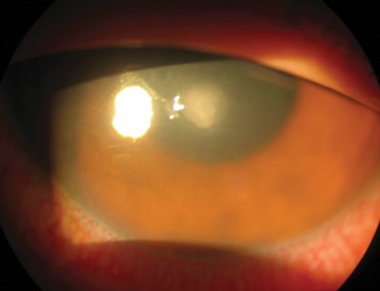
A 24-year-old woman presented with 2 days of left ocular pain, conjunctival injection, and epiphora following continuous silicone hydrogel contact lens use over the preceding week. On examination, visual acuity was 6/6 right and 6/18 left. A central corneal ulcer with stromal infiltrate and significant anterior chamber activity was present in her left eye (Box). Corneal cultures grew Pseudomonas aeruginosa, which responded to topical gentamicin 1% drops hourly. Her final best corrected visual acuity was 6/5 left, 3 weeks after diagnosis.
An 8-year-old girl was seen 2 months after commencing continuous wear of her silicone hydrogel contact lenses for uniocular myopia. She had worn the same lenses for 4 weeks continuously when she presented with a 2-day history of right ocular irritation, photophobia, and conjunctival injection. On examination, visual acuity was 6/36 right and 6/6 left. She was commenced empirically on cephalothin 5% and gentamicin 1% drops hourly. Corneal cultures did not grow any causative organism, and her clinical condition improved significantly over the following 7 days. Her final best corrected visual acuity was 6/9 right.
Although microbial keratitis may only affect a small proportion of individuals1,2,5 and our patients did not experience significant reduction in vision following treatment, microbial keratitis is potentially blinding and should not be trivialised.
Silicone hydrogel contact lenses have a lower risk of associated microbial keratitis than other lens types, but they do not remove it completely. In view of this, contact lenses should not be worn overnight or for an extended period. Furthermore, a painful red eye in a contact lens wearer should be considered microbial keratitis until proven otherwise, and needs a prompt ophthalmologist referral.
References
- Stapleton F, Edwards K, Keay L, et al. The incidence of contact lens related microbial keratitis in Australia [abstract]. Invest Ophthalmol Vis Sci 2005; 46: B228. Abstract No. 5025. 0_CHDHIEDB
- Morgan PB, Efron N, Hill EA, et al. Incidence of keratitis of varying severity among contact lens wearers. Br J Ophthalmol 2005; 89: 430-436. 0_i1091794
- Holden BA, Sankaridurg PR, Sweeney DF, et al. Microbial keratitis in prospective studies of extended wear with disposable hydrogel contact lenses. Cornea 2005; 24: 156-161. 0_pgfId-1121877
- Lam DS, Houang E, Fan DS, et al; Hong Kong Microbial Keratitis Study Group. Incidence and risk factors for microbial keratitis in Hong Kong: comparison with Europe and North America. Eye 2002; 16: 608-618. 0_pgfId-1121884
- Schein OD, McNally JJ, Katz J, et al. The incidence of microbial keratitis among wearers of a 30-day silicone hydrogel extended-wear contact lens. Ophthalmology 2005; 112: 2172-2179. 0_i1091800
Costs of Delivering the Hep B PAST Model of Care in Remote Australia: A Retrospective Pre–Post Study
Hoa Nguyen, Anh Le Tuan Nguyen, Paula Binks, Melita McKinnon, Emily Vintour-Cesar, Karen Wills, Nicola Stephens, Benjamin Cowie, Joshua S. Davis, Yuejen Zhao, Peter Nihill, Julie A. Campbell, Andrew J. Palmer, Jane Davies, Barbara de Graaff
Buruli Ulcer Acquired From Ringtail Possum Rescue
Daniel P. O'Brien, Naomi Clarke, Sara Bonnici, Mohammad A. Hussain
Q Fever Visceral Abscesses After Contact With Native Australian Marsupials
Samantha J. Laws, Enzo Binotto, James Stewart, Jennifer Ho, Trent Yarwood, Josh Hanson, Simon Smith
Hospital-Admitted Injection-Related Infections Among Incarcerated People Who Inject Drugs in Australia: A Retrospective Cohort Study
Andrew Palmer, Matthew Carter, Jeremy Yeo, Cecilia Shim, Jason Connor, Jeremy Hayllar, Gerald Holtmann, Naomi Moy, Elliott G. Playford, Naomi Runnegar, Paul J. Clark
The Live Attenuated Influenza Vaccine in Australia: An Additional Tool for Influenza Prevention
Cyra Patel, Alexis Pillsbury, Tran Nguyen, Xia Wang, Helen E. Quinn, Clayton K. Chiu, Allen C. Cheng, Katie L. Flanagan, Zhicheng Wang
Reflex Testing for Hepatitis D Infection: A Unique Opportunity to Reduce Hepatitis D-Related Chronic Liver Disease Deaths in Australia
Jessica Howell, Lauren Andersson, Miriam T. Levy, James O'Beirne, Leon Adams, Katharine Irvine, Avik Majumdar, Golo Ahlenstiel, Kathy Jackson, Krispin Hajkowicz, Joseph Doyle, Jane Davies, Sarah Cherian, Wayne Dimech, Alexander J. Thompson