




Volume 185 - Issue 11
A possible animal model of naturally occurring multinodular goitre in the Nilgiris of southern India
Authors: Biji T Kurien and Jobin T Kurien
Med J Aust 2006; 185 (11): 677. || doi: 10.5694/j.1326-5377.2006.tb00760.x
Published online: 4 December 2006
Published online: 4 December 2006
Until recently, iodine deficiency had been prevalent for centuries in a number of landlocked mountainous regions of the world.1,2 The Himalayan region3 and the Bernese region of Switzerland4 were especially known for severe endemic goitre as a result of this deficiency. Since the 1920s, the prevalence of goitre has fallen with the widespread use of iodised table salt.4
Many different human and animal inborn errors of metabolism can cause congenital goitre.5-12 It has been shown to occur in animals such as Syrian hamsters, bongo antelopes, Dutch goats, Afrikander cattle, merino sheep, mice, fox terriers, pigs, Abyssinian cats, and horses.5-12 However, we could not find any studies reporting congenital goitre in monkeys.
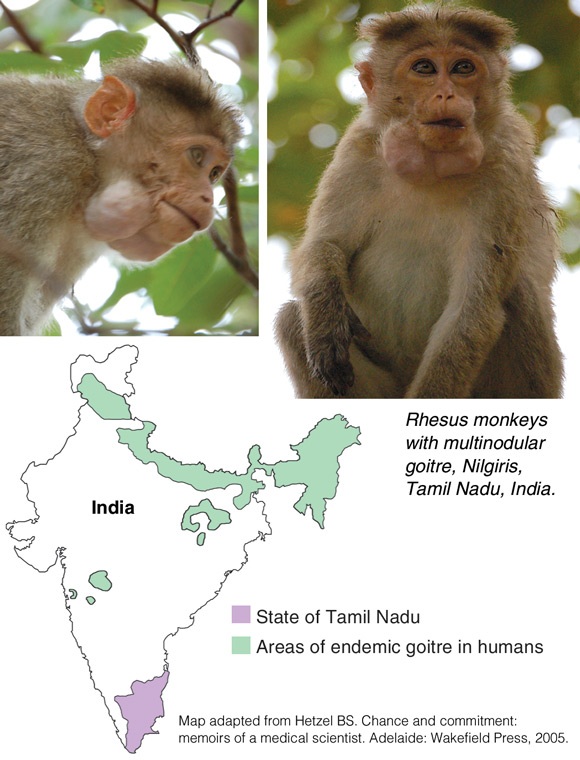
Here we report multinodular goitre occurring in wild rhesus monkeys in the Nilgiris (Blue Mountains) in the state of Tamil Nadu, southern India (Box). It is possible that these animals developed goitre because of a genetic defect. However, research has shown that livestock can develop iodine deficiency disorders (IDDs) due to an iodine-deficient diet, and may require the addition of iodised salt to their food.13 Thus it is possible that the multinodular goitre observed in Nilgiri rhesus monkeys is the result of low iodine levels in their mountain environment. Further investigation is necessary to establish the exact reason for the goitre.
A literature search failed to identify any studies of endemic goitre in humans living in the Nilgiri region, although a 2003 policy note issued by the Government of Tamil Nadu states that goitre is prevalent in some of its districts.14 Tamil Nadu has been aggressively pursuing eradication of goitre by various means, including raising awareness of IDDs, encouraging its people to demand iodised salt, and educating salt retailers to sell only iodised salt.15 If the disorder in the rhesus monkeys is indeed caused by iodine deficiency, they could serve as a model for naturally occurring multinodular goitre and would form a natural resource for studying this major thyroid disorder in humans.
Competing interests
None identified.
References
- Merke F. History and iconography of endemic goitre and cretinism. Bern: Hans Huber, 1984. i1091827
- Als C, Stüssi Y, Boschung U, et al. Visible signs of illness from the 14th to the 20th century: systematic review of portraits. BMJ 2002; 325: 21-28. i1091829
- Ibberston HK. Goitre and cretinism in the high Himalayas. N Z Med J 1974; 80: 484-488. i1091831
- Als C, Keller A, Minder C, et al. Age- and gender-dependent urinary iodine concentrations in an area-covering population sample from the Bernese region in Switzerland. Eur J Endocrinol 2000; 143: 629-637. i1091833
- Livingston RS, Franklin CL, Lattimer JC, et al. Evaluation of hyperplastic goiter in a colony of Syrian hamsters (Mesocricetus auratus). Lab Anim Sci 1997; 47: 346-350. i1091835
- Schiller CA, Montali RJ, Doi S, Grollman EF. Clinical and morphologic findings of familial goiter in bongo antelope (Tragelaphus eurycerus). Vet Pathol 1995; 32: 242-249.
- Tassi VP, Di Lauro R, Van Jaarsveld P, Alvino CG. Two abnormal thyroglobulin-like polypeptides are produced from Afrikander cattle congenital goiter mRNA. J Biol Chem 1984; 259: 10507-10510.
- Taylor BA, Rowe L. The congenital goiter mutation is linked to the thyroglobulin gene in the mouse. Proc Natl Acad Sci U S A 1987; 84: 1986-1990.
- Fyfe JC, Kampschmidt K, Dang V, et al. Congenital hypothyroidism with goiter in toy fox terriers. J Vet Intern Med 2003; 17: 50-57.
- Welchman DD, Cranwell MP, Wrathall AE, Christensen P. An inherited congenital goitre in pigs. Vet Rec 1994; 135: 589-593.
- Jones BR, Gruffydd-Jones TJ, Sparkes AH, Lucke VM. Preliminary studies on congenital hypothyroidism in a family of Abyssinian cats. Vet Rec 1992; 131: 145-148.
- Baker JR, Wyn-Jones G, Eley JL. Case of equine goitre. Vet Rec 1983; 112: 407-408. i1091843
- Pandav CS, Anand K. Towards the elimination of iodine deficiency disorders in India. Indian J Pediatr 1995; 62: 545-555. i1091845
- Co-operation, Food and Consumer Protection Department, Government of Tamil Nadu. Food and public distribution. Policy note 2003–2004, demand no. 12, chapter XI: Food and public distribution. http://www.tn.gov.in/policynotes/archives/policy2003-04/cfcp2003-04-11.htm (accessed Nov 2006).
- International Council for Control of Iodine Deficiency Disorders. IDD Newsletter 2005; 21(4). http://indorgs.virginia.edu/iccidd/newsletter/v21n4_1105.pdf (accessed Nov 2006).