




Volume 183 - Issue 1
Golfer’s vasculitis
Authors: Rosemary L Nixon, Jacinta M Opie and Robert I Kelly
Med J Aust 2005; 183 (1): 32. || doi: 10.5694/j.1326-5377.2005.tb06886.x
Published online: 4 July 2005
Published online: 4 July 2005
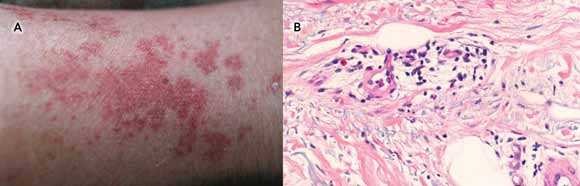
A 76-year-old woman presented for a routine skin check in late spring. On examination, she was noted to have a marked purpuric rash involving her lower legs (Figure A). The rash was accompanied by a slight burning sensation. The patient had played golf the day before. A skin biopsy revealed limited changes suggestive of leukocytoclastic vasculitis (Figure B). The rash resolved over 3 days. As the patient was concerned about herbicides causing the rash, she was subsequently patch-tested to an extensive panel of contact allergens, but all tests were negative.
In our experience, an erythematous-to-purpuric rash occurring on the legs and ankles of older people is not uncommon after prolonged exercise, such as golfing or hiking, in hot weather. It usually resolves within a week.
Surprisingly, there have been very few published reports of this type of rash occurring. We recently reported a case series of 17 other patients,1 and suggested that the condition — a benign variant of cutaneous vasculitis, for which a combination of exercise, heat and stasis appears to be the most significant cause — be known as “golfer’s vasculitis”. However, a colleague who practises in Florida and who is familiar with the condition refers to it as “Disneyworld leg”!
References
- Kelly RI, Opie J, Nixon R. Golfer’s vasculitis. Australas J Dermatol 2005; 45: 11-14. GJHHCAIE
Diagnosing Acute Kava Dermopathy: A Case Report of a Characteristic Cutaneous Eruption
Ali Abid, Nicholas Allen, Abeer Hagelamin, Christopher Henderson, Artiene Tatian
Localised Herpes Simplex Following Midline Laparotomy
Jessica S. Bulluss, Paul Chee, Matthew J. Verheyden
No silver lining with health misinformation: argyria caused by intentional silver consumption
Luke Collins, Logesh Palanikumar, Stephen Bacchi
Lingual Raynaud phenomenon
Michael Taggart, Mina John
Melasma in the male: a less well recognised entity
Tim Aung, Rowland Noakes
Age group‐specific changes in keratinocyte cancer treatment rates in Australia, 2012–2021: a retrospective cohort study based on MBS claims data
Catherine M Olsen, Nirmala Pandeya, Rachel E Neale, David C Whiteman