




Volume 183 - Issue 1
Controversial scientist
Author: Roy MacLeod
Med J Aust 2005 || doi: 10.5694/j.1326-5377.2005.tb06870.x
Published online: 7 April 2005
Published online: 7 April 2005
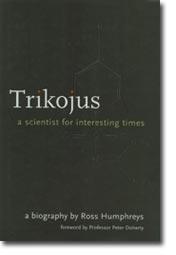
Trikojus: a scientist for interesting times.
Ross Humphreys. Melbourne: Miegunyah Press, 2004 (xviii + 154 pp). ISBN 0 522 85095 2.
Among the rare Sydney University graduates to receive an 1851 Exhibition, Trikojus returned from his doctoral years in Oxford and Munich with much to offer his alma mater. Notwithstanding his scientific reputation, he is perhaps best remembered for his wartime detention as an alleged pro-Nazi sympathiser, an image that was in 1999 wildly exaggerated by articles in The Age, The Sydney Morning Herald, and on SBS television. The son of a German-born, naturalised Australian father, Trikojus was caught up in the tide of anti-Nazi (mixed with anti-communist) hysteria that coursed through Australia in 1940, leading to his formal detention in 1941, and to restrictions on his movements until 1944. A less robust character might have given way before what now seems singularly misjudged persecution by ill-informed and ill-advised, if not actually incompetent, security services. During and after the war, Trikojus, whose European manner and conservative mannerisms conjured an image of the other in an Australia still deeply British in both form and appearance, attracted misunderstanding. To this image, his outspoken, Russian-born wife of mixed European descent, may have inadvertently contributed. At the same time, his dealings with leading Australian scientists were widely praised, and warmly supported.
Humphreys makes good use of the Trikojus archives and, by restoring him to his context, makes fresh sense of his life. If, at times, the account reads like a brief for the defence, the outcome is no worse for that. The book goes well beyond the official biography,1 and recaptures a sense of what life in wartime (and Cold War) Australia could be like for those who differed from the familiar norm. At the same time, it reminds us what a difference a foreigner can make to Australian cultural and intellectual life. Trikojus: a Scientist for interesting times was released in time to coincide with the opening of the new Bio21 Institute at the University of Melbourne, and includes a prefatory appreciation by Australias most recent medical Nobel Prize winner, Peter Doherty.
Roy MacLeodEmeritus Professor of History University of Sydney, NSW
1. Legge JW, Gibson F. Victor Martin Trikojus, 1902-1985. Hist Rec Aust Sci 1987; 6: 519-531.
Intranasal Adrenaline Use for the Management of Insect Venom-Induced Anaphylaxis
Thomas J. Young, Wilhelmina R. F. Johnson, Braydon L. Pennington, Troy Wanandy, Wun Y. Lau, Thanh-Thao A. Le
Gabapentinoid Poisoning Presentations to Victorian Emergency Departments: A 15-Year Trend Analysis
Bishaal Tej Gurung, Amy McNeilage, Angus Skeen, Tina Lam, Joanna F. Dipnall, Jane Hayman, Suzanne Nielsen, Ting Xia
Still Treating Yesterday's Risk? Reconsidering Antiviral Use for Mild-to-Moderate COVID-19 Cases in a Broadly Immune Population
Hadar Mudrik-Zohar, Tim Cutfield, Susan Morpeth, Thomas Hills, Eamon Duffy, Laura J. Edwards, Allen C. Cheng, Steven Y. C. Tong
Birth prevalence, clinical sequelae, and management of congenital cytomegalovirus infections in Australia, 1999–2023: a national prospective study
Ece Egilmezer, Suzy M Teutsch, Carlos Nunez, Stuart T Hamilton, Adam W Bartlett, Pamela Palasanthiran, Elizabeth J Elliott, William D Rawlinson
Medication delivery and dispensing interval preferences of people who use antihypertensive medications in Australia: a survey study
Carissa Bonner, Michael A Fajardo, Rachael M Keast, Emily Atkins, Niamh Chapman, Kristie R Weir, Anthony Rodgers, Aletta E Schutte
Concurrent use of hormonal long‐acting reversible contraception by women of reproductive age dispensed teratogenic medications, Australia, 2013–2021
Michelle KY Chen, Adrian Lim, Deshan F Sebaratnam