




Volume 182 - Issue 11
A bloody good story
Med J Aust 2005 || doi: 10.5694/j.1326-5377.2005.tb06803.x
Published online: 3 June 2005
Published online: 3 June 2005
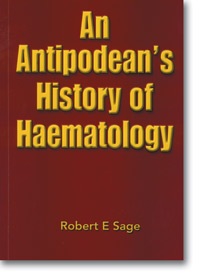
An antipodeans history of haematology.
Robert E Sage.Norwood, SA: Peacock Publications, 2004 (528 pp) ISBN 1 876087 96 X.
The book falls into two sections. In the first six chapters, Sage attempts to cover the history of haematology from antiquity to the 1960s, but sadly, clarity is drowned in the overwhelming detail. It is the following 17 chapters that make the book a bloody good story.
Sage traces the history of antipodean haematology according to Carlyles tenet; he explores the professional lives of 99 Australasian haematologists. Indeed, this is the essence of the books uniqueness the alignment of the professional lives of these haematologists with the growth of Australasian haematology, the foundation and growth of the Haematology Society of Australia (1961) and the Australasian Society of Blood Transfusion (1964), and events beyond.
Sage presents insights into personalities and politics, including the revelations of the intransigence between transfusionists in Melbourne and Sydney over such monumental matters as the transfusion bottle! There were also the philosophical differences over what a haematologist is a rancorous debate, which reached its peak in the 1970s, and embroiled the Austral(as)ian Colleges of Physicians and Pathologists, along with academics and mainstream haematologists. The bad blood was to ooze for years.
Other stories include: the reasons for Melbournes erstwhile position as the power house of Australian haematology, a supremacy sustained by attracting the cream of
Sage unearths some interesting facts. William Osler is called an English physician (he was Canadian); John Hunter is claimed to have been publishing and describing syndromes in 1817 (he died in 1793); the University of St Louis is said to be located in Mississippi (St Louis University is in Missouri); and Wollongong Hospital is said to be located in Sydney (the denizens of Wollongong, some 100 km south of Sydney, would be surprised to learn this).
Nonetheless, the book is a significant history, adorned by innumerable mug shots of people in their prime or decline, and precious photos of local historical events. At its price, it is a bargain and should be on the shelves of all Australasian haematologists and haematology departments. I thoroughly recommend it.
Martin B Van Der WeydenFormer Haematologist, and currently Editor, Medical Journal of Australia, Sydney, NSW
Splenic injury in severe cases of the zoonoses Q fever and rickettsial infection: diagnostic challenges
Ashleigh Drury, Philippa Harrison, Aiveen Bannan
Health and economic benefits of improving pre‐hospital identification of stroke in Australian women: a modelling study
Thomas Gadsden, Lei Si, Emily R Atkins, Cheryl Carcel, Xia Wang, Stephen Jan, Mark Woodward, Laura E Downey
Updating the diagnosis and management of elevated serum ferritin levels in the era of routine ferritin testing of blood donors by Australian Red Cross Lifeblood
Gary D Zhang, James Chen, Daniel M Johnstone, Martin B Delatycki, Katie Allen, John K Olynyk
Early cardiovascular collapse after envenoming by snakes in Australia, 2005–2020: an observational study (ASP‐31)
Geoffrey K Isbister, Katherine Z Isoardi, Angela L Chiew, Shane Jenkins, Nicholas A Buckley
Updated recommendations for warfarin reversal in the setting of four‐factor prothrombin complex concentrate
Danielle Robinson, James McFadyen, Eileen Merriman, Chee Wee Tan, Ross Baker, Huyen Tran
Updating the diagnosis and management of iron deficiency in the era of routine ferritin testing of blood donors by Australian Red Cross Lifeblood
Gary D Zhang, Daniel Johnstone, Michael F Leahy, John K Olynyk