




Volume 181 - Issue 9
Teaching on the run tips 6: determining competence
Authors: Fiona R Lake and Jeffrey M Hamdorf
Med J Aust 2004; 181 (9): 502-503. || doi: 10.5694/j.1326-5377.2004.tb06410.x
Published online: 1 November 2004
Published online: 1 November 2004
Setting
On the round you review a patient who needs long-term intravenous antibiotics. Your registrar says she will put in a “PIC” (percutaneous intravenous catheter) later that day. As you wander off, you wonder how good she is at putting in a PIC line. You wonder who taught her, as you know you didn’t and, indeed, it is many years since you have done one.
Doctors in training need to practise to improve, and, whether we like it or not, practice often involves patients.1 While learning, it is possible that errors will occur. It is our responsibility as senior doctors to ensure that our trainees provide safe and good care and receive support in the learning environment. At a certain point, we also need to decide whether they are good enough to work alone. This involves assessing knowledge, skills, communication skills and professional behaviour. Often we rely on our “gut feeling” about whether they are capable. Is this sufficient? The focus of this teaching tips article is on how to decide when trainees are capable of carrying out procedural skills on patients.
Skills training
It is important to consider what skills you expect your junior doctor or trainee to perform either independently or under your observation, to let them know and to give them training when needed. As many hospitals or training programs now have structured training for common simple skills (eg, suturing) and extensive training and testing of competency for infrequently performed but life-saving skills (eg, intubation), it is initially important to find out what training junior doctors have had in such skills.2
Framework for clinical assessment
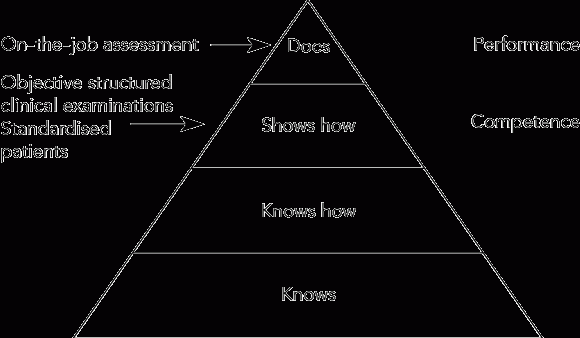
A basic framework for determining clinical competence is shown in Box 1.3,4 The four stages move from “knowing” (awareness) up to “doing” (performance). For clinicians who assess junior staff, competence can be viewed as what these staff do in controlled situations, whereas performance is what they actually do when unsupervised.5 As described in “Tips 5”,6 trainees should not only demonstrate technical competence, but also be able to articulate the indications, contraindications and risks of a procedure, and be able to communicate these details to patients and know when to seek assistance. A trainee may be competent to insert a PIC line in a simulated setting, but, to perform well, he or she needs to be able to cope with a variety of situations (eg, patients who are obese, thin, well, unwell, agitated, or receiving anticoagulants) and know when to call for help.
As clinicians, we are usually called upon to determine competence (can they do it safely in a supervised environment?) or performance (are they safe to do it alone?) while they work with us. How can we do this?
Methods of assessment
Methods that can be used to assess skills include objective, structured clinical examinations, simulated and virtual settings, and “on-the-job” assessment.4,7 Each medical school, medical board, hospital and college uses its own range of tools and uses different methods for different levels (Box 1). Being competent doesn’t guarantee good performance.8 Knowing that trainees passed their medical school course or progressed from internship doesn’t mean they can safely care for patients without supervision.
A review of the reliability or validity of these methods of assessment is beyond the scope of this article, but no single method can provide all the data required for deciding something as complex as whether a trainee is capable of delivering professional services.3
Tips for assessing competence and performance in the clinical setting
Think about assessable moments. Structure work and teaching so you can observe behaviour.
Gather information from multiple sources. Observe often and ask others (colleagues, registrars, nurses, patients).
Ask trainees how they think they are going.
Tell trainees how they performed, offering timely and constructive feedback and supporting them when things don’t go well.
Use a simple rating scale (Box 2) to guide your assessment as to whether further training is required.
Get trainees to describe and demonstrate. This will allow you to determine their weaknesses (Box 2).
Take-home message
In determining whether a trainee is safe to carry out procedures on your patient:
Know what you would expect at each level of training.
Decide whether you are determining competence (can the trainee do it safely in a supervised environment?) or performance (is he or she safe to do it alone?).
In the clinical setting, observe often and ask others.
Provide constructive feedback and further training when needed.
2 Competence rating scale*
No errors observed.
Occasional errors, corrected by trainee.
Frequent errors, corrected by trainee.
Frequent errors, not corrected by trainee.
Trainee unable to proceed without step-by-step instruction.
* Adapted from a competence rating scale used in the Royal Australasian College of Surgeons Basic Surgical Skills Course. Student assessment materials. 2000.
Competing interests
None identified.
Acknowledgements
We would like to thank the teachers and participants in Teaching on the Run courses for their input and the Medical Training Review Panel, Australian Department of Health and Ageing, for funding support.
References
- Gawande A. Complications. A surgeon’s notes on an imperfect science. London: Profile Books, 2002: 11-34. CHDBABJF
- O’Connor HM. Teaching undergraduate medical students in procedural skills. Emerg Med 2002; 14: 131-135. i1085685
- Miller GE. The assessment of clinical skills/competence/performance. Acad Med 1990; 65(9 Suppl): S63-S67. i1085687
- Norcini JJ. ABC of learning and teaching in medicine. Work based assessment. BMJ 2003; 326: 753-755. CHDIDDBB
- Epstein RM, Hundert EM. Defining and assessing professional competence. JAMA 2002; 287: 226-235. CHDFFEID
- Lake FR, Hamdorf JM. Teaching on the run tips 5: teaching a skill. Med J Aust 2004; 181: 327-328. CHDIEAAB
- Smee S. ABC of learning and teaching in medicine. Skill based assessment. BMJ 2003; 326: 703-706. CHDGFFHF
- Talbot M. Monkey see, monkey do: a critique of the competency model in graduate medical education. Med Educ 2004; 38: 587-592. FHEEFIII