




Volume 180 - Issue 8
Teaching on the run tips: doctors as teachers
Author: Fiona R Lake
Med J Aust 2004; 180 (8): 415-416. || doi: 10.5694/j.1326-5377.2004.tb05997.x
Published online: 19 April 2004
Published online: 19 April 2004
Setting
The new intern and registrar are about to commence. The students are also starting soon. These days, the hospital is pushing you to do more for the junior medical officers, the clinical colleges’ forms are getting longer, and the medical school has not only changed its course but increased the intake of students. You like teaching, but it is stressful fitting it in with your other duties. Looking around, you realise there are some good teachers. You wonder what they do that you don’t.
There is a tradition for doctors to teach their colleagues and students. The Hippocratic oath states, in part, that the duties of a doctor are “. . . to teach them this art, if they want to learn it, without fee or indenture”.1 Sharing expertise is regarded as a rewarding and enjoyable aspect of medicine. But it is becoming harder. The task is to maintain our teaching commitments while improving the quality of teaching and keeping it rewarding and enjoyable.2
Problems
Lack of time. With increased patient and administrative loads, the single most important factor clinicians cite is lack of time. The fact that there are fewer patients to teach on, shorter hospital stays and sicker patients also contributes to the problem. These pressures are unlikely to lessen.2
Lack of knowledge. Clinicians need to increase their knowledge about how to motivate the learner, assess competence, give constructive feedback, teach multiple trainee levels at the same time and deal with competing demands of patient care and education.3
Lack of training. Most of us who teach have never been taught how to teach, supervise or assess students, junior doctors or trainees.3
Criticism of teaching. Although we do our best to teach, we are told we do it poorly. Evidence suggests, even today, that there is still teaching by humiliation and sarcasm, teaching that is variable and unpredictable, and poor supervision and assessment, with little feedback.4 A recent inquiry into the clinical services at a tertiary hospital in Western Australia noted poor supervision and training and recommended all senior doctors should partake in “train the trainer”-type courses.5
Lack of rewards. Material rewards and recognition for the teaching we do are poor.
To cope with these challenges, we, as teachers, need knowledge and skills2,6 to teach effectively in the clinical setting “on the run”.
Solutions
Teachers’ goals
Research confirms that the performance of students, as measured by knowledge and skills assessments, is directly related to the prowess of their teachers.7 Good teachers are recognised not only by their teaching abilities (organisation and clarity of presentation, enthusiasm and stimulation of interest, group interaction skills) but also by their “doctoring” qualities (competence, clinical knowledge, analytic ability, professionalism) and their supervisory skills.8
The goals of an effective clinical teacher are:8,9
to provide a clinician role model: being knowledgeable, competent, caring and professional;
to be a supervisor: giving direction in patient care when required; providing feedback; involving trainees, junior medical officers and students in clinical care;
to provide support: mentoring, caring, showing an interest, and providing advice about careers;
to be a dynamic teacher: planning, motivating, understanding the relevance for learners, and identifying learner needs.
The teacher–learner relationship has an enormous impact on the quality of teaching and learning, with interpersonal variables accounting for half the variance in teaching effectiveness.10
The learning cycle
Junior doctors learn while caring for patients. Mistakes may occur and clinical decisions could sometimes be better. As teachers, we need to anticipate mistakes, minimise them, and, when they occur, ensure that a supportive environment allows junior doctors to reflect on their practice and learn from it, rather than feel blamed.8 A framework for thinking about how students, junior doctors or trainees learn and how we can help them learn — either in a discrete session or across a clinical attachment — is embodied in the learning cycle. 9,11 We will be better teachers if we can address each component of the cycle.
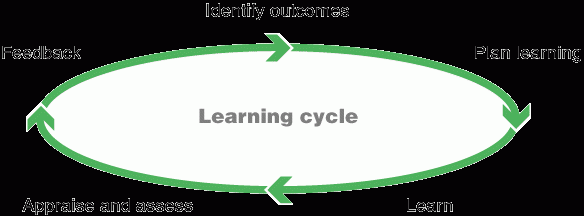
The series “Teaching on the run tips” as it unfolds will explore with clinicians basic educational principles to apply in the clinical setting for all phases of learning and teaching with students, junior doctors and specialty trainees.
Take-home message
Effective clinical teachers of students, junior doctors and specialty trainees
are good clinicians;
understand basic educational principles and have the skills to apply these in practice.
A particular teaching tip may not suit all circumstances or all people — each of us has our own style. Different learners have different needs, and different circumstances require different actions. Therefore, we need a wide range of skills, together with flexibility in applying them at different times. So ...
evaluate your own teaching;
try new methods as suggested in this series and elsewhere, and evaluate their effectiveness;
get feedback from others, and try again.
Evidence suggests we can improve!
Competing interests
None identified.
Acknowledgements
I would like to thank Dr G Ryan and the teachers and participants in Teaching on the Run courses for valuable input and the Medical Training Review Panel, Department of Health and Ageing, for funding support.
References
- Jones WHR, translator. The Hippocratic oath. In: Judge JR, Zuedama GD, Fitzgerald FT. Clinical diagnosis: a physiological approach. Boston: Little Brown and Company, 1982: ii. i1083117
- Spencer J. ABC of learning and teaching in medicine. Learning and teaching in the clinical environment. BMJ 2003; 326: 591-594. i1083119
- Gibson DR, Campbell RM. Promoting effective teaching and learning: hospital consultants identify their needs. Med Educ 2000; 34: 126-130. i1083121
- Irby DM. Teaching and learning in ambulatory care settings: a thematic review of the literature. Acad Med 1995; 70: 898-931. i1083123
- Douglas N, Robinson J, Fahy K. Vol 1 — Inquiry into the obstetric and gynaecological services at King Edward Memorial Hospital 1990–2000. Perth: Department of Health, Government of Western Australia, 2001. Available at: www.health.wa.gov.au/kemhinquiry/about (accessed Feb 2004).
- Wall D, McAleer S. Teaching the consultant teachers: identifying the core content. Med Educ 2000; 34: 131-138. i1083127
- Irby DM, Papadakis M. Does good clinical teaching really make a difference? Am J Med 2001; 110: 231-232. i1083129
- Ulian J, Bland C, Simpson D. An alternative approach to defining the role of the clinical teacher. Acad Med 1994; 69: 832-838. i1083131
- Parsell G, Bligh J. Recent perspectives on clinical teaching. Med Educ 2001; 35: 409-414. i1083133
- Tiberius RG, Sinai J, Flak EA. The role of teacher-learner relationships in medical education. In: Norman GR, van der Vleuten CPM, Newble DI, editors. International handbook of research in medical education. Dordrecht: Kluwer Academic Publishers, 2002: 463-497. i1083135
- Peyton JWR. The learning cycle. In: Peyton JWR, editor. Teaching and learning in medical practice. Rickmansworth, UK: Manticore Europe Limited, 1998:13-19. i1083137