




Volume 180 - Issue 11
Antidote to depersonalised medicine
Author: Sylvia R Cruess
Med J Aust 2004 || doi: 10.5694/j.1326-5377.2004.tb06083.x
Published online: 7 June 2004
Published online: 7 June 2004
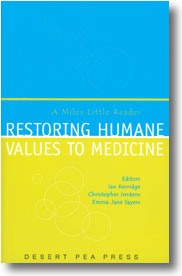
Restoring humane values to medicine. A Miles Little reader.
Ian Kerridge, Christopher Jordens, Emma-Jane Sayers (editors). Sydney: Desert Pea Press, 2003 (x + 307 pp). ISBN 1 87686 108 8.
One of the unique contributions to the book is Littles discussion of the ethics of surgery and the analysis of its five moral domains. These follow the progression of the surgeonpatient relationship through the process of surgery and the patients response to each stage. As Russell Gruen points out in his associated commentary, they help us to understand why surgery cannot be practised as a purely technical exercise. In medicine, which is increasingly technology-dependent, the promotion of humanism in physicians and surgeons must be a strong antidote to the impersonalisation and deprofessionalisation which technology can bring.
The other essays address the conflicts and dilemmas facing the practitioner in contemporary medicine. As one reads each essay there is an opportunity to reflect and gain a better understanding of the issues, whether the subject is euthanasia, death, the place of evidence-based medicine and epidemiology, the real issues of consent and whether it can be informed, the impact of resource restraints, or the demand for accounting logic in medicine leading to ethonomics. Physicians need to reflect on these issues if they are to bring care, compassion, and integrity to their practices. These essays are particularly useful to those in academic medicine where the teaching of the physician as healer and professional require humanism and reflection if these qualities are to be imparted.
Sylvia R CruessAssociate Professor of Medicine McGill University, Montreal, Canada
Mending the Road: A Way Forward From Silence and Silencing
Ayman Hamdan, Anisa J. N. Jafar
Seven Vessel Spontaneous Coronary Artery Dissection and Concurrent Transient Global Amnesia After an Emotional Trigger
Michael J. Stewart, Tom R. Sutherland
Seven Vessel Spontaneous Coronary Artery Dissection and Concurrent Transient Global Amnesia After an Emotional Trigger
Virginia Barbour
Research Priority Setting Is Not Research: A Call for Ethical Clarity in Australia
Bec Jenkinson, Gordon McGurk, Jonathan Quicke, Janelle Bowden, Nadine E. Foster
Organ Donation After Oral Ingestion of a Voluntary Assisted Dying Substance
Joanne Kantianis, Helen I. Opdam, Rohit L. D'Costa
Equity, Diversity and Inclusion From the Start: Reforming Australia's Research Infrastructure for Inclusive Participation
Danielle M. Muscat, Kirsten J. McCaffery, Heather L. Shepherd, Marguerite Tracy