




Volume 180 - Issue 1
EBM — a moral imperative
Author: Wendy A Rogers
Med J Aust 2004 || doi: 10.5694/j.1326-5377.2004.tb05757.x
Published online: 26 August 2003
Published online: 26 August 2003
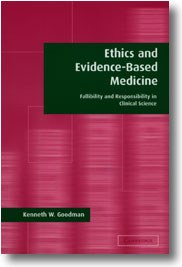
Ethics and evidence-based medicine. Fallibility and responsibility in clinical science.
Kenneth W Goodman. Cambridge: Cambridge University Press, 2003 (xii + 168 pp). ISBN 0 521 79653 9.
A series of well-informed chapters engage with some of the major criticisms of evidence-based medicine (EBM). Issues such as flawed research, redundant publishing, publication bias, and the shortcomings of research synthesis are tackled squarely. Despite these problems, argues Goodman, the use of research is well founded both conceptually and practically, creating the imperative to improve the quality of research production and synthesis rather than abandon EBM. The only weakness in his reasoning is the lack of evidence that using EBM leads to better patient outcomes, or discussion of how this might be demonstrated.
The authors expertise in philosophy and computing are evident in the discussion of ethical issues raised by internet use in research, for data collection and for recruiting. As well as a chapter on clinical EBM and guidelines, the relationship between policy and evidence is explored through three case studies, providing concrete examples of the promises and problems of evidence-based public health.
Overall, this is a thoughtful and sympathetic exploration of the moral imperative to use EBM. The detailed analyses are supplemented with practical suggestions, making the book of interest to academics and practitioners alike. This is a valuable early contribution on the ethics of EBM; no doubt further contributions will engage with some of the wider ethical issues that were beyond the scope of this text.
Wendy A RogersNHMRC Research Fellow Flinders University, Adelaide, SA
Mending the Road: A Way Forward From Silence and Silencing
Ayman Hamdan, Anisa J. N. Jafar
Seven Vessel Spontaneous Coronary Artery Dissection and Concurrent Transient Global Amnesia After an Emotional Trigger
Michael J. Stewart, Tom R. Sutherland
Seven Vessel Spontaneous Coronary Artery Dissection and Concurrent Transient Global Amnesia After an Emotional Trigger
Virginia Barbour
Research Priority Setting Is Not Research: A Call for Ethical Clarity in Australia
Bec Jenkinson, Gordon McGurk, Jonathan Quicke, Janelle Bowden, Nadine E. Foster
Organ Donation After Oral Ingestion of a Voluntary Assisted Dying Substance
Joanne Kantianis, Helen I. Opdam, Rohit L. D'Costa
Equity, Diversity and Inclusion From the Start: Reforming Australia's Research Infrastructure for Inclusive Participation
Danielle M. Muscat, Kirsten J. McCaffery, Heather L. Shepherd, Marguerite Tracy