




Volume 179 - Issue 7
Forensic dental and medical response to the Bali bombing
Authors: Russell Lain, Chris Griffiths and John M N Hilton
Med J Aust 2003; 179 (7): 362-365. || doi: 10.5694/j.1326-5377.2003.tb05594.x
Published online: 6 October 2003
Published online: 6 October 2003
After the Bali bombing on 12 October 2002, once the survivors had been treated or evacuated, many dead, severely burned and fragmented bodies were left. Formal identification was required before any remains could be released to grieving families. Australia sent a team to assist the Indonesians in this daunting and disturbing task. The “disaster victim identification” process eventually confirmed 202 people as dead, including 88 Australians. Personal and professional relationships between the Indonesians and our team were important factors in our acceptance into the Indonesian emergency response.
At 06:00, Sunday, 13 October, Professor John Hilton (Director of the Institute of Forensic Medicine, Sydney; Associate Professor of Pathology, University of Sydney; and Group Captain (ret.) in the RAAF Specialist Reserve) heard on the radio news that there had been an explosion in Bali, with an unknown number killed or injured, including Australians.
John: Thought 1: Must have been an LPG storage tank in a hotel or restaurant or nightclub that blew. Thought 2: What’s the actual size of the problem? I had vivid memories of wild exaggerations of fatalities in East Timor in the aftermath of the independence referendum. Thought 3: Will the Indonesians need some help with the DVI [disaster victim identification], the forensic pathology and odontology? Thought 4: Ring the State DVI Commander [Detective Chief Inspector Mark Edwards] and ring Griffo [Chris Griffiths, Staff Specialist, Westmead Centre for Oral Health; Adjunct Associate Professor, University of Sydney; and Group Captain in the RAAF Specialist Reserve].
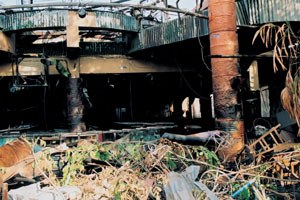
Paddy’s bar
During the day, a picture of bombings, rather than a gas explosion, emerged. John Hilton and Chris Griffiths (Staff Specialist, Westmead Centre for Oral Health; Adjunct Associate Professor, University of Sydney; and Group Captain in the RAAF Specialist Reserve) worked with Superintendent Andy Telfer of the South Australian police, head of Australia’s delegation to Interpol, and, by proxy, with the Department of Foreign Affairs and Trade and the Australian Federal Police (AFP), to formulate a response plan and compile and assemble an equipment list. The AFP was appointed the lead agency in the DVI response. However, DVI is a new area for the AFP; the expertise lies with the states.
On Monday, 14 October, John Hilton and Chris Griffiths flew to Bali, arriving late in the evening.
Meeting the Indonesians
On Tuesday, 15 October, we were up at 05:00 for a breakfast meeting with the AFP in Denpasar. At 08:00, we headed to the site of the bombing, but were denied access because the previous day the AFP had advised the Indonesian police to seal the crime scene and not let anyone in. We went on to Sanglah Hospital, a pleasant pavilion-style tropical hospital coping valiantly with the victims of the bombs, and met Police Brigadier General Eddy Saparwoko, the Indonesian DVI Commander, and Lieutenant Colonel Peter Sahelangi, an Indonesian police odontologist. We made it clear we were there to offer help and were entirely at their disposal. Saparwoko asked us to assist in managing the identification process according to agreed international standards.
Chris: I’d been the Australian delegate to Interpol's DVI Standing Committee for the last eight years and also their Scientific Vice Chairman. Through this, I had a long association with the Indonesian police. In Makassar (in south Sulawesi) in 2002, in conjunction with the Indonesian police, this Standing Committee had organised a South East Asian Meeting that was attended by South East Asian police colleagues and the majority of the regional police chiefs of Indonesia. It was basically because of these associations that Brigadier General Saparwoko asked us both to help him supervise and oversee the identification process.
We also met with the volunteers who, under self-selected leadership, had laboured mightily to start the identification and relative support process. Unfortunately, as they had no previous experience or skills in this area, many of their efforts were inappropriate. We dissuaded them from unproductive efforts and encouraged them to follow agreed standard tracks.
The disaster victim identification process
The process of DVI comprises three steps: collecting ante- mortem (AM) identifying data, collecting postmortem (PM) data, and reconciling the AM and PM records to make positive identifications.
Collecting antemortem data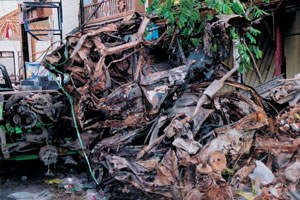
In Australia, AM data collection is under the control of police missing persons units. Researchers gather as much information as possible about people believed to be victims. Information gathered includes dental records, history of broken bones or surgery, tattoos and scars — anything that might assist in making a positive identification.
Destroyed vehicles
Russell Lain (Staff Dentist at the United Dental Hospital of Sydney; Visiting Staff at the Department of Forensic Medicine; and Lieutenant, Royal Australian Naval Reserve) and William Saunderson (Staff Specialist at the United Dental Hospital), both with many years experience in DVI, worked with missing persons police in Parramatta, gathering AM records for dispatch to Canberra and thence to Denpasar. Colleagues in other states similarly divided their duties between retrieval and analysis of the AM data and fieldwork in Indonesia.
Russell: The biggest impact for me was having to deal directly with bereaved relatives. We had to quiz them about possible sources of medical and dental records, charts, x-rays and the like. Some of these people had just come back from Bali. They had been trying to ID their kids from Polaroids of the bodies. They were still shellshocked. And we’re on the phone asking them for details about dentists they might have gone to. Nothing can really train you for this, but we just had to get on with it. The families seemed to take some comfort from seeing that professionals were engaged in a proper ID process. The whole week in the Police Centre doing the AM stuff really brought home to me just how vital that side of things is.
Within 10 days of the bombing, all the available AM records for NSW had been gathered. Russell Lain then flew to Bali.
Collecting postmortem data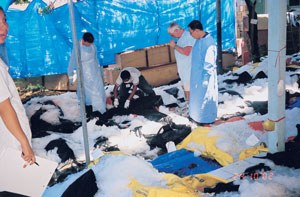
Gathering PM data involves careful examination of each body, recording details of personal property, scars, tattoos, distinctive anatomical features, and dental features. The slowest part of the process is gathering the dental data, and an important lesson for future mass disasters is that, to avoid delays, more trained forensic dentists than pathologists are needed.
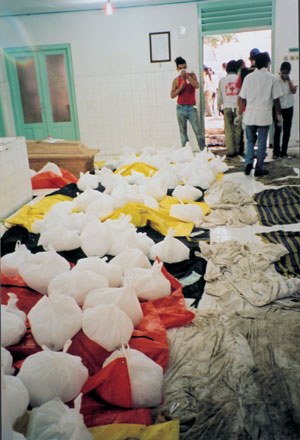
Two features that stood out during the PM phase were the scale of the disaster, and the state of the morgue (Box, "Impressions of the morgue at Sanglah Hospital").
Bodybags packed in ice
Reconciliation
Once the AM and PM data have been gathered, the records are compared to identify victims. The proposed identifications are reviewed by a Reconciliation Board. The process has an inbuilt scepticism that obliges the presenter to illustrate the concordances between AM and PM records. The greatest difficulties arise in cases of poor AM records or incomplete recovery of remains. For the Bali bombing, the Reconciliation Board consisted of Indonesia’s DVI commander (Brigadier General Saparwoko), a forensic odontologist (Professor Chris Griffiths), and an Indonesian forensic pathologist. When all members of the board were satisfied that an identification was correct, a death certificate was issued and the body released to the family.
Chris: I sat on the Reconciliation Board for 21 consecutive days, overseeing the dental evidence. After three weeks of playing devil’s advocate, I was physically and mentally drained.
More than 60 per cent of victims of all nationalities were identified using dental evidence within three weeks of the incident. Most of the later identifications were based on DNA evidence.
This formal standard identification process is extremely important. Of the 18 victims who had been “identified” visually by families, nine were shown to have been identified incorrectly. If bodies had been released on the basis of these family identifications, we might have had nine families, or even more, whose child or parent was never identified and never able to be returned.
Politics and public relations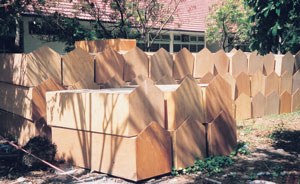
A mass disaster naturally attracts political and frenzied media interest. A particular concern in the Bali bombing involved early release of the bodies. We needed to explain the importance of the formal DVI process to the families, the media, and the politicians.
Coffins
From comments he made in a radio interview, it was obvious that Australia’s Prime Minister, John Howard, was being pressured to have the Indonesian authorities release bodies on the basis of visual identification only. Chris Griffiths phoned the Prime Minister and explained the problems of visual identification and expressed to him our confidence in the Indonesian authorities. Chris also explained that, from our initial assessment, DNA techniques would be needed to identify some of the bodies, and the Indonesian government could not pay the costs of DNA matching. The Prime Minister immediately agreed that the Australian government would cover the costs of DNA matching, irrespective of the victims’ nationality.
More difficult was explaining the process to the relatives of the victims. We try to involve ourselves only with the postmortem area of identification. Dealing with the families makes working in the mortuary too personal, as we pick up the grief of the families.
Chris: In this case, as I walked in the door to address the relatives, Graham Ashton [Australian Federal Police Commander] said, “There is someone in the group that knows you.” Then I saw an old friend from university. I know his children well. He said simply, “James is one of those killed.” I found it very difficult to talk to the relatives after this, but I had to explain to them that releasing bodies that had been tentatively identified by families could jeopardise the identification process for everyone. From my international experience, at least one in three visual identifications turns out to be incorrect.
On Thursday, 17 October, Prime Minister Howard, Deputy Prime Minister John Anderson and Opposition Leader Simon Crean, and their advisers, flew into Bali for a memorial service. We showed them the photographs that had been taken by the volunteers helping the families carry out their visual identifications. Later that evening, we attended a briefing with the Prime Minister’s party, where problems were raised and decisions were instantly made. No months of committee paralysis — just “It sounds like a good idea. Do it!”
One issue raised at that meeting was the need to involve the state coroners. The state Coroners Acts require that a local state coroner make findings as to identity and cause of death of any body connected with the state when the death is caused by violence. If Australian bodies were released without a coroner’s approval, it might lead to difficulties with probate or insurance. By coincidence, the annual coroners’ conference was being held in Sydney, so John Hilton left Bali that night to address the conference. The coroners decided to send two representatives to Bali the next day.
International team relations
Other countries also sent DVI teams to Bali, and there was some difficulty aligning their efforts with the agreed Indonesian–Australian process. One of the problems was that teams from some countries wanted to work independently of the Indonesian–Australian team and only examine non-Caucasian victims. We had to point out that non-Caucasian people were not necessarily nationals from South East Asian countries. The victim lists showed many victims were ethnically of Chinese origin but citizens of Canada, the United Kingdom, the United States or Australia. We also showed them the severe burning of many of the victims, which made it impossible to determine racial groupings. Eventually the various teams agreed to integrate with the international team and to examine each body in order.
Time out
Fatigue is a major issue in this type of work. Team members will always tend to push themselves to the point where they can no longer function efficiently. This is when mistakes are made. It is up to wiser heads to enforce full meal breaks and rest days, even if the team wants to continue working. Occupational health and safety concerns are real, and need genuine commitment by managers. In DVI we talk about the different groups of victims. The first group is the dead and injured; the second group is the families, especially those of the dead. There is a third group of potential victims — the rescuers and DVI workers.
Russell: I remember we had just had a visit from the cast of the Indonesian version of Neighbours. They came through the morgue like royalty, checking the scene and shaking hands. I walked away from that and was in the reconciliation room, working with a colleague to match up AM and PM records for ID. We did about five with no joy. Then we realised we were trying to match AM records with other AM records! We had the next day off.
On the morning of our day off, the security adviser warned us that we were being targeted. We were not to go out alone; we were not to answer questions from locals about what we were doing or how long we would be there; we had to sign in and sign out; we had to carry an encrypted radio, water, money and passports if we were going any distance; we had to be back by dark, keep alert and “have a good day”. Apart from an uneasy feeling when any van like the one used in the bombing pulled alongside our minibus, we did have a good day. Terraced rice paddies, charming villages, nearly deserted streets decked out with colourful misspelled signs expressing sympathy for the victims of the atrocity; those classic Asian city smells of garlic, sewage, coriander and diesel, and everywhere those delightful smiles, even in the face of a devastated economy. It was a good day.
During the weeks in Bali, we stayed at a luxurious hotel, which seemed a bit incongruous in the face of the suffering just outside the gate and the serious job we were doing. However, it is important for the team to have a safe haven to relax in, maybe discuss issues that had come up during the work day, and allow the battered psyche to recharge.
Russell: The hotel had a pool the size of the Mediterranean. There’s a few photos — which I hope never surface — of this pale-skinned crew around the island bar with huge drinks with pink parasols. “The gathering of the Beluga whales”, I called it. The AFP paid for two drinks a day. Happy Hour — that’s half price, four drinks — was between five and six every day. Most days we got back to the hotel between five and six!
Conclusion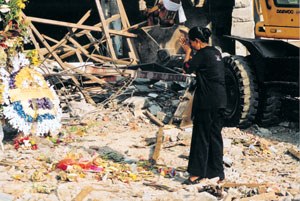
We all learned a lot from that Bali experience, such as the importance of the AM data collection, and a better understanding of DVI fieldwork. It also became clear to us that this was as much an attack on the Balinese as on the tourists.
Family member of Indonesian victims praying at the bomb site
The relationships cemented during the time in Bali represent the prime benefit of the process. The value of long term associations and friendships with colleagues in Indonesia was borne out during the Bali incident. For us to go to another nation and be accepted into their organisational structure in an emergency situation was vital for the early identification of the victims and their early return to their families.
Hospitals, universities and many healthcare professionals in Australia tend to form their associations with European and North American organisations, because of history and the scientific knowledge base. However, if we are going to be good neighbours, we should try to develop stronger ties with our immediate neighbours, on both a personal and a professional level.
We may feel that the information flow is somewhat one-sided. But this is what being a good neighbour is all about. We are reminded of Aesop’s fable of the mouse and the lion. Sometime in the future good deeds will be remembered. This is especially so in South East Asia.
Impressions of the morgue at Sanglah Hospital
Russell: I had been involved in the Thredbo landslip, the Glenbrook train crash and several light plane disasters. But when we walked past the cordon of soldiers and their M-16s at Sanglah Hospital and saw 200-plus body bags and a pile of body part bags laid out on a tiled walkway, the numbers hit home.
I was nervous about the smell. I’ve been doing this work for 10 years but I just hate the smell. I knew it would be too hot to wear a proper charcoal face mask, so I was wondering if I’d be sick in front of the Indonesians.
Anyway, it was amazing. The morgue just did not smell. Well, not too bad anyway. The volunteers kept up a constant bucket brigade of ice and packed it around the bodies. They were fabulous and always had great smiles. The problem was that the ice melted. When the volunteers lifted a body bag onto a trolley for a PM or x-rays, brown juice just poured out of the bags. They mopped it away, but five minutes later there would be another brown pool on the floor. One of the Japanese odontologists saw me staring at this on my first day in the morgue. “Human soup”, he beamed at me cheerfully. That was one of the worst bits. That and walking in among scores of body bags — they were packed pretty close — looking for a certain number bag for a re-examination, and trying very hard not to tread on the bodies.
Reducing Nitrous Oxide Emissions Across the Melbourne Biomedical Precinct
Ross Robertson, Andrew Downey, Daryl Williams, Bjorn Makein, Ben Dunne, Tugce Ozturk, Ying Gu, Rebecca McIntyre
Multimorbidity Clusters Among People Aged 65 Years and Over in Australia: A Nationwide Cross-Sectional Data Linkage Study
Weisi Chen, Christine Y. Lu, Sarah N. Hilmer, Alice A. Gibson, Edwin C. K. Tan
When ‘Liver Enzymes’ Are Not Hepatic: Late-Onset Pompe Disease
Shauna Madigan, Georgina England, Wayne Rankin
West Nile virus Kunjin subtype in rural NSW
Emily Gibson, Megan Whitley, Peter Murray, Linda Hueston, Jane Bennett, Raguharan Kathiresu, David N Durrheim
The impact of the Breast Screen NSW transition from film to digital mammography, 2002–2016: a linked population health data analysis
Rachel Farber, Nehmat Houssami, Katy J L Bell