




Volume 179 - Issue 11
Medical practice on the front line: separating the myths from the reality
Author: Tracy L Smart
Med J Aust 2003; 179 (11): 587-590. || doi: 10.5694/j.1326-5377.2003.tb05707.x
Published online: 1 December 2003
Published online: 1 December 2003
Medical officers (MOs) employed by the Armed Services are, in a sense, both doctors and warriors. The concept of being both a doctor and a warrior is quite difficult for many to grasp. How can someone who has elected to dedicate his or her life to healing be part of an organisation that may enter into armed conflict? How can healing and harming go hand in hand?
Nevertheless, they do. The idea of sending MOs to war is not new, as where there is war there is medical work to be done. Indeed, thousands of MOs around the world have shown a willingness to put their own needs aside to achieve a greater good. Furthermore, many advances in medical science that can benefit us all (eg, transfusion, ambulance services, and various surgical techniques) were first realised or developed in the theatre of war.
MOs have played a vital role in Australia’s military history. Many have been decorated for their bravery and medical work on the front line, including Major General Sir Neville Howse in the Boer War (awarded Australia’s first Victoria Cross), Sir Edward “Weary” Dunlop in WWII, and, more recently, Captain Carol Vaughan-Evans, who was awarded the Medal of Gallantry for working during a massacre at Kibeho refugee camp in Rwanda in 1995. Others have made the ultimate sacrifice, dying in the service of their country — among them a personal hero of mine, Lieutenant (Dr) George Merz (who was killed by hostile Arabs in 1915, after working tirelessly as both an MO and pilot on many dangerous missions in WWI) and Major Susan Felsche (who died in a plane crash in 1993 while serving with the United Nations [UN] mission in the Western Sahara).
Australian MOs continue to serve in wars, peacekeeping missions and humanitarian activities. Since the September 11 attacks on the United States, they have been busier than ever, providing medical support to the Coalition Against Terrorism in Afghanistan, triage and aeromedical evacuation in the wake of the Bali bombings, and a range of medical services in the war against Iraq and the subsequent mission to rebuild Iraq’s infrastructure. Most recently, our medical personnel were again at the front line, supporting the Regional Assistance Mission in the Solomon Islands and providing humanitarian assistance to the people of that country.
These awards and activities are high-profile aspects of what it is to be a military MO in the Australian Defence Force (ADF). But there is much more to the job. Here, I will try to separate the myths from the reality of what it really means to be a military MO in Australia. I will outline what is expected of us at home and on operations, draw a picture of the many and varied experiences of service life and try to explain how the inevitable problems that can develop are dealt with.
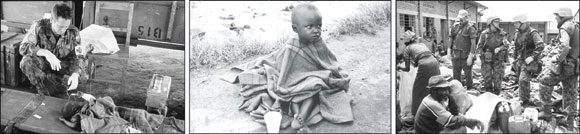
Jack of all trades and more
When not on deployment, the military MOs of all three services (Navy, Army and Air Force) are really “jacks of all trades”. They help to ensure that fit, healthy service personnel stay that way. They combine the roles of general practitioners, sports medicine physicians, preventive health experts and occupational health consultants. Some military MOs are involved in specialist areas of medicine, either at unit level or as part of the ADF’s three health centres of excellence — the Navy’s Submarine and Underwater Medicine Unit in Sydney, the Australian Army Malaria Institute in Brisbane, and the Air Force’s Institute of Aviation Medicine in Adelaide.
On deployment, an MO’s main purpose becomes keeping people fit enough to carry out their job in extreme circumstances. This includes ensuring that only physically fit people are deployed, preventing casualties, and returning people who become ill to health as soon as possible. It involves providing operational health support, which reflects three concepts:
first response (first aid);
the “golden hour” for resuscitation (ie, the first hour after injury, when treatment has the greatest chance of increasing survival);
the “three hour rule” (for initial wound surgery).
Basically, if casualties can survive the first hour, then they have a high probability of surviving three hours,1 which should be time enough for them to be swiftly evacuated (by air, land and/or sea) to a place where they can receive an appropriate, adequate level of care.
Based on these three principles, health support is organised into five levels of care: Level 1 (basic first aid), Level 2 (resuscitation), Level 3 (initial wound surgery), and Levels 4 and 5 (more specialised healthcare and rehabilitation provided in major civilian teaching hospitals).
Surgical and intensive-care capabilities at our Level 3 facilities in the field are provided by members of the ADF’s Specialist Reserve, who include general surgeons, orthopaedic surgeons, anaesthetists and intensivists. Such reservists are often the unsung heroes who form the basis of our deployed health support.
To supply effective support to the ADF personnel involved in the high-risk occupation of waging war, military MOs must be skilled not only in disaster and trauma medicine but also in the detection and management of injury caused by nuclear, biological or chemical attacks. Furthermore, in most of the missions we have been on in recent years, providing humanitarian aid has been an additional priority.
However, more than anything, military medicine plays a major role in upholding the morale of a fighting force — an efficient, well equipped healthcare system allows members of the military to do their job in the knowledge that, if injured, they will be well looked after.
Unique stressors
All doctors know that medicine can be a stressful occupation, and military medicine is no exception. However, there are a number of stressors that are unique to this environment.
Personal and professional stressors
First and foremost, there are the oddities of military life — the discipline, the bureaucracy, the uniforms and the haircuts. This lifestyle doesn’t suit everybody. Then, the ADF is a kind of “extended family”. The people who are your patients are also the friends you eat lunch with, see at the gym or socialise with at the mess. On deployments this is even more of a problem, as you are also living with your patients, who may have difficulty relating to you other than in your role as doctor. Relationships with family and friends can be challenging, as military MOs are often away from home — on courses or deployments or filling in for other people on courses and deployments. Being on very short standby for deployment can make it difficult to plan your life. The unexpected does happen, bringing with it a range of experiences (Box 1).
1: All in a day’s work
One Monday morning in April 1999, I was called at 08:30 and told to be at the airport by 13:00 to be deployed to an island off the coast of Malaysia to investigate a fatal F-111 accident.
It was an incredibly demanding mission, as the accident location was in a small swamp on a small island in the South China Sea. Aircraft wreckage poses many dangers, and the weather was hot and humid. It took several days to retrieve the bodies of the air crew, and both of the casualties were known to me personally. This took a toll on my physical and mental wellbeing, and I was physically ill before heading out to the site of a morning.
But, as the only medical person on the team, I had many responsibilities in addition to my role as an accident investigator. As well as retrieving the bodies, I provided healthcare (including mental health support) to other team members and kept up their spirits. I counselled one of the spouses who visited the site. I liaised with Malaysian military personnel and police to bring the bodies ashore. When we reached Kuala Lumpur, I assisted with the autopsies. When we arrived back in Australia, I had to interview both spouses. Lastly, I organised psychological follow-up for my non-medical team members and, importantly, for myself.
Gaining appropriate clinical expertise and opportunities for professional development can also be a challenge. Young medicos may be directed towards senior administrative roles early in their career; the opportunity to specialise may be limited to a few specific fields. All military MOs must have a broad range of skills, but often may have only limited scope to practise and maintain these skills when not deployed.
On operations, many of the stresses of military medicine are magnified and others enter into the equation. Living conditions can be less than ideal. Working with unfamiliar cultures that may have different standards of care can lead to difficulties and conflict. Long working hours are often unavoidable, and fatigue takes its toll.
War protocol
The Laws of Armed Conflict are the protocols that govern our actions in war. They protect our role as medical personnel and non-combatants, allowing us to do what we do best — tend to the sick and wounded. They also define our use of weapons.
Many may shudder at pictures of personnel wearing the Red Cross while carrying guns; however, the Laws of Armed Conflict allow medical personnel to carry weapons to protect themselves and their patients. The Laws also state that it is our responsibility, as MOs, to treat everyone — friend or foe — using medical criteria to prioritise care. This can create a moral dilemma for the treating doctor, who may know that this same person, now a patient, committed almost inhuman atrocities in front of our personnel, as happened in Rwanda.
Extreme operation: Rwanda
Much of what I have described I have personally experienced in the most extreme operation I have been involved with to date — Australia’s commitment to the UN Assistance Mission in Rwanda.2
After the genocide in that country in April 1994, Australia sent two contingents of 300 peacekeepers to Rwanda from August 1994 to August 1995. As our mission was primarily a medical one — to provide health support to the UN troops and civilian personnel — nearly a third of our deployed personnel were health personnel. Although we were organised primarily to treat fit and healthy UN troops, we were now in a country whose health infrastructure had been largely destroyed in the genocide. Most Rwandan health professionals had either been killed or had fled the country. Consequently about 75% of our efforts were directed towards what was to have been, supposedly, our secondary mission — the humanitarian role.
Despite the best efforts of our military training, there was no way we could have been adequately prepared for the influx and range of illnesses and injuries among civilians that we had to try to treat, as best we could, with limited and inconstant resources.
We were able to save the life of a young mother who had lost both her legs as well as a pregnancy after stepping on a mine. However, we couldn’t help a young boy from a remote village who presented with a massive tumour of the head and neck. He was one of many we could neither diagnose nor treat. All we could do was advise his mother to take him home to die.
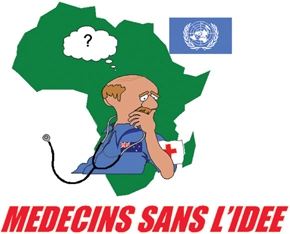
So overwhelmed were we by the broad range of exotic medical and surgical conditions that confronted us that the MOs in my contingent had T-shirts made up with a logo that expressed our predicament precisely: instead of “Médecins Sans Frontières”, like our NGO colleagues, we sometimes felt like “Médecins Sans L’Idée” (Doctors Without A Clue) (Box 2).
2: T-shirt logo aptly expressing how overwhelmed we felt during the Rwandan crisis
Rather than “Doctors Without Borders” (like our NGO colleagues) we sometimes felt like “Doctors Without A Clue”.
It was difficult to come to terms with the harsh reality of trying to manage with extremely limited resources. Further, since our mission was primarily to support the UN troops, we had to give them priority. It felt, at times, as if we had to “play God”, a circumstance that did not sit comfortably with many of us.
The fact that many of our Rwandan patients were HIV positive or had full-blown AIDS added to the danger and stress of our working environment.
However, all of these challenges would have to be considered less distressing than my contingent’s involvement with the April 1995 massacre at the Kibeho refugee camp and dealing with the aftermath. The members of our medical team who witnessed the massacre felt the terrible frustration of seeing death and destruction before their eyes and of not being allowed to lift a finger to stop it. Even without the massacre, conditions at the camp were extreme — when food was in short supply there, I witnessed people picking corn out of human faeces that was scattered throughout the camp so they that could re-cook it. We worked among the filth and squalor, while talk of a sniper in the camp after the massacre persisted. Practising medicine while wearing a flak jacket, helmet and two pairs of gloves can be quite an experience, let me tell you.
Thankfully, our experience at Kibeho ended on a positive note, as we were eventually able to convince the refugees to leave the camp and return home.
Support strategies
You will not be surprised to learn that these stresses do take their toll (Box 3). Military MOs are not immune to developing mental and physical problems, but we are perhaps more likely to ignore such problems in ourselves. On a deployment, we are the primary caregivers, preventive health experts, and often the mental health providers as well, to all personnel, including the health team (and, of course, oneself!). The MO may be the sole doctor at a site of deployment. I know of some who have become so preoccupied with their patients, their duty to fellow team members and their wider responsibilities that they have developed serious medical conditions that they themselves have not always recognised.
3: Post-traumatic stress disorder
All personnel involved in war activities are at risk of developing post-traumatic stress disorder. A study of returned personnel from my contingent in Rwanda (of whom 27% were medical personnel) revealed that most subjects had been exposed to potentially traumatic events, such as seeing or handling dead bodies and fearing exposure to a contagious disease, toxic agent or injury.3 Six years after deployment, one in five were still experiencing significant levels of distress, with symptoms of post-traumatic stress disorder and a measurable impact on general psychological wellbeing. However, compared with infantry (who made up 30% of the sample), medical personnel reported lower levels of post-traumatic stress related symptoms and alcohol use — despite no differences between the groups in their levels of traumatic exposure, either in Rwanda or over their lifetimes.
A questionnaire completed by 16 nursing officers who served in a different contingent in Rwanda revealed that it was not only traumatic experiences that were perceived as negative aspects of deployment. Other things, such as changing guidelines, having to accept some decisions made by non-medical personnel, the difficulty of interactions with other care organisations, and the lack of usual routine, were also a source of frustration.4 However, on a positive note, nearly all participants in the study felt the experience had changed their lives for the better.
However, support strategies exist for helping us through the tough times — our overall military training, medical screening before departure, training with personnel from other services before deployment to develop group cohesiveness, and a willingness to support each other. A strong sense of purpose and an appreciation of the big picture — “we’re here to help, and we’re doing a good job” — and, at times, good old-fashioned MASH-style black humour, are also useful.
Developments
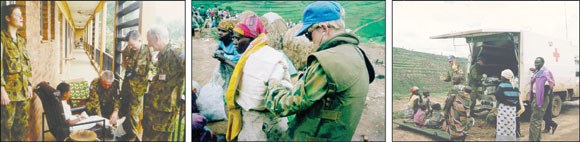
The military has learnt from its experience, and our high operational tempo of recent years has been accompanied by more attention to support for military members on deployment. There is now more focus on adequate preparation for deployment, with appropriate training and medical and psychological screening. Research on personnel returning from deployments has led to improved mental health strategies before, during and after deployment. Personnel are being educated about the support available and encouraged to seek support.
To better prepare medical personnel for the clinical aspects of deployment, military health units have entered into strategic alliances with major civilian hospitals in order to expose our personnel to a broader range of clinical experience. A new MO career structure has been developed that incorporates the need for ongoing professional development and specialisation in relevant areas of medicine. We are also exploring the use of technologies such as telemedicine in providing more and enhanced clinical support to deployed MOs.
Reflections
Military medicine is a challenging occupation. Although it can be stressful, especially when on deployment, it can certainly provide a fulfilling career for a doctor within an organisation that appears, at first glance, to espouse the philosophical opposite to the profession of medicine. Speaking for myself, my military career has also given me some incredible life experiences, such as flying at the speed of sound in fighter aircraft and travelling on duty to countries all over the world. In addition, I have learnt a lot about myself — my limitations and weaknesses as well as my strengths.
Although the very nature of the job means that the health needs of MOs are often considered secondary to the needs of others, this situation can be, and is being, addressed. I look forward to seeing further development in support strategies for military MOs and to my next opportunity to practise medicine on the front line!
References
- Bellamy RF. The causes of death in conventional land warfare: implications for combat casualty care research. Mil Med 1984; 149: 55-62. i1082959
- Ramsey W, Bridgford LR, Lusby RJ, Pearn JH. The Australian Medical Support Force in Rwanda. Med J Aust 1995; 163: 646-651. i1082961
- Hodson SE. Key predictors of post-trauma symptomatology in military peacekeeping veterans [thesis]. Sydney: Macquarie University, 2002. i1082963
- Wright B. Survived the mission — still coming to terms with the consequences. Presented at the Australian Military Medical Association Conference; Oct 1999; Adelaide, SA. i1082965
Prisoner of war pathology in Changi, 1942–1945
Kate Ariotti, Elizabeth Roberts‐Pedersen
Should medical eponyms continue to be used in everyday practice?
Leya Nedumannil, Diana Lewis
100 years on: the first use of insulin in Australia
Sophie Templer
Reflections on the life and career of Professor Dame Valerie Beral AC DBE FRS FRCOG FMedSci (1943–2022)
Karen Canfell, Bette Liu, Emily Banks
The Honourable Dr Donald James Grimes AO
Michael Kirby, Patti Warn
From wipeout to drill out: a history of exostosis management and Australian surfing
Alon Taylor, Hannah North, Narinder P Singh, Paul A Fagan