




Volume 179 - Issue 11
Dejection: a novel cause of rejection?
Author: Anthony J Penington
Med J Aust 2003; 179 (11): 572. || doi: 10.5694/j.1326-5377.2003.tb05700.x
Published online: 1 December 2003
Published online: 1 December 2003
A 51-year-old man presented with non-healing ulceration at the site of a tattoo on his right leg. Some 8 years previously, in celebration of the victory of his favourite team, Carlton, in the Australian Football League Grand Final, he and a friend both had a picture of a stylised Carlton footballer tattooed on one of their legs. The tattooist did not have a navy blue pigment (the team’s colour) to tint the jersey, but improvised with another source of pigment.
The patient reported that about a year before presentation he had developed painful ulceration at the site of the tattoo. The ulcer had progressed and showed no signs of healing. Curiously, the ulceration had occurred at precisely the time when the club was undergoing a dramatic deterioration in its fortunes, as scandal and poor on-field performances saw the team fall to the bottom of the AFL ladder. My patient was just one of the many Carlton supporters who had become very disillusioned.
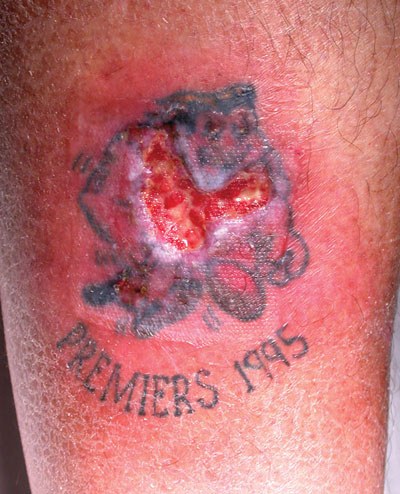
At presentation, there was a granulating ulcer within the tattoo that corresponded to the navy blue areas of the figure (Box), with mild surrounding inflammation. After discussion with the patient, it was decided to excise the ulcer and perform a skin graft. The graft suffered partial loss, associated with a Pseudomonas infection. The wound eventually healed, although at 1 year follow-up the patient complained of occasional itch and mild swelling in the graft.
Histology of the excised ulcer showed a dense lymphocytic infiltrate and multinucleated giant cells forming occasional granulomas, consistent with an immune response to the pigment. Black and yellow pigment was seen throughout the dermis and in histiocytes.
Discussion
A delayed immune response to tattoo pigments is well described. Generally this takes the form of a granulomatous reaction with swelling and irritation in the affected areas. Ulceration is unusual.
A delayed immune response can occur after laser treatment, or may be the first manifestation of systemic sarcoidosis. It can also begin spontaneously several years after having a tattoo, as happened in this case. But an immune rejection of a club’s colours by a disillusioned football supporter has not previously been contemplated as a cause of tattoo rejection.
References
- Bleehen SS. Disorders of skin colour. In: Champion RH, Burton JL, Burns DA, Breathnach SM, editors. Rook/Wilkinson/Ebling textbook of dermatology. Oxford: Blackwell Science, 1998.
- Ashinoff R, Levine VJ, Soter NA. Allergic reactions to tattoo pigment after laser treatment. Dermatol Surg 1995; 21: 285-290.
- Kennedy C. Sarcoidosis presenting in tattoos. Clin Exp Dermatol 1976; 1: 395-399.
Prisoner of war pathology in Changi, 1942–1945
Kate Ariotti, Elizabeth Roberts‐Pedersen
Should medical eponyms continue to be used in everyday practice?
Leya Nedumannil, Diana Lewis
100 years on: the first use of insulin in Australia
Sophie Templer
Reflections on the life and career of Professor Dame Valerie Beral AC DBE FRS FRCOG FMedSci (1943–2022)
Karen Canfell, Bette Liu, Emily Banks
The Honourable Dr Donald James Grimes AO
Michael Kirby, Patti Warn
From wipeout to drill out: a history of exostosis management and Australian surfing
Alon Taylor, Hannah North, Narinder P Singh, Paul A Fagan