




Volume 179 - Issue 11
The costs of weight control: what do young women pay?
Authors: Kylie Ball, Sari Andajani-Sutjahjo and David Crawford
Med J Aust 2003; 179 (11): 586. || doi: 10.5694/j.1326-5377.2003.tb05705.x
Published online: 1 December 2003
Published online: 1 December 2003
To the Editor: We read with interest Abraham’s recent article on bodyweight issues facing young women.1 Abraham notes that this group is at risk of extreme weight-loss behaviours, including excessive exercise and use of slimming tablets. However, recent data from our studies show young women’s high risk of substantial weight gain and obesity.2,3
Obesity entails significant health and social costs for young women. There are also likely to be substantial financial costs associated with efforts to manage weight. The low levels of satisfaction with their body and poor self-esteem among young women, in conjunction with their heightened risk of weight gain, make them prime targets for the slimming industry. A number of studies have estimated what obesity costs and its impact on the healthcare system,4,5 and some have estimated expenditure by consumers on weight-loss products.6 However, none have quantified the financial costs of weight management for women.
We recently (January 2002) investigated weight-management strategies among a randomly selected, nationwide sample of 445 women aged 18–32 years. Our study was approved by the Deakin University Human Research Ethics Committee. Women reported their use of and expenditure on nine methods “to lose weight, prevent weight gain, or control body shape” in the previous 12 months.
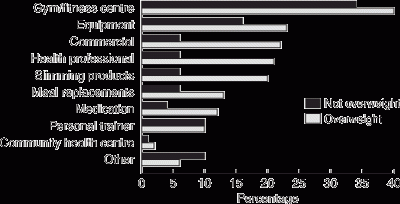
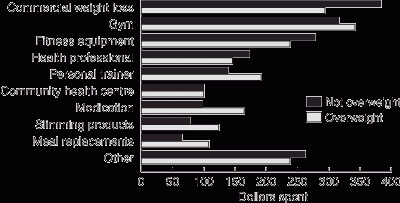
Thirty-one per cent of the sample were overweight or obese (body mass index > 25 kg/m2), and 61% had used at least one weight-loss method in the past 12 months. Box 1 shows the proportions using each method. Some women spent more than $3000, with a mean expenditure of $441 per woman among those using a weight-loss method, or $251 per woman across all women in the sample (Box 2). Extrapolating these results to the population of women in this age group, this equates to almost $414 million per annum spent by young women to manage their weight. Thus, young women are investing considerable amounts of money to manage their weight.
Increasing rates of obesity suggest that young women’s efforts to manage their weight are ineffective. Promotion by general practitioners of safe, low-cost weight-management strategies — including low-fat healthy eating, as well as walking for exercise — could help alleviate the substantial health and economic costs of obesity and weight control.
Acknowledgements
Kylie Ball is supported by a Public Health Postdoctoral Research Fellowship from the National Health and Medical Research Council (NHMRC), ID 136925. David Crawford is supported by a Career Development Award funded by the NHMRC and National Heart Foundation of Australia.
References
- Abrahams SF. Dieting, body weight, body image and self-esteem in young women: doctors’ dilemmas. Med J Aust 2003; 178: 607-611.
- Ball K, Brown W, Crawford D. Who does not gain weight? Prevalence and predictors of weight maintenance in young women. Int J Obesity 2002; 26: 1570-1578. i1082895
- Ball K, Crawford D, Ireland P, Hodge A. Patterns and demographic predictors of five-year weight change in a multi-ethnic cohort of men and women in Australia. Public Health Nutr 2003; 6: 269-280. i1082897
- National Health and Medical Research Council. Acting on Australia’s weight: a strategic plan for the prevention of overweight and obesity. Canberra: AGPS, 1997. Available at: www.health.gov.au/nhmrc/publications/pdf/n21.pdf (accessed Oct 2003).
- Reidpath D, Crawford D, Tilgner L, Gibbons C. Relationship between body mass index and the use of healthcare services in Australia. Obesity Res 2002; 10: 526-531. i1082902
- The Consumer Advocacy and Financial Counselling Association of Australia. Tipping the scales. Melbourne: CAFCA, 1992. i1082904
Beyond Fibrosis Stratification: Integrating Behavioural, Metabolic and Policy-Level Interventions in Metabolic Dysfunction-Associated Steatotic Liver Disease
Yousef Hakimi, Prarthana Thiagarajan, Michael Braude
Fatty Liver Disease in Australia: A Narrative Review on the Epidemiology, Natural History, Prognostication and Management in People With Metabolic Dysfunction
Karl Vaz, Daniel Clayton-Chubb, William W. Kemp, Stuart K. Roberts, Ammar Majeed
When ‘Liver Enzymes’ Are Not Hepatic: Late-Onset Pompe Disease
Shauna Madigan, Georgina England, Wayne Rankin
Fatty Liver Disease in Australia: A Narrative Review on the Epidemiology, Natural History, Prognostication and Management in People With Metabolic Dysfunction
Karl Vaz, Daniel Clayton-Chubb, William W. Kemp, Stuart K. Roberts, Ammar Majeed
The early implementation phase of the Omega‐3 Test‐and‐Treat Program for reducing the risk of preterm birth, South Australia, 2021–22: an implementation evaluation study
Karen P Best, Celine Northcott, Lucy A Simmonds, Philippa Middleton, Lisa N Yelland, Vanessa Moffa, Khoa Lam, Penelope Coates, Cornelia Späth, Carol WK Siu, Karen Glover, Rhiannon Smith, Robert Gibson, Maria Makrides
Cause‐specific mortality among Queensland people with cirrhosis, by cirrhosis aetiology and decompensation status, 2007–22: a retrospective cohort study
Vikas Bhasker, Jessica R Fong, Paul J Clark, Gunter F Hartel, Richard Skoien, James O’Beirne, Elizabeth E Powell, Patricia C Valery