




Volume 178 - Issue 8
An Anzac's childhood: John Simpson Kirkpatrick (1892–1915)
Authors: John H Pearn and David Gardner-Medwin
Med J Aust 2003; 178 (8): 400-402. || doi: 10.5694/j.1326-5377.2003.tb05259.x
Published online: 21 April 2003
Published online: 21 April 2003
John Simpson Kirkpatrick, generally known as "Simpson", is one of the most famous Anzacs of the Gallipoli campaign.1-3 From the Gallipoli landing on 25 April 1915 until his death 25 days later, Simpson and his donkey retrieved perhaps 300 casualties from the battlefield. He did this work independently, sometimes in disregard of orders, and frequently with a disregard for danger that kept the onlooking soldiers in the trenches enthralled as they watched him moving calmly to rescue wounded soldiers while under direct fire from the enemy. He is often thought of as the quintessential larrikin Anzac, although he was born in England and only spent four years in Australia before enlisting in the Australian Army Medical Corps in 1914.
Simpson's childhood was spent in Tyneside, United Kingdom, where his selfless military service is also well remembered.
Early childhood
John Kirkpatrick was born on 6 July 1892 in a newly-built4 three-roomed terrace tenement at 10 South Eldon Street, in the Tyne Dock area of South Shields.5 He was the son of Robert Kirkpatrick (c.1845–1909), a merchant navy seaman, and a domestic housekeeper, Sarah Simpson (c.1856–1933).6 Kirkpatrick had three surviving elder sisters and one elder brother. Census records reveal that their mother was sometimes away, and help with the care of the children in 1892 was provided by a domestic live-in servant, Ettie Crozier, aged 15 years.5 His younger sister Annie (born 10 November 1884) wrote to John and sent him cigarettes when he was working as a ship's stoker on Australian coastal traders and subsequently at Gallipoli.2
It is known from Kirkpatrick's surviving letters that food was not plentiful in his family, and the neighbourhood was poor.2 There was no social welfare. In one letter dated 31 May 1911 he replies to his mother's plan to become a shopkeeper in Edward Street, South Shields:
A short life of Simpson
1892 |
John Simpson Kirkpatrick ("Simpson") born at 10 Eldon Street, Tyne Dock, South Shields, UK. |
||||||||||
1898–1905 |
Attended school. |
||||||||||
1906–1908 |
Worked as a milk-float boy. |
||||||||||
1908–1909 |
Volunteer coastal-defence gunner with the 4th Durham (Howitzer) Battery of the 4th Northumbrian County of Durham Brigade, Royal Field Artillery. |
||||||||||
1909–1914 |
Went to sea. Worked as a stoker and engine room greaser, mostly on Australian coastal shipping vessels. |
||||||||||
1914 |
Enlisted in the Australian Army Medical Corps on 24 August, 20 days after Britain declared war on Germany. |
||||||||||
1915 |
Landed at Anzac Cove on 25 April as a stretcher bearer with 3 Australian Field Ambulance. An undisciplined soldier, Simpson worked alone with donkeys he found in camp. He retrieved 200–300 men before he was killed by machinegun fire on 19 May — his 25th day of active service. |
||||||||||
I am very much afraid that you are in the wrong district ... for the people round there would rob "Old Nick" himself if he gave "Tick" [ie, credit] and I suppose you will know that there is no hope unless you give the good old "Tick". I wasn't four years going round with the milk without finding out a little of there [sic] weak points.
Robert Kirkpatrick and his family moved frequently, perhaps because of difficulties paying the rent. John Kirkpatrick lived in at least five homes, and possibly six or more, during the first 16 years of his life. His father was frequently at sea, until he was injured in 1904, thereafter remaining at home as an invalid until his death in 1909 when John was 17 years old.2
The boy's entire childhood was spent in working-class streets. Census data from 1891 lists the occupation of the Kirkpatricks' neighbours as sailor, boilersmith, dressmaker, blacksmith, steam-engine fitter and iron moulder;5 in 1901 the neighbours were a shipyard plater, shipyard labourer, boilersmith and draper's assistant.7 The local society in which he grew up was dominated by shipbuilding and its industries, the Tyne River and the sea beyond.
Schooling
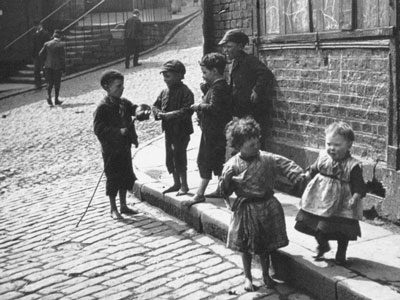
Kirkpatrick began school, aged six years, at the Barnes Road Infants' School in 1898. Surviving archives record that the school was crowded; in 1904 (four years after Kirkpatrick had left) it was closed for some weeks because 40 of the 509 pupils had measles, mumps, whooping cough or diphtheria. Kirkpatrick's initial two years of education included a curriculum of "reading, recitation, writing, arithmetic, singing and drawing".8
In July 1900, about the time of his eighth birthday, Kirkpatrick transferred to the South Shields Barnes Road Boys' School, where he remained a pupil until 19 June 1903.9 His attendance was exemplary, and he was absent for only one day throughout the school year of 1900–1901.10 He learned to read and write fluently at school. He was a prolific letter-writer in his later teenage years, although his punctuation and spelling were somewhat deficient. In 1903 he transferred to Mortimer Road Council School, where he completed his formal education in 1905 immediately before his thirteenth birthday.
Tyneside children, contemporaries of John Simpson Kirkpatrick, playing in the street at the beginning of the 20th century. Epidemics of diphtheria, measles, scarlet fever, whooping cough and mumps swept through the Tyneside estates. (Photograph courtesy of the Ward Philipson Group, Gateshead, UK.)
After Kirkpatrick's death at Anzac Cove, two memorial bursaries were instituted at Mortimer Road School, but these were abandoned in the 1960s. A building at the school was also named the Kirkpatrick House Block. The building was subsequently demolished in 1990.
Of Kirkpatrick's surviving correspondence, nothing remains that refers to his childhood. Information from his sister Annie suggests that he had a typical Tyneside boyhood.2 The young Jack "played cricket using wickets chalked on a brick wall". He kept rabbits and "was an ordinary boy with little relish for scholarship but delighted in pranks and games and an occasional escapade". He played in the environs of the Gutt leading to Tyne Dock. The "Gutt" was an inlet with stone paving sloping down into the water to facilitate coal-loading. It was a scene of constant activity between people, animals, goods and the water of the Tyne. He attended weekly Sunday School at St Mary's Church (now demolished).
Teenage years
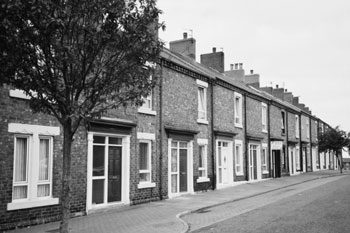
The terrace of John Williamson Street, Tyne Dock, South Shields, UK, built about 1889. Simpson lived briefly at number 360, far right.
Kirkpatrick left school before his 13th birthday, and was employed as a milk-float boy. His sister Annie wrote later: 2
Jack had a dappled grey pony [which pulled the milk float] with which he became close friends. His devotion to "Andrew", to whom he talked like a human, was known to everybody on the milk rounds.
Like many local teenage boys, Kirkpatrick volunteered to train at weekends as a coastal defence gunner in the Royal Field Artillery.11 He served in the Howitzer Battery at South Shields and trained nearby at Trow Lea and attended annual Volunteer Camp at Fleetwood in Lancashire, with his volunteer colleagues. It is probable that this was the first time, at 17 years of age, that he had journeyed beyond Tyneside.
After his father's death in 1909, Kirkpatrick left Tyneside to go to sea. His second ship, the SS Yeddo, brought him to Australia via South America. He then worked for four years, mostly at sea, as a stoker and as an engine-room greaser on Australian coastal shipping vessels. He tried cane cutting and horse-mounted stock work in north Queensland, each for a period of about one week, but found the overwhelming heat and humidity intolerable.
Life-saving influences?
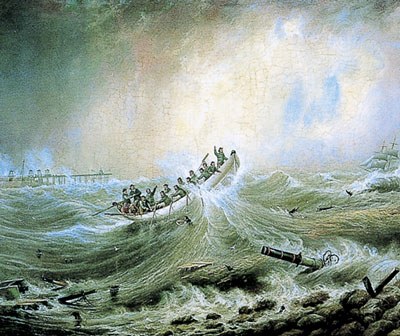
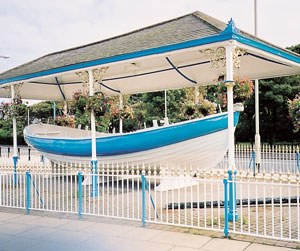 | John Kirkpatrick spent the first 16 years of his life in South Shields, Tyneside. It was here that the life boat was invented by Greathead and Wouldhave in 1789. A second lifeboat, the "Tyne", managed by the Tyne Lifeboat Institution, was said to have saved 1028 lives between 1833 and 1894. It was then placed on public display in Ocean Road, South Shields, close to where Simpson grew up. The painting, "A wreck off the South Pier, South Shields, 1861", by John Scott, shows the "Tyne" in action. The painting has been on display in the South Shields Museum and Art Gallery since the late 19th century. (Reproduced courtesy of Tyne and Wear Museums.) |
 | |
During this time Kirkpatrick was leading a knockabout life. He jumped ship when it suited him, and, as his letters to his mother showed,2 enjoyed a drunken brawl with his fellows.
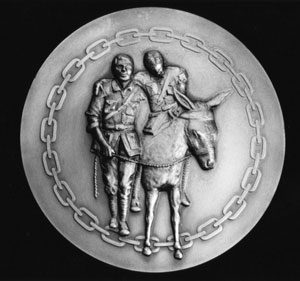
This medallion showing Simpson and his donkey is presented annually by the Returned and Services League to an outstanding Australian "for exceptional service to the Australian community demonstrating compassion, endurance and dedication". (Photograph courtesy of Dr Robert Pearce.)
At the outbreak of war in 1914, he was one of the first to enlist (on 25 August 1914) at Perth, in 3 Australian Field Ambulance. His physical strength and fitness (of which he was very proud) were ideally suited to his Anzac duties as a stretcher-bearer in the Australian Army Medical Corps. On a number of occasions he rescued two wounded soldiers simultaneously.
His gregarious "Geordie" personality stamped him as a "character" among his fellow soldiers at Gallipoli. He has been described variously as "original, forthright, fearless, ingenious and generous hearted"; and as "witty, cracking jokes, happily lazy at times, careless of dress, a friendly chap and one who was a 'handful' to ... his Section Sergeant".2
Simpson's lasting fame arises from just 25 days of active service. What made him such a hero? The record we have cannot quite unfold the enigmatic "incalculable personal factor" which Lord Moran felt was "the essence of courage".12
"Simpson" on the web
Simpson and his donkey (John Simpson Kirkpatrick). Australian War Memorial. <http://www.awm.gov.au/encyclopedia/simpson.htm>
Simpson and his donkey. Convict Creations.Com — The hidden story of Australia's missing links. <http://www.convictcreations.com/history/simpson.htm>
John Simpson Kirkpatrick. July 6, 1892 – May 19, 1915. Anzac House Youth Hostel. <http://www.anzachouse.com/simpson.shtml>
Stretcher bearers. Digger history: an unofficial history of the Australian Armed Services. <http://www.diggerhistory.info/pages-nurses/stretcher.htm>
Acknowledgements
We thank particularly Dr Christopher Gardner-Thorpe, Consultant Neurologist of Exeter, for much encouragement; Mr John Moreels of the Ward Philipson Group, Gateshead; and Mr James Fell and the Tyne and Wear Museums for gracious permission to publish photographs.
References
- Benson I. The man with the donkey. John Simpson Kirkpatrick. The good samaritan of Gallipoli. London: Hodder and Stoughton, 1965. CACFICEG
- Cochrane P. Simpson and the donkey. The making of a legend. Melbourne: Melbourne University Press, 1992. CHDFBGCA
- Curran T. Across the bar. The story of "Simpson", the man with the donkey. Australia and Tyneside's great military hero. Brisbane: OGMIOS Publications, 1994. CACHHEFF
- Ward's Directory of Newcastle-upon-Tyne, Gateshead, North and South Shields. Newcastle-upon-Tyne: R. Ward and Sons. Annual Ward's Directories from 1888. [South Eldon Street, John Kirkpatrick's birthplace address, was not listed in Ward's Directory for South Shields until 1891–92, page 248]. CHDCBFJG
- Public Record Office, UK. The 1891 Census for England and Wales. Administrative County of South Shields, Civil Parish of Westhoe, Municipal Ward of Tyne Dock. Census entry for 10 South Eldon Street. [Robert Kirkpatrick, head of family. Lists children and Ettie Crozier, a 15-year-old domestic servant]. CHDEGFDG
- Register of Births, Marriages and Deaths, UK. Birth certificate of John Kirkpatrick, born 6 July 1892 at 10 South Eldon Street, Westhoe. Son of Robert Kirkpatrick and Sarah Simpson, domestic housekeeper. Certificate No. 223, birth registered 3 August 1892. Registration District of South Shields, sub-District of Westhoe, Counties of South Shields and Durham, Copied Cert No. CM 365464 dated 16 Sept 2002. CHDIBBBF
- Public Record Office, UK. The 1901 Census for England and Wales. Administrative County of Durham, Civil Parish of South Shields, Ward Borough of Dean's Ward. Entry for South Frederick Street [Nos 127-153]. PRO Reference No. RG 13/4736. CHDGHIIG
- Memorandum Book of the South Shields School Board. Ref T116/1-8 [487-557]. CHDICGBJ
- Tyne and Wear. The County Archives. Admission Register. South Shields Barnes Road Board School [School No. 1416]. Boys Department Ref T116/1-8 (Unpag). School record of John Kirkpatrick. CHDGBBFB
- Tyne and Wear. The County Archives. South Shields School Board: Barnes Boys' School. Memorandum Book [Ref T116/I-unpag]. CHDGJJFB
- Hogg OFG. The history of the 3rd Durham Volunteer Artillery, now part of the 274th (Northumbrian) Field Regiment, R.A. (T.A.) 1860–1960. South Shields [Durham], The Northern Press Limited, undated [c.1970]: 41. CHDBBCFC
- Moran C. The anatomy of courage. London: Constable, 1945. BEGEIECG
Prisoner of war pathology in Changi, 1942–1945
Kate Ariotti, Elizabeth Roberts‐Pedersen
Should medical eponyms continue to be used in everyday practice?
Leya Nedumannil, Diana Lewis
100 years on: the first use of insulin in Australia
Sophie Templer
Reflections on the life and career of Professor Dame Valerie Beral AC DBE FRS FRCOG FMedSci (1943–2022)
Karen Canfell, Bette Liu, Emily Banks
The Honourable Dr Donald James Grimes AO
Michael Kirby, Patti Warn
From wipeout to drill out: a history of exostosis management and Australian surfing
Alon Taylor, Hannah North, Narinder P Singh, Paul A Fagan