




Volume 178 - Issue 5
Management of acute adult sexual assault
Authors: Jacqueline K Mein,*†, Cheryn M Palmer,†, Meon Carol Shand,*, David J Templeton,*†, Vanita Parek,*, Margaret Mobbs,*†, Kay Haig,*, Sarah E Huffam and Lyndall Young
Med J Aust 2003; 178 (5): 226-230. || doi: 10.5694/j.1326-5377.2003.tb05168.x
Published online: 3 March 2003
Published online: 3 March 2003
1: Clinical definition of adult male or female sexual assault6
a) Penetration of the vulva (beyond the labia majora) and/or anus by a penis or any other object, and/or penetration of the mouth by a penis
and
b) Without the consent of the person
A United States meta-analysis estimates that 13% of women and 3% of men worldwide may be raped at some time during their lives.1 New Zealand and Australian data suggest similar findings,2 ranging from 4.6%3 to 11.3%4 in different populations. Although reliable incidence figures are impossible to estimate given considerable barriers to reporting,4 sexual assault presents, often unexpectedly, to healthcare providers working in diverse areas.5 Practitioners may feel sexual assault is challenging to manage, but it is simple when broken into components — emotional, physical and medicolegal. Here we provide a framework for non-forensic medical management of recent adult sexual assault. Box 1 gives a clinical definition, broader than that used in Australian law.
Disclosure
Victims are reluctant to disclose that they have been sexually assaulted for many reasons, including fear of police, not being believed or retribution, as well as guilt and a desire to forget the event. However, they may present for medical care because of concerns about pregnancy, sexually transmissible infections (STIs), or injury.7 They may present with post-traumatic stress, depressive symptoms,8 alcohol or substance misuse or self-harm.9 To encourage disclosure it is necessary to ask directly about the possibility of sexual assault.
2: Asking about sexual assault
Have you ever been forced to have sex you didn't want?
Have you ever had sex forced on you?
Have you ever been sexually assaulted?
Most victims of reported sexual assault are women; men are also assaulted, but are less likely to disclose.10 Although people of all ages and cultures are vulnerable, prisoners,11 adolescents, injecting drug users, the elderly, those who experienced sexual assault as children, and people with mental or physical disabilities are at particular risk.12 A recent survey of sexual health clinics in Australia and New Zealand found that staff were more likely to ask about sexual assault if their workplace encouraged it.13 It also identified patient distress, time constraints and lack of expertise in managing a positive response as barriers to asking. However, nearly all of the patients in the survey reported they did not mind being asked about sexual assault.13 A recent Sydney survey linked sexual assault firmly with the words "forced" and "non-consent" (L Dayan, Director, Sexual Health Services, Royal North Shore Hospital, Sydney, personal communication). Suggestions on how to ask about sexual assault are shown in Box 2.
Management
When responding to a disclosure of sexual assault, it is important to:
ensure privacy, safety and adequate time for the victim;
acknowledge their courage in speaking out;
accept the victim's story in a non-judgemental way — it is the role of police to investigate story veracity;
explain that reactions to rape, such as shock, arousal, anxiety and fear are normal, emphasising that the victim is not to blame; and
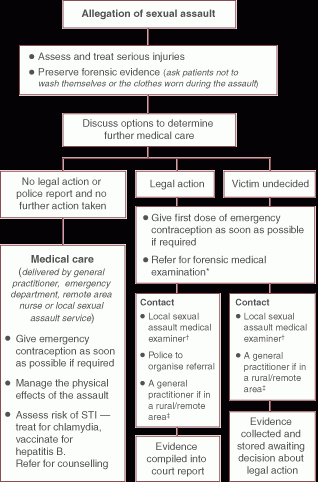
understand that the aim of management is to return control to the victim by enabling them to make choices about reporting, counselling and medical therapy (see Box 3).
Further action is defined by whether the victim decides to make a formal complaint. Most jurisdictions require that the first person who hears an allegation of sexual assault must give evidence if the complaint comes to trial, so document the exact words used, even if the victim is referred for forensic management.
History
Assess any injuries and ongoing safety and support. Emergency accommodation may be needed if the victim's home is not safe. A brief history of when and where the assault took place, who put what where, and contraception or condom use will inform immediate treatment.
Ask whether the victim wants to report the assault to the police. Early referral to a sexual assault service assists forensic testing. A forensic assessment involves careful documentation of injuries and testing for the presence of foreign DNA; the findings are compiled in a court medicolegal report. Even if the victim is unsure about wanting to report the assault, if there is any possibility of a complaint being made forensic assessment will preserve evidence in case a formal report is made to police at a later date. Ask about the possibility of drug-assisted rape, which is becoming increasingly common worldwide.14 Early forensic referral may facilitate detection of commonly used drugs (eg, flunitrazepam, ketamine) in the victim's blood or urine. Testing must be performed in a police laboratory to preserve continuity of court evidence. If the patient keeps a spot urine specimen, this can be handed directly to the police.
Examination
A thorough general and genital examination should be performed and any injuries documented. Although most sexual assault services use speculums for examining women, this depends on both the woman (comfort versus her need to know all is normal) and the practitioner (expertise and requirement for testing), and should be discussed with the woman before examination. Similarly, the use of a proctoscope may be required. Victims are often afraid that there has been genital damage which will make it obvious to others that they have been raped. Feedback that everything looks normal, as is usually the case,15 can be very reassuring.
Investigation
Tests for forensic purposes, sexually transmissible infections and pregnancy are performed according to need. If a woman is being transferred to a sexual assault service for forensic assessment after unprotected vaginal rape, the initial dose of the emergency contraceptive pill should be given first.
Forensics: If the victim is willing for the police to be involved, he or she should be referred immediately to an expert sexual assault service for forensic assessment (a list is provided at the end of this article). If a victim is undecided about reporting the assault, forensic specimens may be stored while a formal complaint is considered.
DNA evidence left on or in the body of a victim, particularly in moist areas, degrades quickly over 2–10 days.16,17 Therefore, forensic assessments need to be made as soon as possible, but within 10 days of an assault. If proceeding to a forensic assessment, advise victims not to shower (or to clean their teeth or rinse their mouths if the assault was oral), and ensure all clothes worn during the assault remain unwashed. As DNA evidence degrades quickly if moist, ask the victim to store underclothes worn during the assault in paper (not plastic) bags.
In remote areas, timely expert forensic assessment is difficult. Most sexual assault services provide 24-hour phone assistance by doctors experienced in forensic medicine to discuss assessment. After discussion, some practitioners in remote areas may decide to perform forensic assessments, but this can be a difficult decision, as the practitioner may later be required to give evidence in court. Sexual assault services in Western Australia suggest a compromise solution that entails wiping the victim's vulval and/or anal area with sterile gauze, air-drying it, putting it into a labelled sterile container and handing it directly to local police for forensic testing before the victim's transfer for forensic assessment.18
Pregnancy risk: Depending on the victim's contraceptive and menstrual history, testing urine or serum might be useful to direct therapy and follow-up.
Sexually transmissible infections: Baseline testing of sexual assault victims for sexually transmissible infections (STIs) in Australia varies with local clinical practice. In some Queensland sexual assault services serum is held in case STI testing is requested or required later (M Mobbs, Visiting Medical Officer, Brisbane Sexual Assault Service, personal communication). Baseline testing usually occurs in sexual assault services and communities with known high STI risk. As victims of sexual assault have higher rates of STIs compared with the general population,19 opportunistic screening is worthwhile if follow-up can be organised. Under Australian law, a rape victim's sexual history is inadmissible in court and this includes any history of STI. Thus, possible court prejudice is not a reason to withhold testing. See Box 4 for screening test recommendations. Note PAP smears are not generally included.
The HIV/STI status of the perpetrator is usually unknown. In the absence of any better indicators, ethnicity or culture is sometimes used as a proxy for HIV/STI risk. The purpose of this judgement of risk is not to vilify minority groups, but to assess the victim's risk of infection on the basis of often very limited information about the perpetrator. Treatment recommendations alter for victims assaulted by anyone thought to be from a high risk group (see Box 5).
The National HIV/AIDS Strategy states that community prevalence of HIV and STIs is higher in certain groups, including African and South-East Asian people, homosexual and bisexual men, and injecting drug users.21 Rates of STI are high in northern Australia, including in Indigenous communities,22,23 while HIV prevalence is higher in inner Sydney than elsewhere in Australia.24 As the risk of sexual transmission of hepatitis C virus (HCV) is low,25 tests are usually only performed in high risk situations (eg, assault with bleeding injuries, or assault by known HCV-positive assailant).
Although the risk of HIV from one act of unprotected intercourse is very small, if the assault was penetrative unprotected vaginal or anal rape victims should be advised to use condoms until follow-up testing at three months. Most victims are concerned about HIV risk, even though they may not admit it.7 The vast majority will not require HIV prophylaxis, as the risk of transmission from an HIV-positive assailant is very small (see Box 6) and the chance that the perpetrator was HIV positive far smaller.
Specific therapy
Counselling
Sexual assault is a frightening and sometimes life-threatening violent experience and counselling should be offered to all. Even if victims do not wish to attend counselling, it is important that they know where they can go for help, as memories can surface later (eg, at first childbirth) and can impair future functioning.27 Family and partners may also require counselling, or referral may be needed for domestic violence issues. Safety after rape can require moving house if the rapist lives with the victim, or knows where he or she lives. Emergency housing may be needed, as may other forms of immediate support, such as certificates for absence from work and support letters for school.
Emergency contraception
If the assault was unprotected vaginal rape, or if there was any possibility that this occurred (eg, victim lost consciousness, was intoxicated or is unsure), then emergency contraception can be offered up to three, and possibly up to five, days after the assault.28 The progesterone-only regimen is recommended over the Yuzpe method because it is more effective with fewer side effects. Give the first dose as soon as possible, as efficacy halves with each 12-hour interval after the assault.29
Progesterone-only method: 750 μg levonorgestrel orally; repeat 12 hours later. A 750 μg tablet (Postinor-2, Schering Pty Ltd) is now available in Australia, or 25 30-μg tablets (Microval, Wyeth Australia Pty Ltd; or Microlut, Schering Pty Ltd) can be used for each dose.
Yuzpe method: 100 μg oestradiol orally; repeat 12 hours later. Use two 50-μg oestrogen-containing combined oral contraceptive tablets for each dose. This regimen should only be used if the progesterone-only method is not tolerated or unavailable.
Sexually transmitted infections
For unprotected vaginal or anal assault, victims are offered single-dose prophylaxis with azithromycin for chlamydia (see Box 5). They are also offered prophylactic hepatitis B vaccine if likely to be non-immune.
Treatment varies according to community prevalence of STIs and perceived individual risk. In tropical areas of Australia, or if the perpetrator is considered at high risk of being infected, prophylaxis may also be added for gonorrhoea, occasionally syphilis, and passive vaccination with hepatitis B immune globulin30 may also be given if the recipient is not immune.
For victims at high risk of having acquired HIV infection (eg, rape by someone from an area of high HIV prevalence), urgent phone consultation with an infectious diseases or sexual health physician about post-exposure prophylaxis for HIV is recommended (see Box 7).
Review
It is notoriously difficult to get victims back for follow-up.31 The review program suggested (Box 4) is a guide only and should be tailored to suit individual patients. At the very least, an appointment is recommended at two weeks for discussing test results, further testing (eg, pregnancy), review of coping, and assessment of healing. Follow-up serological tests should be performed at three months for HIV, hepatitis B virus and syphilis. Reviews are a good opportunity to assess the need for counselling if this has not already been organised.
Before the victim leaves, give written instructions for taking medications and review appointments, and include counselling service phone numbers. Victims may be intoxicated, shocked or tired and are unlikely to remember verbal medical instructions.
Summary
Management of acute adult sexual assault may appear daunting, but when viewed in its component parts is not difficult. Review by a sympathetic, non-judgemental practitioner can play an important role in helping victims regain control of their lives.
Australia-wide resources
Websites
Comprehensive listing of services available in Australia and New Zealand, both updated 2002.
Australia: http://www.acshp.org.au/sexual_health/assault.htm New Zealand: http://www.dsac.org.nz
Major State and Territory resource phone numbers for sexual assault services
The following lists only one major service for each Australian State or Territory, as these services will refer to other local services as appropriate.
Australian Capital Territory Forensic and Medical Sexual Assault Care
Canberra Rape Crisis Centre
|
Queensland Brisbane Sexual Assault Service
Government Medical Office
(forensic regional services)
|
Tasmania Sexual Assault Support Service
Hobart
|
|||||||||
New South Wales Eastern and Central Sexual Assault Service, Sydney
|
South Australia http://www.wch.sa.gov.au/yarrow/index.html |
Western Australia Sexual Assault Resource Centre, Perth
|
|||||||||
Northern Territory Darwin Sexual Assault Referral Centre
|
Victoria Victorian Institute of Forensic Medicine
|
||||||||||
* Denotes 24-hour contact number. |
|||||||||||
3: Guide for sexual assault care
* Usually includes medical care; check with local service. † See resources section at end of article. ‡ Some rural/remote general practitioners perform forensic assessments after consultation with a sexual assault service. STI = sexually transmitted infection.
4: Baseline screening recommendations for sexually transmitted infections
Infection |
Test |
Site (take according to history) |
|||||||||
HIV |
HIV antibody |
Blood |
|||||||||
Hepatitis B |
Hepatitis B surface antigen (HbsAg), core antibody (anti-HBc) and surface antibody (anti-HBs) |
Blood |
|||||||||
Syphilis |
Rapid plasma reagin (RPR) + treponema pallidum haemagglutination assay (TPHA) |
Blood |
|||||||||
Chlamydia |
Polymerase chain reaction |
Endocervical swab, first-void urine or high vaginal swab |
|||||||||
Gonorrhoea |
Polymerase chain reaction or microscopy, culture and sensitivity (M,C&S) |
Endocervical swab, first-void urine, rectal swab* or throat swab* |
|||||||||
Trichomonas |
Microscopy, culture and sensitivity (M,C&S) |
High vaginal swab |
|||||||||
* M,C&S only, as PCR is not validated for these sites. |
|
||||||||||
5: Suggested prophylaxis for sexually transmitted infections (treatment for high risk is bolded)
STI |
Treatment |
||||||||||
Chlamydia |
Azithromycin (1 g orally) |
||||||||||
Hepatitis B |
Hepatitis B vaccine (1 mL intramuscularly) |
||||||||||
For high risk add: Hepatitis B immune globulin (400 IU intramuscularly*) |
|||||||||||
Gonorrhoea (only if high risk) |
Ceftriaxone (250 mg intramuscularly) OR, where local gonococcal sensitivities permit: 20 Ciprofloxacin (500 mg orally) OR Amoxycillin (3 g orally) and probenecid (1 g orally) |
||||||||||
Syphilis (if high risk) |
Benzathine penicillin (1.8 g intramuscularly) |
||||||||||
HIV (if high risk) |
Phone local infectious diseases or sexual health physician urgently |
||||||||||
Other STIs |
Consult local infectious diseases or sexual health physician |
||||||||||
* Available from Commonwealth Serum Laboratories. STI = Sexually transmitted infection. |
|||||||||||
6: HIV transmission risk per unprotected act of intercourse with an HIV-positive person*26
Type of intercourse |
Risk per 1000 acts |
||||||||||
Receptive anal |
1–30 in 1000 |
||||||||||
Receptive vaginal |
1–2 in 1000 |
||||||||||
Insertive vaginal |
1 in 1000 |
||||||||||
Insertive anal |
3–9 in 1000 |
||||||||||
* For comparison, the risk of acquiring HIV infection from using a shared HIV-contaminated needle is 667 in 1000, and from a needlestick injury to healthcare workers is about 4–8 in 1000. |
|||||||||||
7: Suggested review program
2–3 days: Assess injury healing if relevant
2 weeks: Test results, pregnancy testing, healing, coping
Follow-up testing: Chlamydia, gonorrhoea, trichomonas (depending on local practice and whether previous treatment was given)
3 months: Follow-up serological tests for HIV, hepatitis B virus, syphilis
6 months: Follow-up serological test for hepatitis C virus if a test was performed initially
Competing interests
None identified. The article did not receive funding from any source.
References
- Spitzberg BH. An analysis of empirical estimates of sexual aggression victimisation and perpetration. Violence Vict 1999; 14: 241-260. i1082353
- Shew R, Hurst C. Should the question "have you been sexually abused?" be asked routinely when taking a sexual health history? Venereol 1993; 6: 21-23. i1082355
- Taylor A, Dal Grande E, Wollacott T, et al. South Australian health goals and targets violence and abuse health priority area. May 1998. Adelaide: South Australian Health Commission, Department of Human Services, 1998: 42-43. Available at: http: //www.dhs.sa.gov.au/pehs/CPSE/violence.pdf (accessed Oct 2002).
- Australian Bureau of Statistics. Crime and justice special article – violence against women. 1-6. Australian Bureau of Statistics Year Book Australia. Canberra: ABS, 1998. (ABS Catalogue No 1301.0). i1082360
- Walch AG, Broadhead WE. Prevalence of lifetime sexual victimisation among female patients. J Fam Pract 1992; 35: 511-516. i1082362
- Social science and common usage definitions. Section 1.1.2. In: Shand C, editor. The medical management of sexual abuse. Auckland: Doctors for Sexual Abuse Care, 2002: 1-2. i1082364
- Hill P, Mein J. A survey of sexual assault needs amongst urban Darwin Aboriginal women. Sexual assault workshop. Abstract no. 91, Ven Troppo Sexual Health Conference, Darwin. Sydney: Dart Associates, 2000: 22. i1082366
- Rothbaum BO, Foa EB, Riggs DS, et al. A prospective examination of post-traumatic stress disorder in rape victims. J Trauma Stress 1992; 5: 455-475. i1082368
- Long term psychological and physicial health effects of sexual assault. Section 1.5.2.7. In: Shand C, editor. The medical management of sexual abuse. Auckland: Doctors for Sexual Abuse Care, 2002: 15-16. i1082370
- Hillman R, O'Mara N, Taylor-Robinson D, et al. Medical and social aspects of sexual assault of males: a survey of 100 victims. Br J Gen Pract 1990; 40: 502-504. i1082372
- Heilpern DM. Fear or favour: sexual assault of young prisoners. Sydney: Southern Cross University Press, 1998. i1082374
- Factors that contribute to sexual victimisation. Section 1.4. In: Shand C, editor. The medical management of sexual abuse. Auckland: Doctors for Sexual Abuse Care, 2002: 5-9. i1082376
- Hurst C, MacDonald J, Say J. Routine questioning about non-consenting sex; a survey of practice in Australasian sexual health clinics. STI 2002. In press. i1082378
- Smith KM. Drugs used in acquaintance rape. J Am Pharm Assoc 1999; 39: 519-525. i1082380
- Bowyer L, Dalton ME. Female victims of rape and their genital injuries. Br J Obstet Gynaecol 1997; 104: 617-620. i1082382
- Silverman E. Persistence of spermatozoa in the lower genital tracts of women. JAMA 1978; 240: 1875-1877. i1082384
- Hampton H. Care of the woman who has been raped. N Engl J Med 1995; 332: 234-237. i1082386
- Lincoln C. Sexual Assault Resource Centre remote protocol. Sexual Assault Resource Centre manual. Perth: Sexual Assault Resource Centre, 1999. 12-13. i1082388
- Reynolds MW, Peipert JF, Collins B. Epidemiologic issues of STDs in victims of sexual assault. Obstet Gynaecol Surv 2000; 1: 51-57. i1082390
- Tapsall J. Gonococcal surveillance in Australia. Commun Dis Intell 2001; 25: 304. i1082393
- National HIV/AIDS Strategy 1999–2000 to 2003–2004: changes and challenges. Canberra: Commonwealth Department of Health and Ageing, 2000: 15-17. i1082395
- NT AIDS/STD Program surveillance update. Vol. 2 Jul-Sep 2001 and Oct-Dec 2001: 2-3. Available at: http: //www.nt.gov.au/health/cdc/aids_std/report/surveillance_report_jul_dec_01.pdf (accessed Oct 2002).
- Pugh R. Sexually transmitted infections. Queensland Health 1997–2001 Notifiable Diseases Report. Brisbane: Queensland Health, 2002: 64-77. i1082400
- Menzies R. Epireview: HIV infection and AIDS in NSW, 1981–1999. NSW Public Health Bull 2000; 11: 217-219. i1082402
- Lemon S, Alter M. Viral hepatitis. Holmes KK, Sparling PF, Mardh P-A, et al, editors. In: Sexually transmitted diseases. 3rd ed. New York: McGraw-Hill, 1999: 377-378. i1082404
- Centers for Disease Control and Prevention. Management of possible sexual, injecting drug use, or other non-occupational exposure to HIV, including considerations related to antiretroviral therapy (No. RR-17). MMWR Morb Mortal Wkly Rep 1998; 47: 2-5. i1082406
- Ross M, Channon-Little L, Rosser B. Sexual health concerns. 2nd ed. Sydney: MacLennan and Petty, 2000: 24, 98. i1082408
- Rodrigues I, Grou F, Joly J. Effectiveness of emergency contraceptive pills between 72 and 120 hours after unprotected intercourse. Am J Obstet Gynecol 2001; 184: 531-537. i1082410
- Task Force on Postovulatory Methods of Fertility Regulation. Randomised controlled trial of levonorgestrel versus the Yuzpe regimen of combined oral contraceptives for emergency contraception. Lancet 1998; 352: 428-433. i1082412
- Palmovic D. Prevention of hepatitis B infection in health care workers after accidental exposure. J Infection 1987; 15: 221-224. i1082414
- Holmes M, Resnick HS, Frampton D. Follow up of sexual assault victims. Am J Obstet Gynecol 1998; 179: 336-342. i1082416
Costs of Delivering the Hep B PAST Model of Care in Remote Australia: A Retrospective Pre–Post Study
Hoa Nguyen, Anh Le Tuan Nguyen, Paula Binks, Melita McKinnon, Emily Vintour-Cesar, Karen Wills, Nicola Stephens, Benjamin Cowie, Joshua S. Davis, Yuejen Zhao, Peter Nihill, Julie A. Campbell, Andrew J. Palmer, Jane Davies, Barbara de Graaff
Buruli Ulcer Acquired From Ringtail Possum Rescue
Daniel P. O'Brien, Naomi Clarke, Sara Bonnici, Mohammad A. Hussain
Q Fever Visceral Abscesses After Contact With Native Australian Marsupials
Samantha J. Laws, Enzo Binotto, James Stewart, Jennifer Ho, Trent Yarwood, Josh Hanson, Simon Smith
Hospital-Admitted Injection-Related Infections Among Incarcerated People Who Inject Drugs in Australia: A Retrospective Cohort Study
Andrew Palmer, Matthew Carter, Jeremy Yeo, Cecilia Shim, Jason Connor, Jeremy Hayllar, Gerald Holtmann, Naomi Moy, Elliott G. Playford, Naomi Runnegar, Paul J. Clark
The Live Attenuated Influenza Vaccine in Australia: An Additional Tool for Influenza Prevention
Cyra Patel, Alexis Pillsbury, Tran Nguyen, Xia Wang, Helen E. Quinn, Clayton K. Chiu, Allen C. Cheng, Katie L. Flanagan, Zhicheng Wang
Reflex Testing for Hepatitis D Infection: A Unique Opportunity to Reduce Hepatitis D-Related Chronic Liver Disease Deaths in Australia
Jessica Howell, Lauren Andersson, Miriam T. Levy, James O'Beirne, Leon Adams, Katharine Irvine, Avik Majumdar, Golo Ahlenstiel, Kathy Jackson, Krispin Hajkowicz, Joseph Doyle, Jane Davies, Sarah Cherian, Wayne Dimech, Alexander J. Thompson