




Volume 178 - Issue 2
Opportunistic GP-based bowel cancer screening
Authors: Susan J Harnett, SK Cyril Wong and Gavin W Lackey
Med J Aust 2003; 178 (2): 92-93. || doi: 10.5694/j.1326-5377.2003.tb05077.x
Published online: 20 January 2003
Published online: 20 January 2003
To the Editor: Colorectal cancer is, after skin cancer, the most common cancer in Australia, with 11 245 new cases diagnosed in 1997, and over 4600 deaths.1 In clinical trials, screening programs using faecal occult blood testing (FOBT) have been shown to reduce mortality. The Commonwealth Department of Health and Ageing estimates that implementation of effective FOBT screening programs would save around 400 lives per year.1 However, such screening programs have not been widely implemented because of perceived difficulties with patient acceptance, funding, and the complexity of support structures.
General practitioners are in the front line of healthcare, and well placed to institute FOBT screening. Thus, we established an opportunistic screening program whereby patients over the age of 50 years attending surgery are asked by reception staff to complete a short questionnaire while in the waiting room. This questionnaire, developed locally to quickly establish whether a patient has symptoms or a family history of bowel cancer, is given to the GP by the patient during the consultation. If the questionnaire indicates colorectal symptoms, appropriate clinical assessment is undertaken. If a family history of colorectal cancer is elicited, the GP further defines the patient's risk by using the established National Health and Medical Research Council guidelines.2 If there are neither symptoms nor a family history, the patient is offered annual FOBT screening.
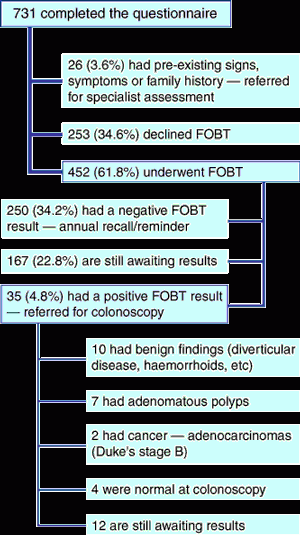
From 17 June to 30 September 2002, 731 patients under the care of 29 GPs completed the questionnaire. Our findings are summarised in the Box.
GP-based opportunistic screening can reach significant numbers of people. Moreover, unlike other strategies (eg, distribution of test kits by pharmacies), review by GPs of patients' questionnaires ensures that cases unsuitable for FOBT screening (such as those with previously undeclared symptoms or family history) are appropriately assessed.
References
- National Health Priority Areas report on cancer control 1997. Canberra: Commonwealth Department of Health and Family Services, and Australian Institute of Health and Welfare, 1998.
- National Health and Medical Research Council. Guidelines for the prevention, early detection and management of Colorectal Cancer (CRC). Canberra: NHMRC, 1999. i1071164
Early-Onset Colorectal Cancer With Liver-Only Metastases: A Retrospective Cohort Study Integrating Prospectively Collected Real-World Clinical and Molecular Data From an Australian National Database (2009–2024) to Guide Treatment Planning
Savio G. Barreto, Christos S. Karapetis, Shahid Ullah, Matthew Burge, Susan Caird, Angus Campbell, Azim Jalali, Ross Jennens, Muhammad A. Khattak, Belinda Lee, Stephanie H. Lim, Shehara Mendis, Louise Nott, Timothy J. Price, Jeremy D. Shapiro, Jeanne Tie, Javier Torres, Colin Williams, Rachel Wong, Vanessa Wong, Peter Gibbs
Australian Pathways for Specialist Pain Management and Early Palliative Care for People With Pancreatic Cancer: Developed Using a Community Consensus Approach
Jennifer Philip, Melanie R. Lovell, Kylee Bellingham, Gail Garvey, Gregory B. Crawford, Nicole M. Rankin, Kara Burns, Isabel Young, Vivienne Milch, Dorothy Keefe, Katrina Anderson, James Lawson, Meinir Krishnasamy
Cause‐specific mortality among Queensland people with cirrhosis, by cirrhosis aetiology and decompensation status, 2007–22: a retrospective cohort study
Vikas Bhasker, Jessica R Fong, Paul J Clark, Gunter F Hartel, Richard Skoien, James O’Beirne, Elizabeth E Powell, Patricia C Valery
Clinical practice guidelines for hepatocellular carcinoma surveillance for people at high risk in Australia: summary of recommendations
Jacob George, Nicole L Allard, Stuart K Roberts, Leon A Adams, Jane Davies, Behzad Hajarizadeh, Jennifer H MacLachlan, Suzanne E Mahady, Rosalie Altus, Catherine Brown, David C Fry, Belinda Greenwood‐Smith, Natali Smud, Patricia C Valery, Nafisa Yussf, Kate Broun, Denise Campbell, Karen Canfell, Chelsea Carle Harrison, Victoria Freeman, Paul Grogan, Catherine Holliday, Suzanne Hughes, Anna Kelly, Cathelijne Kemenade, Claire Latumahina, Amanda McAtamney, Megan Varlow, Joachim Worthington, Susan Yuill, Eleonora Feletto
Assessment of metabolic dysfunction‐associated fatty liver disease in primary care: a consensus statement summary
Leon A Adams, William W Kemp, Kate R Muller, Elizabeth E Powell, Stuart K Roberts, Luis Calzadilla Bertot, Stephanie Best, Gary Deed, Jon D Emery, Samantha L Hocking, Graham R Jones, John S Lubel, Sinead Sheils, Stephen M Twigg, Gerald F Watts, Jacob George
Treatment outcomes for people with hepatitis C referred to tertiary care in Victoria, 2021–22: a retrospective observational study
Elly Layton, Nicole Matthews, Brendan Quinn, Nasra Higgins, Gabrielle Lindeman, Mielle Abbott, Jennifer MacLachlan, Elizabeth Birbilis, Margaret E Hellard, Joseph Doyle, Benjamin C Cowie, Mark Stoové