




Volume 178 - Issue 10
Amoebic appendicitis
Authors: Ibrahim M Zardawi, Joseph S Kattampallil and Jurgen W Rode
Med J Aust 2003; 178 (10): 523-524. || doi: 10.5694/j.1326-5377.2003.tb05335.x
Published online: 19 May 2003
Published online: 19 May 2003
To the Editor: We describe six cases of amoebic appendicitis, encountered during a 15-month period in the Pathology Department of the Royal Darwin Hospital. The patients were all Indigenous Australians and four of them came from remote communities. The average age was 24 years and five of the six were men. They all presented with abdominal pain, fever and right iliac fossa tenderness for up to 6 days. The clinical notes did not indicate the presence of pre-existing dysentery, and no faecal examination was undertaken. Recovery following appendicectomy was uneventful in all the cases. No further follow-up is available.
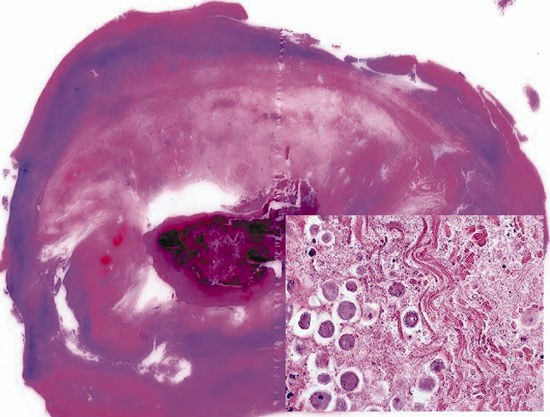
The aetiology was established histo-logically, as no distinctive clinical or macroscopic features were noted. The appendices showed extensive coagulative necrosis of the mucosa, submucosa and muscularis propria and invasion of the wall by variable numbers of amoebae with ingested blood cells. Inflammation secondary to perforation was evident in the serosa and the mesoappendix, but no significant inflammation was seen in the inner layers of the wall (Box).
Coagulative necrosis of the appendiceal wall was seen in all the cases. In fact, in some of the cases the diagnosis was suspected on seeing this distinctive coagulative necrosis and the amoebae were only found later. Thus, we believe this type of necrosis, which has not been previously emphasised in the literature, to be characteristic of the condition.
Amoebiasis is rare in a developed country like Australia. The infection is generally acquired during travel to endemic parts of the world. However, case reports of invasive amoebiasis in Indigenous Australians who have not travelled outside Australia have been previously reported.1,2 Immigration, immunosuppression and poor sanitation are other settings in which amoebiasis can be seen.3
The finding of six cases of amoebic appendicitis in Indigenous Australians in the Northern Territory in a 15-month period is significant, as appendicitis is a very rare manifestation of the disease. McCarthy et al, in a recent MJA article,2 highlight the potential public health significance of endemic invasive amoebiasis because of its high transmissibility in settings where hygiene may be suboptimal. We agree with this and believe in selective screening and appropriate treatment of at-risk contacts of the patients, as prolonged latency between infection and disease is well documented.3
References
- Weinmann AJ, Spelman DW, Spicer WJ. Indigenous invasive amoebiasis in Australia. Aust N Z J Surg 1992; 62: 235-237. CBBIEFDF
- McCarthy JS, Peacock D, Trown KP, et al. Endemic invasive amoebiasis in northern Australia. Med J Aust 2002; 177: 570. <eMJA full text>
- Petri WA, Singh U. Diagnosis and management of amoebiasis. Clin Infect Dis 1999; 29: 1117-1125. CBBEBFID
Costs of Delivering the Hep B PAST Model of Care in Remote Australia: A Retrospective Pre–Post Study
Hoa Nguyen, Anh Le Tuan Nguyen, Paula Binks, Melita McKinnon, Emily Vintour-Cesar, Karen Wills, Nicola Stephens, Benjamin Cowie, Joshua S. Davis, Yuejen Zhao, Peter Nihill, Julie A. Campbell, Andrew J. Palmer, Jane Davies, Barbara de Graaff
Buruli Ulcer Acquired From Ringtail Possum Rescue
Daniel P. O'Brien, Naomi Clarke, Sara Bonnici, Mohammad A. Hussain
Q Fever Visceral Abscesses After Contact With Native Australian Marsupials
Samantha J. Laws, Enzo Binotto, James Stewart, Jennifer Ho, Trent Yarwood, Josh Hanson, Simon Smith
Hospital-Admitted Injection-Related Infections Among Incarcerated People Who Inject Drugs in Australia: A Retrospective Cohort Study
Andrew Palmer, Matthew Carter, Jeremy Yeo, Cecilia Shim, Jason Connor, Jeremy Hayllar, Gerald Holtmann, Naomi Moy, Elliott G. Playford, Naomi Runnegar, Paul J. Clark
The Live Attenuated Influenza Vaccine in Australia: An Additional Tool for Influenza Prevention
Cyra Patel, Alexis Pillsbury, Tran Nguyen, Xia Wang, Helen E. Quinn, Clayton K. Chiu, Allen C. Cheng, Katie L. Flanagan, Zhicheng Wang
Reflex Testing for Hepatitis D Infection: A Unique Opportunity to Reduce Hepatitis D-Related Chronic Liver Disease Deaths in Australia
Jessica Howell, Lauren Andersson, Miriam T. Levy, James O'Beirne, Leon Adams, Katharine Irvine, Avik Majumdar, Golo Ahlenstiel, Kathy Jackson, Krispin Hajkowicz, Joseph Doyle, Jane Davies, Sarah Cherian, Wayne Dimech, Alexander J. Thompson