




Volume 177 - Issue 8
Corticosteroid-induced scleroderma renal crisis
Authors: Anita T Y Lee and Simon Burnet
Med J Aust 2002; 177 (8): 459-459.
Published online: 21 October 2002
Published online: 21 October 2002
To the Editor: A 63-year-old woman presented with polyuria, polydipsia, lethargy and vomiting. Two weeks previously, she had been diagnosed as having diffuse scleroderma with possible interstitial lung disease, and had started taking 50 mg prednisolone daily. Her past history included diabetes, hypertension, hypercholesterolaemia and β-thalassemia trait, and her other medications were metformin, glibenclamide, quinapril and amlodipine.
Examination revealed blood pressure 150/60 mmHg, a loud second heart sound with no murmurs, and late inspiratory crepitations at lung bases. Her serum creatinine concentration was 270 μmol/L (compared with 100 μmol/L two weeks previously) and serum glucose concentration was 26.5 mmol/L. Treatment by the admitting doctor included insulin, rehydration, and cessation of prednisolone (given hyperglycaemia) and quinapril (secondary to acute renal impairment). She developed a fever and cough, with bilateral pneumonia, which was treated with intravenous ceftriaxone.
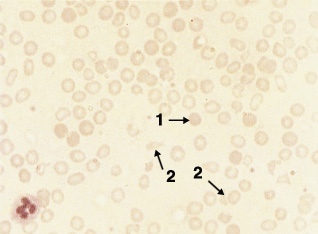
Despite normotension, concern regarding scleroderma renal crisis (SRC) was raised. On Day 12 of admission, when renal failure had developed to the dialysis-dependent level (serum creatinine level, 690 μmol/L), quinapril was recommenced for its proposed renoprotective effect and haemodialysis was initiated. Microangiopathic haemolytic anaemia (haemoglobin, 7.2 g/L) was diagnosed, with fragmented red blood cells (Box).
Several months later, she continues on haemodialysis three times a week. Renal biopsy was not performed given the clinical picture of diffuse scleroderma and recent corticosteroid use with rapid development of renal failure — consistent with SRC.
SRC is defined as rapidly progressive renal failure and/or new onset of malignant hypertension during the course of scleroderma, occurring in 15%–20% of patients with the diffuse variety.1 Risk factors include male sex, black race, and early diffuse scleroderma with rapidly progressive skin thickening.2 Precipitation of SRC by corticosteroid use, especially in normotensive patients, is well described, particularly with high-dose (>15 mg/day) treatment.2
Early diagnosis is critical because treatment may preserve renal function.3 Outcomes have improved with use of angiotensin-converting enzyme (ACE) inhibitors,2 which are thought to improve renal function by controlling the high renin levels seen in patients with SRC. About 61% of patients have a good outcome, with no or temporary dialysis.3 Predictors of poor outcome, despite ACE inhibitor use, include older age, male sex, higher initial serum creatinine level, and scleroderma myocardial disease.1 Eleven per cent of SRC patients remain normotensive and have significantly reduced 12-month survival rates.4 This may relate to delay in diagnosis of SRC.
The use of high dose corticosteroids in patients with early diffuse scleroderma should be strongly discouraged, and intensive monitoring for SRC is recommended if low dose corticosteroids are required.
References
- Steen VD. Scleroderma renal crisis. Rheum Dis Clin North Am 1996; 22: 861-878.
- Steen VD, Medsger TA Jr. Case–control study of corticosteroids and other drugs that either precipitate or protect from the development of scleroderma renal crisis. Arthritis Rheum 1998; 41: 1613-1619. i1149942
- Steen VD, Medsger TA Jr. Long-term outcomes of scleroderma renal crisis. Ann Intern Med 2000; 133: 600-603. i1149944
- Helfrich DJ, Banner B, Steen VD, Medsger TA Jr. Normotensive renal failure in systemic sclerosis. Arthritis Rheum 1989; 32: 1128-1134. i1149946
The first Australian evidence‐based guidelines on male infertility
Darren J Katz, Liza O’Donnell, Robert I McLachlan, Tim J Moss, Clare V Boothroyd, Veena Jayadev, Sarah R Catford
The epidemiology of haemodialysis catheter infections in Australia, 2016–20: a prospective cohort study
Benjamin Lazarus, Kevan R Polkinghorne, Martin P Gallagher, Jayson Catiwa, Nicholas A Gray, Sarah Coggan, Kathryn R Higgins, Girish Talaulikar, Stephen P McDonald AM, Sradha Kotwal
Am I on the list? Clinician‐reported factors for kidney transplantation non‐waitlisting among Aboriginal and Torres Strait Islander people with kidney failure: a cross‐sectional study
Stephen P McDonald AM, Katie Cundale, Christopher E Davies, Kelli Karrikarringka Owen (Kaurna, Nharangga, and Ngarrindjeri), Kerry Dole, Feruza Kholmurodova, Matilda D’Antoine (Paakantyi), Jaquelyne T Hughes (Wagadagam)
Hyperkalaemic cardiac arrest due to cream of tartar ingestion
Daniel Yee Lee Ng, Laksmi Govindasamy, Andrew Hughes, Hwee Min Lee
Dialysis care in Australia: a call for reform and innovation
Dharshana Sabanayagam, Angela Makris, Frederika Sciberras, Nicole J Scholes‐Robertson, Germaine Wong
Closing the gap in kidney disease: validating the reporting of Aboriginal and/or Torres Strait Islander identification in a clinical quality registry using linked data
Heather J Baldwin, Nicole De La Mata, Grant Sara, Faye McMillan, Brett Biles, Jianyun Wu, Paul Lawton, Stephen McDonald, Angela C Webster