




Volume 177 - Issue 11
The Medical Students' Aid Project: building partnerships with the developing world
Authors: Angus G Ritchie, Adrian T Fung, Peter N Fox, Kathryn E Roberts, John S Vedelago, Rebecca C Blake, Asif A Saber, Jess M Glass and Linda K Martin
Med J Aust 2002; 177 (11): 641-643. || doi: 10.5694/j.1326-5377.2002.tb04995.x
Published online: 9 December 2002
Published online: 9 December 2002
An elective term in Malawi inspired students to make a difference in medical aid.
When, at the end of 2000, medical students Greg Fox and Greg Moloney travelled from the University of New South Wales (UNSW) to Blantyre, Malawi, Africa, to complete an elective term at Queen Elizabeth Central Hospital, they witnessed a health system drastically hampered by a shortage of medical resources. On return to Australia, they resolved to "give back" to those in the developing world who had taught and welcomed them so generously. With the support of other UNSW medical students, the Medical Students' Aid Project (MSAP) was born. Our non-profit, student-run, volunteer organisation is the first of its kind in Australia. Our primary goal is to deliver targeted medical aid to hospitals in developing countries.
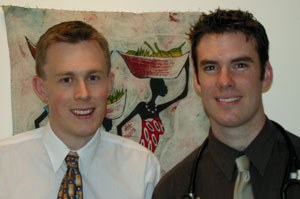
Working in the children's ward we realised what a huge difference some basic items such as cannulas, needles and emergency equipment would make to the doctors' ability to care for sick children. The health problems facing these countries are not simple, but we believe that many individual contributions can together make a difference — Greg Fox (left) and Greg Moloney MSAP co-founders.
Ideals
MSAP tries to ensure that all aid is appropriate and beneficial to our partner hospitals. We do so by delivering only aid that is specifically requested by recipient hospitals. At the beginning of each year, our partner hospitals submit a prioritised wishlist for medical aid, which we use to direct our efforts in fundraising and equipment seeking. MSAP student volunteers visit partner hospitals each year as part of their final-year elective term. Their visits are timed to coincide with the arrival of aid, to ensure it is used appropriately. The hospital wishlists are refined through first-hand feedback during these visits.
Forming long-term, sustainable partnerships with the partner hospitals enhances MSAP's effectiveness. Donating to the same hospitals each year ensures that lessons learned from previous years can be used to better meet our goals in the future.
Partner hospitals share a number of qualities: they have a need for aid that may be met by MSAP; they provide valuable experience of medical practice in the developing world; and they are in locations that will continue to attract medical students in the future.
In return for our efforts, our visits to partner hospitals enrich us with a vivid cultural and educational experience, the memories of which we carry back to share with fellow students and the wider community.
Partner hospitals
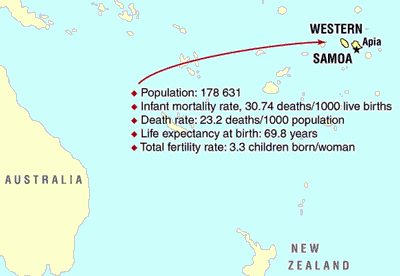
The MSAP partner hospitals in 2001 were in Malawi (Box 1), Samoa (Box 2), Tonga (Box 3) and India (the Lady Willingdon Hospital in Manali). Korle-bu Hospital, in Accra, Ghana, has been included in 2002 and has already received a paediatric cystoscope (worth over $5000), and diathermy and laparoscopic equipment. Smaller donations of equipment and medication will also be made to Gizo Hospital in the Western Province of the Solomon Islands and Hospital Santa Barbara in Sucre, Bolivia.
"As a MSAP volunteer, I have become aware of the stark contrast between the First World ideals of sterile operating theatres and universal vaccination and the developing world reality of overcrowded clinics and inadequate resources. It is satisfying to have made a small contribution towards bringing the two worlds closer. MSAP has been an important part of my medical education."
— Asif Saber, MSAP member
How MSAP works
MSAP is entirely student administered and receives generous support from the UNSW Faculty of Medicine and the UNSW Foundation. All MSAP members volunteer their time and the university covers our administration costs. About 20 medical students were involved in 2001 and 2002. Our current patron, Dr Gaye Casper (Senior Conjoint Lecturer, School of Women's and Children's Health, UNSW), provides moral support and practical advice to the students.
MSAP collects tax-deductible monetary donations from private and corporate sources. Monetary donations are used to purchase equipment and to fund transportation.
Donations of basic and specialised medical equipment are received primarily from Area Health Services in New South Wales. Other sources include private donors, such as retired doctors, medical companies and volunteer organisations such as Global Medical Support (which sends medical supplies to countries in need).
MSAP purchases subsidised and in-date medication through Overseas Pharmaceutical Aid for Life (OPAL) (http://www.opal.org.au), a South Australian company that supplies pharmaceuticals to developing countries in accordance with WHO Guidelines for Drug Donations (http://whqlibdoc.who.int/hq/1999/WHO_EDM_PAR_99.4.pdf, link updated Nov 2005). OPAL puts together medication packages, organises customs documentation and arranges commercial delivery or delivery by MSAP volunteers.
All equipment collected by MSAP is stored free-of-charge at a Waverley Council depot in Sydney. Towards the end of the year we organise "packing days" to sort equipment onto pallets for shipment to each hospital. Five pallets of equipment were sent overseas in 2001 and in 2002 we expect to deliver five more.
"Throughout Australia, large quantities of medical equipment — such as superseded anaesthetic equipment, ECG machines and glucometers — lie in storage and are desperately needed in developing countries"
— Peter Fox, MSAP volunteer
So far, medical equipment has been transported by commercial shipping lines at MSAP's expense. Members have also carried small quantities of equipment with them when visiting partner hospitals. Free transportation to Tonga in 2002 has been negotiated through the Tongan Consulate General in Australia and the Pacific Forum Line.
In two years MSAP has delivered over $100 000 worth of medical aid.
The community role of MSAP
MSAP is active in international health education for other medical students through lectures, "Developing World Health" night and contributions to student publications. MSAP also contributes to wider UNSW campus activities, for example through our involvement with Anti-Poverty Week. Our annual "MSAP Benefit Night" increases awareness of our cause, raises funds and gives us a chance to thank donors for their generosity. Updates, our newsletter, communicates activities and news to followers.
The future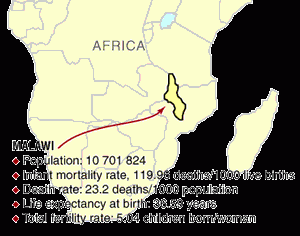
In just two years, we have received enormous support from the medical profession and the broader community. With ongoing assistance we will continue to expand as an organisation and maintain our capacity to deliver medical aid to the developing world.
MSAP has inspired considerable interest among medical students from other Australian universities, who are eager to establish similar ventures. We hope to share our experiences and encourage others to adopt an active role in developing world health.
1: Queen Elizabeth Central Hospital, Blantyre, Malawi
MSAP donations
2001: Equipment with a paediatric focus (eg, cephalosporin antibiotics, high-kilojoule powder, paediatric nasogastric tubes and textbooks).
2002: Medications worth $2500 (mainly antibiotics), urine dipsticks, psychiatry textbooks. No pallets sent this year (too expensive).
We spent two months studying paediatrics at this tertiary referral hospital towards the end of 2001. The cases we saw were sometimes novel, sometimes gratifying and sometimes heartbreaking. HIV is having a devastating effect in Africa, while conditions such as meningitis, malaria, tuberculosis and malnutrition, readily treatable in Australia, are moving beyond the capacity of the systems attempting to cope with them.
One afternoon we basked in a golden sunset by the serene lake shore as fishermen in dugout canoes repaired their nets and infants cavorted in the waters. We'd just finished a long afternoon's clinic where one young man with advanced AIDS sought treatment for painful, widespread shingles; a stooped old lady who had lost all her family wanted relief for her chronic back pain; and a younger widow needed to go to hospital immediately for a renal infection but couldn't afford the dollar to get her there. At least we could help her.
Through MSAP, I know that we have made a small but undeniable difference to the patients we met, who first became real and then became our friends.
Rebecca Blake, Toby Winton-Brown
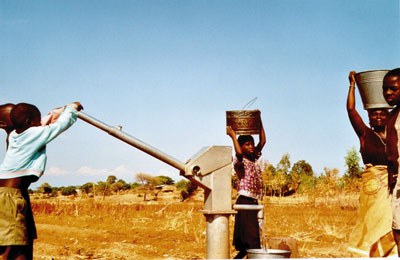
Women and children fetching water from the village pump.
2: Tupua Tamasese Meaole Hospital, Apia, Samoa
MSAP donations
2001: Syringes, gloves, defibrillator, textbooks.
2002: New ECG machine, 1 pallet of equipment (nebuliser, glucometers, ophthalmoscope/otoscope, stethoscopes, anaesthetic equipment, sutures, catheters, stoma-related products).
At the end of 2001, I had the privilege of spending two months working in the emergency department of this tertiary referral hospital. Hundreds of patients would queue each day with complaints that would be easy to address in Australia but impossible to treat locally given the lack of basic medications. I will always remember the young patient who sat, seemingly forever, on the surgical ward awaiting an amputation, as his leg infection could not otherwise be treated.
The most rewarding part of my time in Samoa was being able to give something back to the community through the MSAP donations. It was overwhelming to see how grateful the people were for these basic medications and equipment.
Cath Tacon
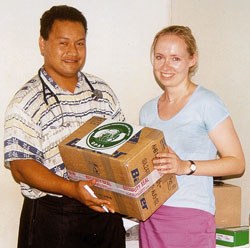
MSAP volunteer Cath Tacon handing supplies to Dr Satu Viali.
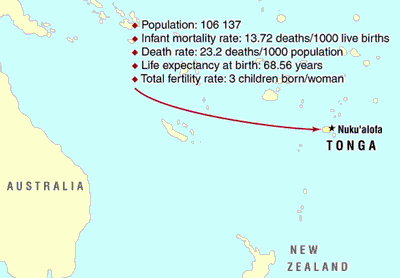
3: Vaiola Hospital, Nuku'alofa, Tonga
MSAP donations
2001: Syringes, bandages, sutures, surgical forceps, operating microscope, hysteroscopy and laparoscopy equipment.
2002: Three pallets with similar supplies to those sent in 2001; medications worth $2000 (mainly cephalosporin antibiotics); cardiotocography machine.
Throughout 2001, members of MSAP put an enormous amount of energy into collecting and transporting equipment for the Polynesian kingdom of Tonga. Being our inaugural year we had no way of knowing exactly what to expect or how our donation would be received, but my anxieties were allayed the moment I stepped off the plane by the warm welcome I received.
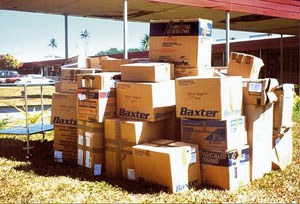
The arrival of medical equipment at Vaiola Hospital, a tertiary referral hospital, was greeted with great excitement and thanks. One of the antibiotics was used almost immediately to treat a man with several resistant infections. The equipment "handing over" ceremony was reported by the local newspaper and even made the Tongan Nightly News!
Sarah Woodgate
MSAP supplies outside Vaiola Hospital, Tonga.
Acknowledgements
The members of MSAP are greatly indebted to all our supporters, without whom our success would not have been possible. Special thanks to the Faculty of Medicine (UNSW), UNSW Foundation, UNSW Union, Gaye Casper, Peter Brophy (Global Medical Support Incorporated), Peter Aston (Waverley Works Depot), Area Health Services of NSW, Crows Nest, Bondi Junction and Wahroonga Rotary Clubs, and the Tongan Consulate General.
Dousing the burning inequity of global warming for people experiencing homelessness
Timothy English, Alejandro Vásquez Hernández, Glenn Miller, Nuala Fogarty, Charles Cosgrove, Paul Rosenthal, Matthew Larkin, Jon Swain, Danielle Austin, Jo River
The contribution of evidence‐based practice and the practice‐based evidence approaches to contemporary Australian psychology: implications for culturally safe practice
Paul Gray (Wiradjuri), Dawn Darlaston‐Jones, Pat Dudgeon AM (Bardi), Kate Derry, Joanna Alexi, William Smith (Wiradjuri and Wemba Wemba), Tanja Hirvonen (Jaru and Bunuba), David Badcock, Shraddha Kashyap, Belle Selkirk (Noongar)
Explaining risk in chronic conditions: the Yolŋu science of signs
Emma Haynes, Alison Mitchell, Minitja Marawili (Yolŋu), Dawn C Bessarab (Bardi)
Is it time to retire the label “CALD” in public health research and practice?
Sabine Allida, Della Maneze
What do Aboriginal people in the Northern Territory value during the operation journey? A qualitative study
Edith B Waugh, Marita Hefler, Sophie Pascoe, Mark Mayo, Matthew JL Hare, David A Story, Neil Wilkshire, Peter Henwood, David Croker, Jampijinpa Ross
Fulfilling First Nations health, cultural safety and equity accreditation standards in primary medical education: reflections from a First Nations desktop review team
Paul Saunders, Nicole Mercer, Maria Mackay, Ian Lee, Madelyne Hudson‐Buhagiar, Miriam Cavanagh, Emma Milliss, Melody Muscat, Kathleen Martin, Adam Shipp, Melissa Johnson, Belinda Gibb