




Volume 177 - Issue 1
Howard Florey, Alexander Fleming and the fairy tale of penicillin
Authors: Ivo D Vellar and Thomas B Hugh
Med J Aust 2002; 177 (1): 52-53. || doi: 10.5694/j.1326-5377.2002.tb04641.x
Published online: 1 July 2002
Published online: 1 July 2002
To the Editor: I read with interest the article by Goldsworthy and McFarlane on Howard Florey, Alexander Fleming and penicillin.1 With regard to the cause of Florey's "famous pinched smile", which allegedly hid tooth erosion caused by his drinking dilute hydrochloric acid prescribed for achlorhydria, a more prosaic yet interesting explanation is found in the memoirs of Raymond Valentine Hennessy. Hennessy was Senior Ear, Nose And Throat Surgeon at St Vincent's Hospital, Melbourne, between 1928 and 1951.2
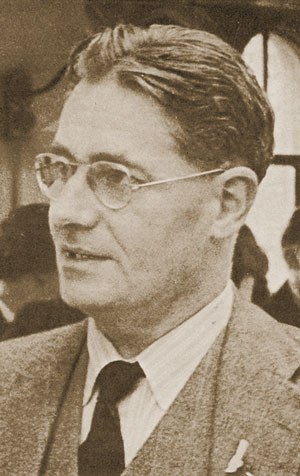
In August 1936, Florey, who was then Professor of Pathology at Oxford, visited his dying mother in Melbourne. He and his family stayed with his sister, Dr Hilda Gardner. Florey had a supply of sulfanilamide, probably the first in Melbourne, to treat his daughter, who was convalescing from a recent mastoid operation. During his stay, Florey attended a local dentist for treatment of a painful lateral incisor tooth. Some days later (on a Saturday evening), his face had become swollen and he began having rigors. His sister, a medical graduate who was then working as a clinical pathologist and microbiologist at the Melbourne Hospital, appreciated the danger — an abscess of a lateral incisor tooth can produce a cavernous sinus thrombosis — and quickly contacted Raymond Hennessy, who lived nearby. Hennessy had graduated as a dentist before pursuing a career as an ear, nose and throat surgeon and had written about the dangers of a lateral incisor dental abscess.3 After examining Florey, Hennessy told him that the offending tooth required extraction that night. Initially, Florey refused to heed his advice, preferring to see his own dentist the following Monday. Fortunately for Florey, he was persuaded by his sister to have the extraction.
Hennessy then telephoned a dentist colleague, and they all met at the latter's surgery in Collins Street, where Hennessy gave Florey a gas–oxygen anaesthetic, and the nervous dentist proceeded to extract the incisor. However, he extracted the normal central incisor, not the offending lateral! On realising his mistake, the dentist "went to water", but Hennessy immediately rose to the occasion and extracted the correct tooth. When Florey woke from the anaesthetic, as Hennessy well remembered, he was not amused. Later, he had a dental plate made but did not like wearing it. Whether he took the sulfanilamide is not known.
This episode is not mentioned in Gwyn Macfarlane's biography of Florey.4 However, the photograph of Florey in the frontispiece of this book shows the gap in his upper incisors (pictured). I believe this is the explanation for Florey's "famous pinched smile".
References
- Goldsworthy PD, McFarlane AC. Howard Florey, Alexander Fleming and the fairy tale of penicillin. Med J Aust 2002; 176: 176-178. <eMJA full text>
- Hennessy R. Memoirs [typescript]. St Vincent's Hospital Archives, Fitzroy, VIC, Aug 1970. i1149924
- Hennessy R. Acute inflammatory conditions of the mouth and pharynx. Med J Aust 1926; 2: 469-472. i1149927
- Macfarlane G. Howard Florey: the making of a great scientist. London: The Scientific Book Club, 1980: 268-270.
- Goldsworthy PD, McFarlane AC. Howard Florey, Alexander Fleming and the fairy tale of penicillin. Med J Aust 2002; 176: 176-178. <eMJA full text>
- Wainwright M. Miracle cure. The story of antibiotics. Oxford: Basil Blackwell Ltd, 1990. 2
- Macfarlane G. Alexander Fleming. The man and the myth. London: Chatto and Windus, 1984.
- Goldsworthy PD, McFarlane AC. Howard Florey, Alexander Fleming and the fairy tale of penicillin. Med J Aust 2002; 176: 176-178.<eMJA full text>
Prisoner of war pathology in Changi, 1942–1945
Kate Ariotti, Elizabeth Roberts‐Pedersen
Should medical eponyms continue to be used in everyday practice?
Leya Nedumannil, Diana Lewis
100 years on: the first use of insulin in Australia
Sophie Templer
Reflections on the life and career of Professor Dame Valerie Beral AC DBE FRS FRCOG FMedSci (1943–2022)
Karen Canfell, Bette Liu, Emily Banks
The Honourable Dr Donald James Grimes AO
Michael Kirby, Patti Warn
From wipeout to drill out: a history of exostosis management and Australian surfing
Alon Taylor, Hannah North, Narinder P Singh, Paul A Fagan