




Volume 176 - Issue 12
Be warned this book may change your life
Author: Alexandra L Barratt
Med J Aust 2002 || doi: 10.5694/j.1326-5377.2002.tb04577.x
Published online: 1 May 2002
Published online: 1 May 2002
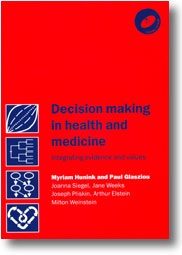
Decision making in health and medicine. Integrating evidence and values.
M G Myriam Hunink, Paul P Glasziou, Joanna E Siegel et al. Cambridge: Cambridge University Press, 2001 (xvi + 388 pp). ISBN 0 521 77029 7.
Its fundamental premiss is that medicine (defined in its broadest sense to cover clinical medicine, population research, policy development and health management) is about uncertainty and the need to make decisions despite this uncertainty. For example, you have just diagnosed a 58-year-old man with atrial fibrillation. If you prescribe warfarin you can reduce his risk of embolic stroke by 70%, but this benefit comes at the price of an increased risk of haemorrhage, and the need for regular blood tests and avoidance of activities that increase his risk of injury. How do you weigh up the probabilities and incorporate into the decision your patients individual values about what is important to him?
This book presents an approach and a handful of tools for making complex, value-laden decisions such as this. The approach, PROACTIVE, is adapted from a generic approach to decision making. As the authors say, one of its greatest strengths is that it requires you to make the decision-making process transparent. By carefully outlining your decision, viewing it from other perspectives and considering what the important objectives are, the best decision may become readily apparent without having to go any further.
If you need to work quantitatively with probabilistic data, to make trade-offs between benefits and risks (or length of life versus quality of life, or costs versus benefits), and to incorporate peoples values and preferences, the book provides detailed guidance on the tools that are available. It takes the novice from a definition of a probability and a proportion all the way to advanced microsimulation modelling.
Decision making in health and medicine updates the 1980 book Clinical decision analysis. It has a broader framework, and covers population health decision-making. It also includes more information on diagnostic testing, methods for measuring and incorporating quality-of-life measures and newer approaches to modelling. To support it, there is an accompanying CD with solutions to exercises, decision-analytical software, examples of decision-analytic models using the software, spreadsheets and references with abstracts. It is an extraordinarily ambitious book that achieves its aim.
Alexandra L BarrattEpidemiologistUniversity of Sydney, NSW
Capturing the Benefits of Clinical Quality Registries
Taryn Bessen, Stephen McDonald
Medical Colleges Have an Obligation to Ensure Full Participation in Clinical Quality Registries
Thomas J. Hugh
Getting on the Same Page: Why Australia Needs a National Maternity Early Warning System (MEWS) Chart
Briony A. Cutts, Lucy Bowyer, Nisha Khot, Sandra Lowe, Stefan C. Kane
Data for Equity: Can Linked Administrative Data Inform Pathways to More Equitable Child Health?
Sarah Gray, Shuaijun Guo, Meredith O'Connor, Elodie O'Connor, Katrina Williams, Hannah Badland, Susan Woolfenden, Josie Dickerson, Gerry Redmond, Marnie Downes, Sharon R. Goldfeld
Specialty College Selection: Why Change is Critical to Support a Future Rural Workforce
Matthew R. McGrail, Jenny May AM, Katherine Logan
Differentiated and simplified oral HIV pre‐exposure prophylaxis (PrEP) models hold the key to virtually eliminating HIV transmission in Australia by 2030
Tyson Arapali, Sarah Warzywoda, Anthony K J Smith, Curtis Chan, Timothy R Broady, Erin Sullivan, Catherine MacPhail, Mohamed A Hammoud, Alexander Dowell‐Day, Benjamin R Bavinton