




Volume 176 - Issue 10
John St George MB BS, FRCS, FRCOG, FRACOG
Author: Lourdes I St George
Med J Aust 2002; 176 (10): 558. || doi: 10.5694/j.1326-5377.2002.tb04540.x
Published online: 3 June 2002
Published online: 3 June 2002
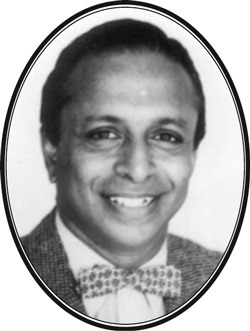
John St George was born in Malaya on 2 December 1924. His family returned to Ceylon in 1925, where he studied at St Patrick's College in Jaffna. In 1950, he graduated with Honours in medicine from the University of Ceylon in Colombo.
Between 1957 and 1959, John worked with Professor T Jeffcoate at the University of Liverpool, UK, then with Dr P Myerscough at the Eastern General Hospital, Edinburgh. He was accepted as a Member of the Royal College of Obstetricians and Gynaecologists (1958) and a Fellow of the Royal College of Surgeons (1959), the International College of Surgeons (1968), and the Royal College of Obstetricians and Gynaecologists (1970).
After working as a Consultant in Obstetrics and Gynaecology for the Government of Ceylon from 1959 to 1964, John spent a number of years (1964–1967 and 1972–1975) as Chief Consultant in Obstetrics and Gynaecology for the government of northern Nigeria. It was there that he perfected his technique of vesicovaginal fistula repair. These fistulae, which are relatively common among rural women, arise from obstructed labour or from application of potassium permanganate by "bush doctors" (local herbalists).
While in Nigeria, John initiated the obstetric "flying squad" to enable women in remote areas to receive emergency medical treatment, and helped to invent a two-wheel collapsible trolley for bush track roads to help reduce maternal mortality. In 1974, the London School of Hygiene and Tropical Medicine awarded him the Langley Memorial Prize for this work.
In 1975, John migrated to Australia and set up practice at Burwood and Lakemba, in Sydney, working as a gynaecologist at the Western Suburbs Hospital until 1993. He retired in 1998.
John was passionately interested in sports and the Church. From his early years at St Patrick's College, where he was the captain of both the athletics and soccer teams, he took to heart the College's motto "fide et labore" (faith and work). He based his entire life on this simple yet profound philosophy, which saw him succeed in his career and adapt to many different cultures and countries with ease.
John died peacefully (of hypostatic pneumonia) at Concord Hospital on 9 December 2001, at the age of 77.
Forty Years in the Making: Reporting on the Co-Creation of a National Roadmap for Birthing on Country Services for the Best Start to Life
Res McCalman, Anneka J. Bowman, Roianne West, Kristie Watego, Jyai Allen, Claire Clack, Sue Kildea, Sue Kruske, Melanie Briggs, Cleone Wellington, Rebecca Coddington, Yu Gao, Isabella Garti, Sascha Kowalenko, Sarah Ireland, Catherine Austin, John D. Boffa, Marah Prior, Kelsie Kahl, Bettina Chaseling, Sarah Khaw, Emily Armstrong, Donna Hartz, Yvette Roe
Temporal Trends in Preterm Birth Associated With Hypertensive Disorders of Pregnancy in Victoria, Australia: A Population-Based Interrupted Time-Series Study
Melvin Marzan, Heng Jiang, Daniel Lorber Rolnik, Joanne M. Said, Lisa Hui
Linguistic Manoeuvres: Obstetric Violence Camouflages Harm and Loss of Consent From Birth
Liz Sutton, Harsha Ananthram, Rebecca Matthews
Linguistic Manoeuvres: Obstetric Violence Camouflages Harm and Loss of Consent From Birth
Bashi Kumar-Hazard, Andrew M. Bisits, Sharon L. Settecasse, Jenny Gamble, Hazel Keedle, Hannah G. Dahlen
Linguistic Manoeuvres: Obstetric Violence Camouflages Harm and Loss of Consent From Birth
Wendy Pollock, Alissa Fleming, Ensieh Fooladi, Joy Kloester, Anne Tremayne, Yasmin Zisin, Bethany Carr, Kym Davey, Suzanne Willey, Jenny Gamble
Getting on the Same Page: Why Australia Needs a National Maternity Early Warning System (MEWS) Chart
Briony A. Cutts, Lucy Bowyer, Nisha Khot, Sandra Lowe, Stefan C. Kane