




Volume 176 - Issue 10
Fatalities from bread tag ingestion
Author: Trevor W Beer
Med J Aust 2002; 176 (10): 506. || doi: 10.5694/j.1326-5377.2002.tb04536.x
Published online: 20 May 2002
Published online: 20 May 2002
Plastic bread clips are a rare but potentially avoidable cause of gastrointestinal obstruction or perforation which can be fatal.
Case 1: A 79-year-old woman presented with peritonitis thought to be the result of a perforated viscus. Her condition was too poor for immediate operative intervention, and despite supportive treatment she died the same day. At autopsy, ileal perforation was identified related to a firmly adherent plastic bread tag (Figure). Two adjacent foci of congestion and mucosal distortion 24 cm proximally suggested a prior clip attachment site. She had suffered from dementia and her meals were made by her husband, who was blind.
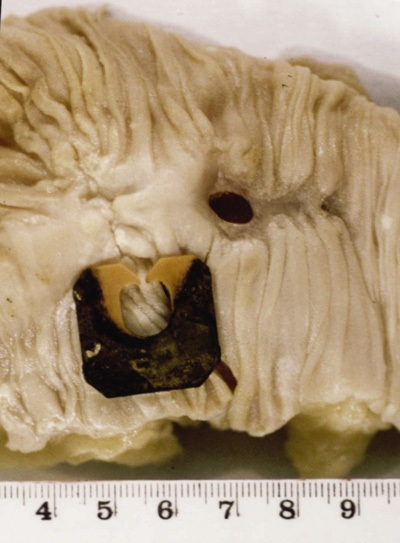
Bread tag from the patient in Case 1, detached to reveal the site of ileal perforation. Scale is in centimetres.
Case 2: An edentulous 82-year-old woman presented with a one-day history of abdominal pain. A laparotomy showed ileal perforation related to a bread tag attached to the mucosa. Postoperatively, she developed bronchopneumonia which proved fatal. Three months before presentation, she had suffered a less severe episode of abdominal pain which had resolved on conservative treatment from her general practitioner.
In Australia most bread bags are sealed by hard plastic clips. These are cheap and convenient, enabling the bag to be resealed after use. However, some countries have withdrawn their use because of gastrointestinal problems after ingestion.1,2
Patients swallowing clips are typically elderly and edentulous. The clips tend to snag on the small bowel mucosa, which may obstruct, erode or perforate. Impaction in the oesophagus, stomach or colon has also been reported.3 The tags are generally not seen on plain x-ray2 and patients are often unaware that they have swallowed them. Because of the high risk of complications, early endoscopic removal is advocated.4 With an ageing population, the proportion of edentulous people is likely to rise, increasing the risk of foreign-body ingestion.
Alternative plastic bag sealers are available, although some also present health hazards. For example, ileal perforation has been reported after swallowing a freezer bag tie containing a wire.5
Bread bag clips have recently been replaced with tape in the United Kingdom for safety reasons (A Bennett, Allied Bakeries Customer Services Representative, Allied Technical Centre, Maidenhead, Berkshire, UK, personal communication). Abandoning the use of hard plastic bread tags in Australia in favour of adhesive tape would counter this health hazard.
References
- Cook DS. Dietary dangers: ingestion of a bread bag clip [letter]. J Clin Pathol 2001; 54: 79.
- Newell KJ, Taylor B, Walton JC, Tweedie EJ. Plastic bread-bag clips in the gastrointestinal tract: report of 5 cases and review of the literature. CMAJ 2000; 162: 527-529. i1067272
- McKaigney J, Cole M, Simon JB. Picking up the tab: obstruction of the gastrointestinal tract by plastic bread bag clips [letter]. Gastrointest Endosc 1985; 31: 112-113. i1067274
- Ellul JP, Hodgkinson PD. Problems with a plastic bread-bag clip [letter]. Arch Emerg Med 1989; 6: 156-157. i1067276
- Al-Fallouji MA. A hazard of modern life [letter]. Lancet 1983; 2: 334. i1067278
Early-Onset Colorectal Cancer With Liver-Only Metastases: A Retrospective Cohort Study Integrating Prospectively Collected Real-World Clinical and Molecular Data From an Australian National Database (2009–2024) to Guide Treatment Planning
Savio G. Barreto, Christos S. Karapetis, Shahid Ullah, Matthew Burge, Susan Caird, Angus Campbell, Azim Jalali, Ross Jennens, Muhammad A. Khattak, Belinda Lee, Stephanie H. Lim, Shehara Mendis, Louise Nott, Timothy J. Price, Jeremy D. Shapiro, Jeanne Tie, Javier Torres, Colin Williams, Rachel Wong, Vanessa Wong, Peter Gibbs
Australian Pathways for Specialist Pain Management and Early Palliative Care for People With Pancreatic Cancer: Developed Using a Community Consensus Approach
Jennifer Philip, Melanie R. Lovell, Kylee Bellingham, Gail Garvey, Gregory B. Crawford, Nicole M. Rankin, Kara Burns, Isabel Young, Vivienne Milch, Dorothy Keefe, Katrina Anderson, James Lawson, Meinir Krishnasamy
Cause‐specific mortality among Queensland people with cirrhosis, by cirrhosis aetiology and decompensation status, 2007–22: a retrospective cohort study
Vikas Bhasker, Jessica R Fong, Paul J Clark, Gunter F Hartel, Richard Skoien, James O’Beirne, Elizabeth E Powell, Patricia C Valery
Clinical practice guidelines for hepatocellular carcinoma surveillance for people at high risk in Australia: summary of recommendations
Jacob George, Nicole L Allard, Stuart K Roberts, Leon A Adams, Jane Davies, Behzad Hajarizadeh, Jennifer H MacLachlan, Suzanne E Mahady, Rosalie Altus, Catherine Brown, David C Fry, Belinda Greenwood‐Smith, Natali Smud, Patricia C Valery, Nafisa Yussf, Kate Broun, Denise Campbell, Karen Canfell, Chelsea Carle Harrison, Victoria Freeman, Paul Grogan, Catherine Holliday, Suzanne Hughes, Anna Kelly, Cathelijne Kemenade, Claire Latumahina, Amanda McAtamney, Megan Varlow, Joachim Worthington, Susan Yuill, Eleonora Feletto
Assessment of metabolic dysfunction‐associated fatty liver disease in primary care: a consensus statement summary
Leon A Adams, William W Kemp, Kate R Muller, Elizabeth E Powell, Stuart K Roberts, Luis Calzadilla Bertot, Stephanie Best, Gary Deed, Jon D Emery, Samantha L Hocking, Graham R Jones, John S Lubel, Sinead Sheils, Stephen M Twigg, Gerald F Watts, Jacob George
Treatment outcomes for people with hepatitis C referred to tertiary care in Victoria, 2021–22: a retrospective observational study
Elly Layton, Nicole Matthews, Brendan Quinn, Nasra Higgins, Gabrielle Lindeman, Mielle Abbott, Jennifer MacLachlan, Elizabeth Birbilis, Margaret E Hellard, Joseph Doyle, Benjamin C Cowie, Mark Stoové