




Medical education
Snapshot
Volume 218 - Issue 10
A solitary triangular alopecia
Author: Tim Aung
Med J Aust 2023; 218 (10): 450-450. || doi: 10.5694/mja2.51940
Published online: 5 June 2023
Published online: 5 June 2023
An otherwise well, five-year-old girl was brought in by parents for review of a bald patch over the left frontotemporal scalp
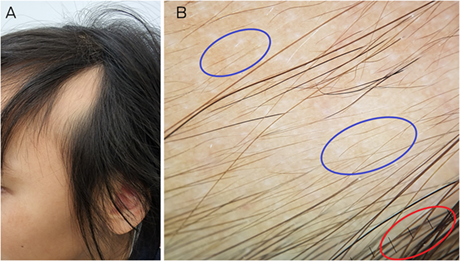
An otherwise well, five‐year‐old girl was brought in by parents for review of a bald patch over the left frontotemporal scalp which was noticed from the age of two years. Clinically, the bald area was a solitary smooth and shiny patch of alopecia with apex pointing posteriorly (Figure, A), consistent with a congenital triangular alopecia (CTA), also known as temporal triangular alopecia. The diagnosis was supported by the dermoscopic features of CTA:1,2 i) normal follicular openings with vellus hairs centrally (Figure, B; blue) and terminal hairs (Figure, B; red) at the periphery the lesion; ii) absence of “exclamation mark” hairs; and iii) absence of black and yellow dots (Figure, B) — presence of the features described in the second and third points could indicate alopecia areata and other entities. CTA is a localised non‐scarring and non‐progressive alopecia that occurs on either side of the frontotemporal scalp, with triangular, spear or oval shape.2 It usually remains unchanged throughout the life.1,2 CTA may mimic with alopecia areata, traction alopecia, trichotillomania, and congenital aplasia cutis.1,2 No effective treatment has been reported for CTA, and surgical excision, if the area is small, or hair transplant may be considered.1,2
Competing interests
No relevant disclosures.
References
- De Campos JG, Oliveira CM, Romero SA, et al. Use of dermoscopy in the diagnosis of temporal triangular alopecia. An Bras Dermatol 2015; 90: 123‐125.
- Viswanath V, Kalambe V, Sanap D. Congenital triangular alopecia: clinical and dermoscopic differentials. Indian J Paediatr Dermatol 2019; 20: 75‐77.
Diagnosing Acute Kava Dermopathy: A Case Report of a Characteristic Cutaneous Eruption
Ali Abid, Nicholas Allen, Abeer Hagelamin, Christopher Henderson, Artiene Tatian
Localised Herpes Simplex Following Midline Laparotomy
Jessica S. Bulluss, Paul Chee, Matthew J. Verheyden
No silver lining with health misinformation: argyria caused by intentional silver consumption
Luke Collins, Logesh Palanikumar, Stephen Bacchi
Lingual Raynaud phenomenon
Michael Taggart, Mina John
Melasma in the male: a less well recognised entity
Tim Aung, Rowland Noakes
Age group‐specific changes in keratinocyte cancer treatment rates in Australia, 2012–2021: a retrospective cohort study based on MBS claims data
Catherine M Olsen, Nirmala Pandeya, Rachel E Neale, David C Whiteman