




Volume 216 - Issue 1
Preparing for out‐of‐season influenza epidemics when international travel resumes
Author: Sheena G Sullivan
Med J Aust 2022; 216 (1): 25-26. || doi: 10.5694/mja2.51340
Published online: 22 November 2021
Published online: 22 November 2021
Influenza vaccination for travellers and the resources mobilised during the COVID-19 pandemic could mitigate the effects of an influenza resurgence
Influenza vaccination for travellers and the resources mobilised during the COVID‐19 pandemic could mitigate the effects of an influenza resurgence
In this issue of the MJA, Marsh and colleagues1 report that inter‐seasonal influenza activity in New South Wales was unusually high during the 2018–19 summer, and provide compelling evidence for the role of international travel in seeding local influenza epidemics. During December 2018 – March 2019, people with notified influenza infections were 3.7 times as likely to report recent overseas travel as other people; however, the odds were almost seven times as high for people with infections identified during the first two months of summer, suggesting that some of these cases initiated local outbreaks, with subsequent community transmission.1
This interpretation is consistent with previous findings that influenza circulation in Australia undergoes serial, local eliminations at the end of winter, with epidemics re‐ignited by new viruses imported from overseas via international travel.2 This phenomenon has never been better exemplified than during the coronavirus disease 2019 (COVID‐19) pandemic. In early 2020, influenza activity was higher than normal for the inter‐seasonal period, but plummeted with the introduction of COVID‐19 restrictions in March 2020.3 Introduction of new viruses was prevented by the closure of the Australian international border and the requirement that all returning travellers undergo 14 days of hotel quarantine. As a result, we have not confirmed the presence of influenza virus in any community samples sent to our reference laboratory since April 2020. It would seem that the virus has been locally eliminated, but the threat of its re‐introduction looms with the imminent re‐opening of our border.4
Throughout the pandemic, influenza A(H1N1)pdm09, A(H3N2), and B/Victoria have continued to circulate globally, with evidence of small, sporadic outbreaks, chiefly in tropical and subtropical regions of Asia and Africa (Box), where influenza seasonality is less marked than in temperate regions and year‐round, low level activity is typical.5 Marsh and colleagues1 found that returned travellers with notified influenza had most frequently arrived from South‐East Asia (42 of 168, 25%). However, current circulation patterns suggest that this region is not the most likely source of influenza importation into Australia. Our laboratory has confirmed the presence of influenza viruses in samples collected from travellers in hotel quarantine who have returned from South Asia, particularly those in the Howard Springs facility in the Northern Territory. As the influenza incubation period, infectious period, and serial interval are short,6 the current duration of hotel quarantine (14 days) has prevented people leaving quarantine while still infectious, even in the context of chains of transmission within travelling groups. However, if quarantine periods are reduced or eliminated, infected travellers may enter the community and instigate local outbreaks.
The report by Marsh and colleagues1 indicates that, as borders open in late 2021, we should expect the introduction of influenza viruses into Australia and possibly intense out‐of‐season activity. Re‐opening will precede our seasonal influenza vaccination campaign, which usually begins in April. To restrict the entry of influenza viruses, all returning travellers should be required to be vaccinated against influenza prior to travel, as recommended by the New South Wales Ministry of Health in response to the study by Marsh and colleagues.1 Given the similarities in disease presentation, diagnosis, and management, the wealth of resources made available during the COVID‐19 pandemic should also be leveraged to mitigate the consequences of influenza outbreaks. To avoid unclear messaging and to harmonise the response to all respiratory virus outbreaks, this would include testing for influenza as well as the severe acute respiratory syndrome coronavirus 2 (SARS‐CoV‐2), especially in people in hotel quarantine, and sharing the resources of the special COVID‐19 public health divisions that have been established in many jurisdictions.
Any resurgence of influenza will be most harshly felt by older people,7 particularly those in aged care facilities, among whom influenza mortality is high8 and the COVID‐19 pandemic has already exerted a heavy toll.9 It behoves us as a nation to protect our older citizens, and it reflects on us poorly when we fail to do so. In addition, influenza is likely to infect a considerable proportion of young children. In contrast to those infected with SARS‐CoV‐2, many children infected with influenza, especially those less than six months old, may need hospital care.7 A resurgence of respiratory syncytial virus outbreaks in late 2020/early 2021 has already challenged some paediatric hospitals in Australia.10 Increased severity of disease among patients co‐infected with SARS‐CoV‐2 and influenza was reported in China in 2020,11 and this could also have consequences for our healthcare system.
The mathematical models driving government decision making regarding the re‐opening of borders may therefore need to be adjusted to take into account hospital and public health systems overwhelmed by the dual, and possibly out‐of‐season, circulation of these two virus families.
Box – Influenza viruses collected and sequenced between 1 May 2020 and 1 October 2021*
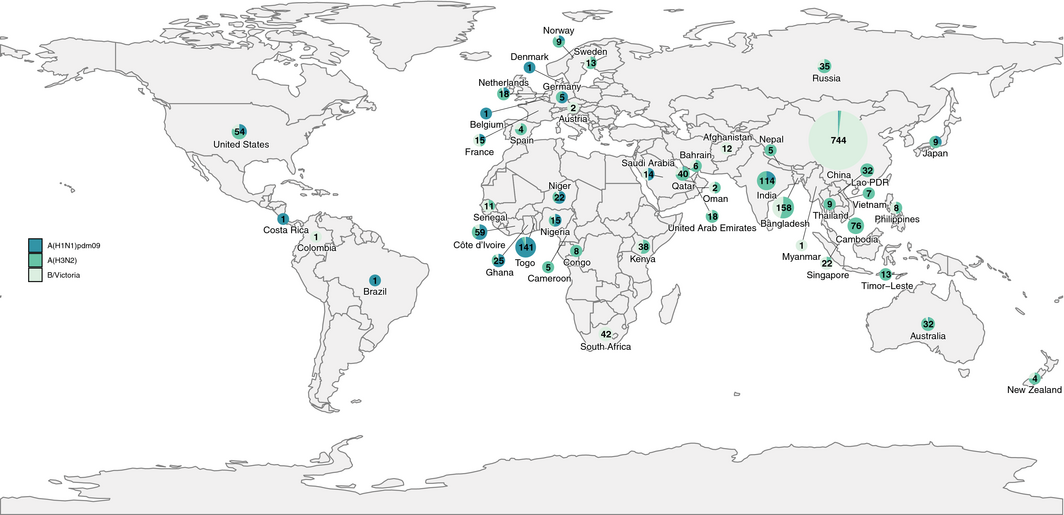
* Source: the GISAID Initiative (https://www.gisaid.org). Although influenza viruses have also been reported to the World Health Organization from countries not included here, low level circulation increases the possibility of false positive detections; the availability of sequencing data provides confirmation that viruses detected in these countries were true positives. Countries from which more than ten viruses have been sequenced since 1 May 2021 include Bangladesh, China, Cote d’Ivoire, Ghana, India, the Netherlands, Qatar, the Russian Federation, Singapore, South Africa, and the United States. Viruses detected in Australia and New Zealand have been identified in returned travellers in managed quarantine facilities and have not been associated with community transmission. The proportions of viruses detected in other countries associated with travel are unknown.
Competing interests
The WHO Collaborating Centre for Reference and Research on Influenza receives funding from the International Federation of Pharmaceutical Manufacturers and Associations, and Seqiris, for the development of influenza candidate vaccine viruses.
Acknowledgements
The WHO Collaborating Centre for Reference and Research on Influenza is supported by the Australian Department of Health. We thank Arseniy Khvorov for his technical assistance with the figure, and Ian Barr for his helpful comments on the draft manuscript.
References
- Marsh CK, Sheppeard V, Tobin S, et al. Drivers of the summer influenza epidemic in New South Wales, 2018–19. Med J Aust 2022; 216: 33–38.
- Geoghegan JL, Saavedra AF, Duchêne S, et al. Continental synchronicity of human influenza virus epidemics despite climactic variation. PLoS Pathog 2018; 14: e1006780.
- Sullivan SG, Carlson S, Cheng AC, et al. Where has all the influenza gone? The impact of COVID‐19 on the circulation of influenza and other respiratory viruses, Australia, March to September 2020. Euro Surveill 2020; 25: 2001847.
- Prime Minister of Australia. Next steps to reopen to the world, 2021 [media release]. 1 Oct 2021. https://www.pm.gov.au/media/next‐steps‐reopen‐world (viewed Oct 2021).
- Tamerius JD, Shaman J, Alonso WJ, et al. Environmental predictors of seasonal influenza epidemics across temperate and tropical climates. PLoS Pathog 2013; 9: e1003194.
- Cori A, Valleron AJ, Carrat F, et al. Estimating influenza latency and infectious period durations using viral excretion data. Epidemics 2012; 4: 132–138.
- Leung VKY, Wong JY, Barnes R, et al. Excess respiratory mortality and hospitalizations associated with influenza in Australia, 2007–2015. Int J Epidemiol 2021; https://doi.org/10.1093/ije/dyab138 [online ahead of print].
- Merritt TD, Dalton CB, Kakar SR, et al. Influenza outbreaks in aged care facilities in New South Wales in 2017: impact and lessons for surveillance. Commun Dis Intell (2018) 2021; 45.
- Victorian Department of Health COVID‐19 writing group. Population‐based analysis of the epidemiological features of COVID‐19 epidemics in Victoria, Australia, January 2020 – March 2021, and their suppression through comprehensive control strategies. Lancet Reg Health West Pac 2021; 17: 100297.
- Foley DA, Phuong LK, Peplinski J, et al. Examining the interseasonal resurgence of respiratory syncytial virus in Western Australia. Arch Dis Child 2021; https://doi.org/10.1136/archdischild‐2021‐322507 [online ahead of print].
- Yue H, Zhang M, Xing L, et al. The epidemiology and clinical characteristics of co‐infection of SARS‐CoV‐2 and influenza viruses in patients during COVID‐19 outbreak. J Med Virol 2020; 92: 2870–2873.
Linked content
-
MJA Research: Drivers of the summer influenza epidemic in New South Wales, 2018–19
-
MJA Podcast: Associate Professor Sheena Sullivan
-
InSight+: Under 2s at risk when flu comes through open borders
Provenance: Commissioned; externally peer reviewed.
Costs of Delivering the Hep B PAST Model of Care in Remote Australia: A Retrospective Pre–Post Study
Hoa Nguyen, Anh Le Tuan Nguyen, Paula Binks, Melita McKinnon, Emily Vintour-Cesar, Karen Wills, Nicola Stephens, Benjamin Cowie, Joshua S. Davis, Yuejen Zhao, Peter Nihill, Julie A. Campbell, Andrew J. Palmer, Jane Davies, Barbara de Graaff
Buruli Ulcer Acquired From Ringtail Possum Rescue
Daniel P. O'Brien, Naomi Clarke, Sara Bonnici, Mohammad A. Hussain
Q Fever Visceral Abscesses After Contact With Native Australian Marsupials
Samantha J. Laws, Enzo Binotto, James Stewart, Jennifer Ho, Trent Yarwood, Josh Hanson, Simon Smith
Hospital-Admitted Injection-Related Infections Among Incarcerated People Who Inject Drugs in Australia: A Retrospective Cohort Study
Andrew Palmer, Matthew Carter, Jeremy Yeo, Cecilia Shim, Jason Connor, Jeremy Hayllar, Gerald Holtmann, Naomi Moy, Elliott G. Playford, Naomi Runnegar, Paul J. Clark
The Live Attenuated Influenza Vaccine in Australia: An Additional Tool for Influenza Prevention
Cyra Patel, Alexis Pillsbury, Tran Nguyen, Xia Wang, Helen E. Quinn, Clayton K. Chiu, Allen C. Cheng, Katie L. Flanagan, Zhicheng Wang
Reflex Testing for Hepatitis D Infection: A Unique Opportunity to Reduce Hepatitis D-Related Chronic Liver Disease Deaths in Australia
Jessica Howell, Lauren Andersson, Miriam T. Levy, James O'Beirne, Leon Adams, Katharine Irvine, Avik Majumdar, Golo Ahlenstiel, Kathy Jackson, Krispin Hajkowicz, Joseph Doyle, Jane Davies, Sarah Cherian, Wayne Dimech, Alexander J. Thompson