




Volume 216 - Issue 1
A massive pulmonary arteriovenous malformation with platypnoea–orthodeoxia: an important and reversible cause of refractory hypoxaemia
Author: Michael Toolis
Med J Aust 2022; 216 (1): 19-19. || doi: 10.5694/mja2.51356
Published online: 17 January 2022
Published online: 17 January 2022
An 82-year-old woman presented to hospital with worsening chronic dyspnoea without fever or other specific symptoms
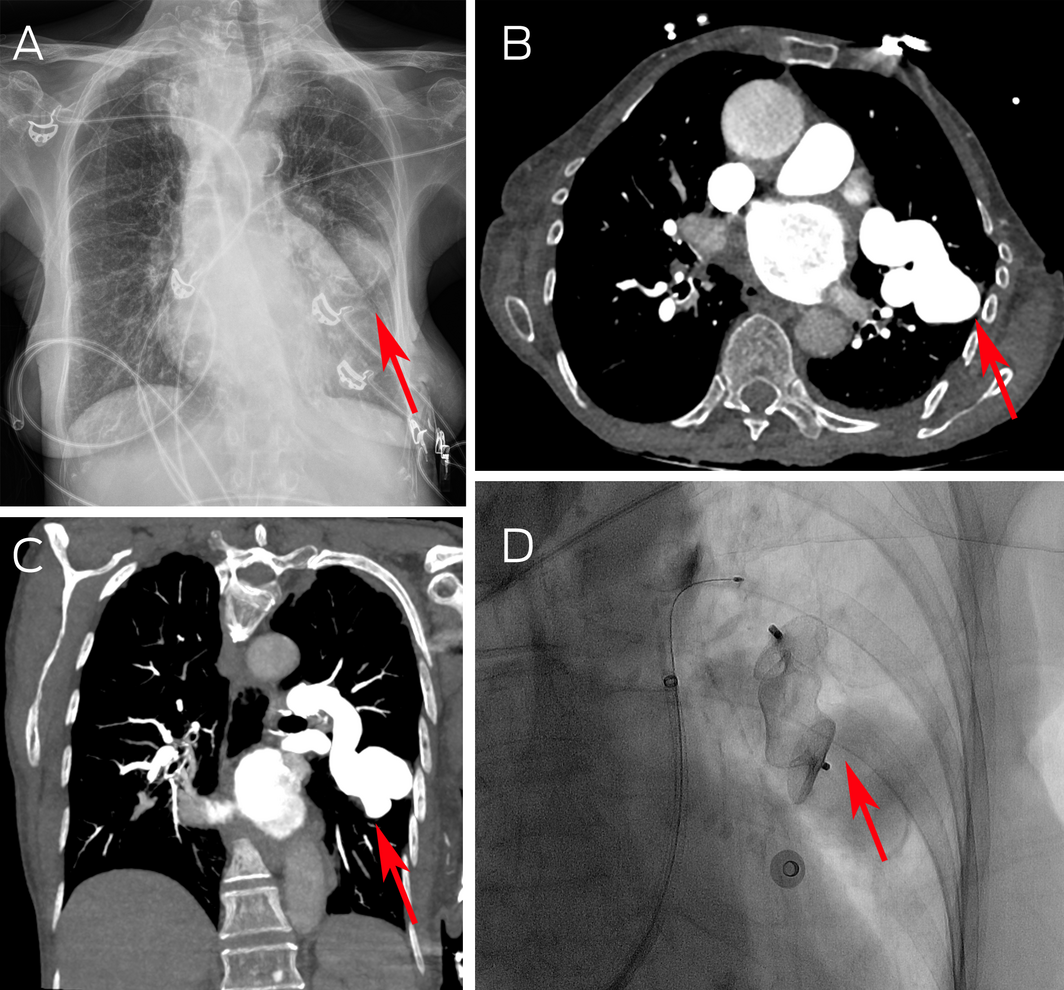
An 82‐year‐old woman presented to hospital with worsening chronic dyspnoea without fever or other specific symptoms. Despite receiving 100% oxygen via non‐invasive ventilation, arterial oxygen saturation remained low at 70–80%. However, the oxygen saturation improved when positioned flat — a phenomenon known as platypnoea–orthodeoxia, which is associated with right‐to‐left shunts.1,2 Chest x‐ray revealed a left mid‐zone mass contiguous with the hilar vessels (Figure, A, arrow), and echocardiography excluded an intracardiac shunt. Computed tomography scan with intravenous contrast demonstrated a massive pulmonary arteriovenous malformation at the level of the pulmonary arteries (Figure, B [axial] and C [coronal], arrows). This was subsequently managed by radiological embolisation with a 20 mm type II Amplatzer plug (St Jude Medical; Figure, D), with good radiographic result and rapid improvement in arterial oxygenation.3 Pulmonary arteriovenous malformations are an important and reversible cause of hypoxaemia due to right‐to‐left shunting and can result in paradoxical embolic stroke if untreated.4
Competing interests
No relevant disclosures.
References
- Agrawal A, Palkar A, Talwar A. The multiple dimensions of platypnea–orthodeoxia syndrome: a review. Respir Med 2017; 129: 31–38.
- Henkin S, Negrotto S, Pollak PM, et al. Platypnea–orthodeoxia syndrome: diagnostic challenge and the importance of heightened clinical suspicion. Tex Heart Inst J 2015; 42: 498.
- Hart JL, Aldin Z, Braude P, et al. Embolization of pulmonary arteriovenous malformations using the Amplatzer vascular plug: successful treatment of 69 consecutive patients. Eur Radiol 2010; 20: 2663–2670.
- Shovlin CL, Condliffe R, Donaldson JW, et al. British Thoracic Society clinical statement on pulmonary arteriovenous malformations. Thorax 2017; 72: 1154–1163.
Barriers and Facilitators to Timely Detection and Optimal Management of Chronic Wet Cough in Aboriginal Children Across Australia From the Perspectives of Carers of Aboriginal Children: A Qualitative Study
Gloria T. Y. Lau, Pam Laird, Robyn Aitken, Melanie Barwick, Liam Bedford, Emily R. Bowden, Jamie Everingham, Angela Fuery, Reece Griffin, Neha Jain, Mina Kinghorn, Renae Knapp, Gabrielle B. McCallum, Peter Morris, Richard Norman, Peter C. Richmond, Aarti Saiganesh, Slade Sibosado, Cameron Taylor, Maree Toombs, Roz Walker, Joan Wilson, Anne B. Chang, André Schultz
Barriers and Facilitators to Timely Detection and Optimal Management of Chronic Wet Cough in Aboriginal Children Across Australia From the Perspective of Health Care Providers: A Qualitative Study
Gloria T. Y. Lau, Pamela Laird, Robyn Aitken, Melanie Barwick, Liam Bedford, Emily R. Bowden, Corey Dalton, Jamie Everingham, Angela Fuery, Reece Griffin, Neha Jain, Mina Kinghorn, Renae Knapp, Gabrielle B. McCallum, Peter Morris, Richard Norman, Peter C. Richmond, Aarti Saiganesh, Slade Sibosado, Maree Toombs, Roz Walker, Joan Wilson, Anne B. Chang, André Schultz
Respiratory Syncytial Virus Disease Burden and Evidence Gaps in Australia Before Immunisation Introduction: A Retrospective Population-Based Study Using 2016–2019 Hospitalisation and 2023 Laboratory Surveillance Data
Chisato Imai-Boulter, Jean Li-Kim-Moy, Clayton Chiu, Sanjay Jayasinghe, Kristine Macartney
Not Gone but Often Forgotten: Action Needed to Address Tuberculosis in Aboriginal and Torres Strait Islander Communities
Nikkita Joshua, Emma L. Smith, Eunice (Cheeky) Love, Christopher P. Lowbridge, Nicole Tukana, Amy Bowden, Megan A. Campbell, Dawn Casey, James Ward
Uneven Ground: Survival Differences Among Victorian Lung Cancer Patients by Location of Residence (2011–2023): A Retrospective Cohort Study
Evangeline Samuel, Eldho Paul, Mike Lloyd, Sanuki Tissera, Craig Underhill, Sagun Parakh, Phillip Parente, Inger Olesen, Javier Torres, Katharine See, Gavin M. Wright, David Langton, Thomas John, Matthew Conron, James Bartlett, Nicola Atkin, Nikolajs Zeps, Susan V. Harden, Wasek Faisal, John R. Zalcberg, Rob G. Stirling
Treatment and Survival Outcomes for Indigenous and Non-Indigenous Australians Within the Victorian Lung Cancer Registry: A Retrospective Cross-Sectional Cohort Study
Melanie Wong, Mike Lloyd, Jessie Zeng, Sanuki Tissera, Kalinda E. Griffiths, Justine Clark, Jonathan Gillies, Lisa Briggs, Jacqueline Lesage, Tom Wood, Craig Underhill, Sagun Parakh, Louis B. Irving, Wasek Faisal, Rob Blum, Gary E. Richardson, Phillip Parente, Michelle Caldecott, Inger Olesen, Javier Torres, Evangeline Samuel, Christopher Lyne, Katharine See, David Langton, Thomas John, Gavin Wright, Matthew Conron, James Bartlett, Golsa Adabi, Maggie Moore, Susan Harden, Zoe K. McQuilten, John R. Zalcberg, Rob Stirling