




Volume 215 - Issue 5
The ABCD of the comprehensive geriatric assessment
Authors: Paven Kaur, Jeffrey Rowland and Elizabeth Whiting
Med J Aust 2021; 215 (5): 206-207.e1. || doi: 10.5694/mja2.51203
Published online: 9 August 2021
Published online: 9 August 2021
The “ABCD of CGA” concept presents varying models of CGA depending on the setting and needs of the patient
The concept of the “ABCD of CGA” would result in varying assessments depending on the environment and needs of the patient
The comprehensive geriatric assessment (CGA) is considered the gold standard assessment tool for evaluating and providing care to at‐risk and frail older patients. The key elements of the CGA include a multidimensional approach with a coordinated multidisciplinary assessment to identify medical, psychosocial, environmental and functional concerns. The information gathered is used to inform and formulate a detailed and individualised care plan with identified goals focusing on restoring or maintaining function with clear follow‐up.1,2,3
The concept of the geriatric evaluation was developed in the 1930s by British geriatrician Marjory Warren, who recognised that older patients with multiple comorbidities and poor functional status often lacked diagnoses and clear management plans. Warren advocated for specialised and coordinated care, which is the basis of CGA, demonstrating many older patients previously considered dependent on care could be discharged home.1,4
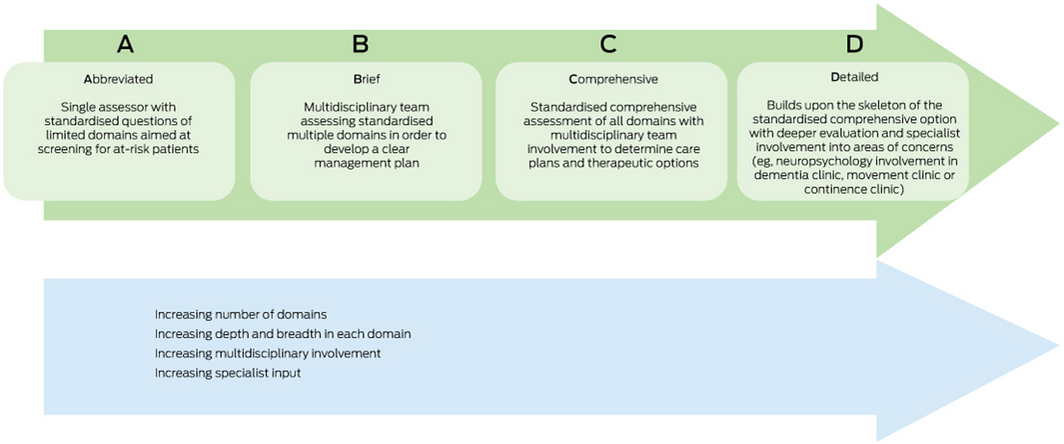
In today’s health care system, increasing rates of hospitalisation with longer lengths of stay and poorer outcomes have been noted in the frail, older population compared with other demographics. The CGA encompasses a holistic approach of the frail older patient with an emphasis on function and quality of life and promotes the use of quantitative assessment tools with early involvement of the multidisciplinary team. Increasingly, a multidisciplinary team approach and assessment of different domains has been adopted into standard care; however, this is often not formally a CGA, which requires definition and specifics that are yet to be properly determined. We propose a new concept of the “ABCD (abbreviated, brief, comprehensive, detailed) of CGA” with varying models of CGA depending on the setting and needs of the patient.
The core components of the CGA are functional status, including cognition, mobility, comorbidities with a focus on the geriatric syndromes, polypharmacy, mood, nutrition, visual and hearing impairment, living environment, social network, finances, support and care needs, goals of care, and advanced care planning.2,5
The evidence supporting the use of CGA is strong and noted in a variety of clinical settings.
Within the geriatric evaluation and management unit setting, the use of CGA has shown multiple benefits:
- increased likelihood of discharge home;5,6,7
- reduction in discharges to residential aged care facilities;5,6
- improvement in functional status;5,7
- greater functional independence on discharge;5
- cognitive improvement;5,6,7
- reduction in mortality;5,7
- reduction in re-hospitalisation and shorter hospital stays;5 and
- greater satisfaction among patients, families and medical and nursing staff.5
The use of CGA within acute care of the elderly units is one of the defining features separating these units from other acute medical units, with the demonstrated benefit of increased likelihood of living at home and a reduction in functional decline at discharge.8
More recently, the use of CGA in the emergency department (ED) setting has been considered in a cohort study conducted in United Kingdom investigating the impact of using CGA in the ED. The CGA was integrated to the ED with an on‐site consultant geriatrician present 7 days a week sharing decision making and with the implementation of a standardised integrated proforma with care pathways and joint education between staff. These changes were associated with a statistically significant reduction in admissions and in the readmission rate, thus demonstrating early intervention is beneficial for patients and hospitals.9
Although the benefits of CGA have been clearly demonstrated, it is not always feasible or beneficial to implement a full comprehensive assessment in all situations due to constraints, including time and resources. Contributing to the difficulty is the definition of the CGA which remains broad and ill‐defined, making it difficult for the user to adopt across various settings. Hence, we propose the concept of the “ABCD of CGA” to establish varying models and intensity of CGA depending on the need. This concept would result in targeted domains in the rapid assessment environment of the ED and a more comprehensive assessment over time in the more subacute environment of the Geriatric Evaluation and Management unit (Box). It is important to understand that CGA does not change management but directs management depending on the CGA findings and the clinical environment.
The next step for this concept would be the development of standardised CGA tools for use in identified settings for specific purposes. Should this concept be accepted, further work would need to be done to validate the four different approaches. Once determined, this would enable common language and understanding with the ability to compare CGA use in various research and clinical settings, including across primary to tertiary care.
Competing interests
No relevant disclosures.
References
- Rubenstein LZ, Rubenstein LV. Chapter 35: multidimensional geriatric assessment. In: Fillit HM, Rockwood K, Woodhouse K, editors. Brocklehurst’s textbook of geriatric medicine and gerontology; 7th ed. Philadelphia: Saunders Elsevier, 2010; pp 211–217.
- Pilotto A, Panza F. Section 2 — key concepts in care of older adults: comprehensive geriatric assessment: evidence. In: Michel JP, Beattie BL, Martin FC, Walston JD, editors. Oxford textbook of geriatric medicine. Oxford University Press, 2018; pp 117–127.
- Parker SG, McCue P, Phelps K, et al. What is comprehensive geriatric assessment (CGA)? An umbrella review. Age Ageing 2018; 47: 149–155.
- St John PD, Hogan DB. The relevance of Marjory Warren’s writings today. Gerontologist 2014; 54: 21–29.
- Pilotto A, Cella A, Pilotto A, et al. Three decades of comprehensive geriatric assessment: evidence coming from different healthcare settings and specific clinical conditions. J Am Med Dir Assoc 2017; 18: 192.
- Ellis G, Whitehead MA, Robinson D, et al. Comprehensive geriatric assessment for older adults admitted to hospital: a meta-analysis of randomised controlled trials. BMJ 2011; 343: d6553.
- Stuck AE, Siu AL, Wieland GD, et al. Comprehensive geriatric assessment: a meta-analysis of controlled trials. Lancet 1993; 342: 1032–1036.
- Baztán JJ, Suárez-García FM, López-Arrieta J, et al. Effectiveness of acute geriatric units on functional decline, living at home, and case fatality among older patients admitted to hospital for acute medical disorders: meta-analysis. BMJ 2009; 338: b50.
- Conroy SP, Ansari K, Williams M, et al. A controlled evaluation of comprehensive geriatric assessment in the emergency department: the “emergency frailty unit”. Age Ageing 2014; 43: 109–114.
Linked content
-
MJA Letter: The ABCD of the comprehensive geriatric assessment
-
MJA Letter: In reply
Provenance: Not commissioned; externally peer reviewed.
Respiratory Syncytial Virus Disease Burden and Evidence Gaps in Australia Before Immunisation Introduction: A Retrospective Population-Based Study Using 2016–2019 Hospitalisation and 2023 Laboratory Surveillance Data
Chisato Imai-Boulter, Jean Li-Kim-Moy, Clayton Chiu, Sanjay Jayasinghe, Kristine Macartney
Multimorbidity Clusters Among People Aged 65 Years and Over in Australia: A Nationwide Cross-Sectional Data Linkage Study
Weisi Chen, Christine Y. Lu, Sarah N. Hilmer, Alice A. Gibson, Edwin C. K. Tan
Predictors of Ambulance Transport to Hospital for Older People Living in Tasmanian Aged Care Facilities: A Retrospective Cohort Study
Sharon Andrews, Pieter F. Fouche, Belinda Flanagan, Michael McDermott, Melanie Greenwood
Deprescribing in Older People: A Clinical Practice Guideline Summary
Stephen Tucker, John D. G. Watson, Donna Wellins, Tim Whitmore, Christopher Etherton-Beer, Amy T. Page
Emergency Department Presentations and Hospitalisations for Elder Abuse in People Accessing Aged Care Services in Australia: A Retrospective Cross-Sectional Study
Stephanie L. Harrison, Sahar Barmomanesh, Bryan Morden, Maria C. Inacio, Gillian E. Caughey, on behalf of the ROSA Consumer and Community Advisory Committee
A future for the hospital‐in‐the‐home (HITH) deteriorating patient: shifting the paradigm
Davide R Tomassoni, Iftah Amith