




Volume 215 - Issue 3
Schistosomiasis: a rare cause of gastrointestinal bleeding
Authors: Julia Lim, Shweta Sharma and Damian Dowling
Med J Aust 2021; 215 (3): 139-139.e1. || doi: 10.5694/mja2.51169
Published online: 2 August 2021
Published online: 2 August 2021
To the Editor: A 35‐year‐old man born in Dire Dawa, Ethiopia, with childhood exposure to swimming in rivers, migrated to Australia 18 years ago. He presented with recurrent gastrointestinal bleeding. His index gastroscopy revealed portal hypertensive gastropathy and large oesophageal varices with high risk stigmata of recent bleeding requiring banding. Abdominal ultrasonography and transient elastography excluded liver cirrhosis.
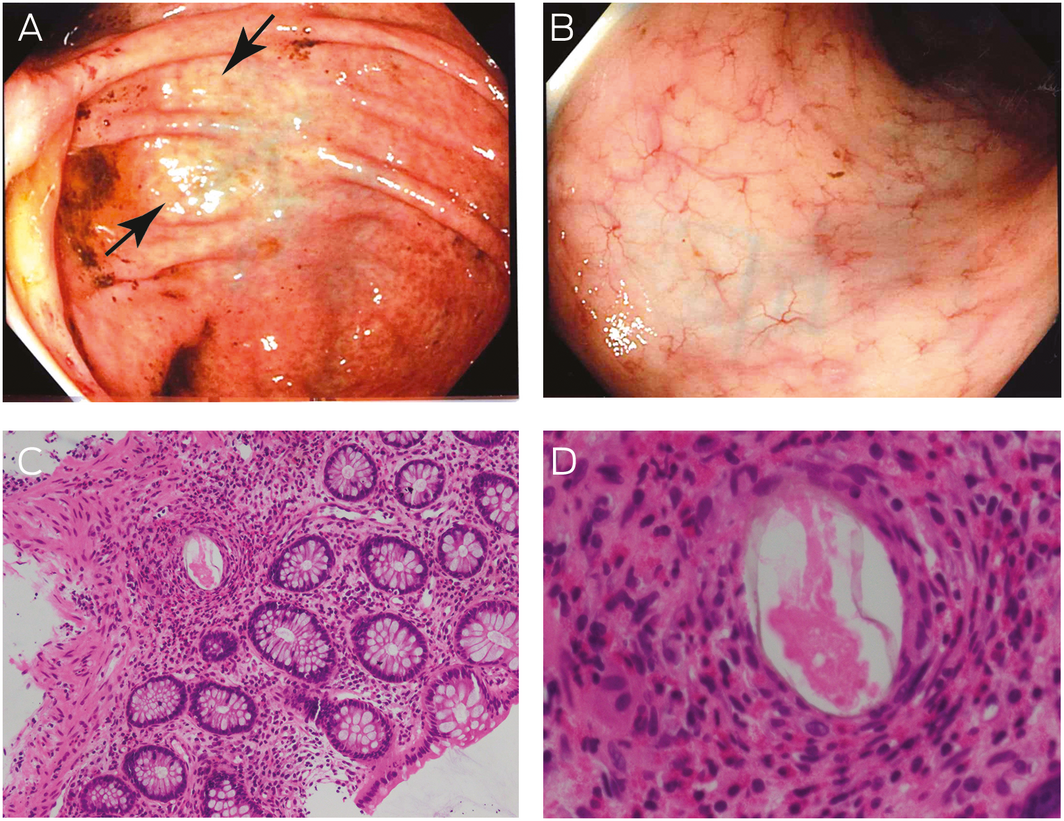
Six weeks later, he re‐presented with recurrent severe haematemesis associated with dark maroon rectal bleeding. Repeat urgent gastroscopy and flexi‐sigmoidoscopy revealed oesophageal varices without active bleeding. On sigmoidoscopy, a large amount of dark blood was seen, presumed to be related to rapid transit from recent oesophageal variceal bleeding. In the next 48 hours, a repeat colonoscopy was performed. Colonoscopy identified yellowish nodules throughout the colon with diffuse telangiectasia (Box, A and B). Mucosa was oedematous and friable. Aphthous ulcers were seen in the transverse colon and biopsies were obtained. No polyps or focal source of colonic bleeding were evident.
Histopathology confirmed the presence of cystic ova resembling Schistosoma in the lamina propria immediately adjacent to crypts. Although classical granuloma formation was absent, aggregation of eosinophils was seen around a ruptured ovum (Box, C and D). Indirect assay via serology testing was positive for Schistosoma mansoni antibody (titre of 1:640). His eosinophil count was normal and stool microscopy was negative. He was treated with praziquantel. Four months later, a follow‐up gastroscopy revealed stable appearance of grade 1 oesophageal varices without high risk features. Routine variceal surveillance had been organised but not further colonoscopies.
Schistosomiasis affects over 200 million people worldwide but is not acquired in Australia. In a national survey in Ethiopia, 37.3 million individuals were living in endemic areas.1 Schistosoma mansoni is the commonest species to cause intestinal and hepatic schistosomiasis. In the 2016 national census, there were 11 795 people in Australia who were born in Ethiopia, 64.3% (7584) of whom were Australian citizens.2 Most screening data for schistosomiasis in Australia are based on African refugees, with 37% in Newcastle, 38% in Hobart and 12% in Melbourne.3 Despite anecdotal knowledge, there are no published cases of non‐cirrhotic portal hypertension related to schistosomiasis in Australia. As a multiracial country with high immigration and tourism, increased recognition in Australia is paramount.
References
- Negussu N, Mengistu B, Kebede B, et al. Ethiopia Schistosomiasis and Soil‐Transmitted Helminthes Control Programme: progress and prospects. Ethiop Med J 2017; 55 (Suppl 1): 75–80.
- Australian Bureau of Statistics. 2016 Census data. https://quickstats.censusdata.abs.gov.au/census_services/getproduct/census/2016/quickstat/9207_036 (viewed Oct 2020).
- Chaves NJ, Paxton G, Biggs BA, et al. Recommendations for comprehensive post‐arrival health assessment for people from refugee‐like backgrounds. 2nd ed. Sydney: Australasian Society for Infectious Diseases, 2016. https://www.asid.net.au/documents/item/1225 (viewed June 2021).
Early-Onset Colorectal Cancer With Liver-Only Metastases: A Retrospective Cohort Study Integrating Prospectively Collected Real-World Clinical and Molecular Data From an Australian National Database (2009–2024) to Guide Treatment Planning
Savio G. Barreto, Christos S. Karapetis, Shahid Ullah, Matthew Burge, Susan Caird, Angus Campbell, Azim Jalali, Ross Jennens, Muhammad A. Khattak, Belinda Lee, Stephanie H. Lim, Shehara Mendis, Louise Nott, Timothy J. Price, Jeremy D. Shapiro, Jeanne Tie, Javier Torres, Colin Williams, Rachel Wong, Vanessa Wong, Peter Gibbs
Australian Pathways for Specialist Pain Management and Early Palliative Care for People With Pancreatic Cancer: Developed Using a Community Consensus Approach
Jennifer Philip, Melanie R. Lovell, Kylee Bellingham, Gail Garvey, Gregory B. Crawford, Nicole M. Rankin, Kara Burns, Isabel Young, Vivienne Milch, Dorothy Keefe, Katrina Anderson, James Lawson, Meinir Krishnasamy
Cause‐specific mortality among Queensland people with cirrhosis, by cirrhosis aetiology and decompensation status, 2007–22: a retrospective cohort study
Vikas Bhasker, Jessica R Fong, Paul J Clark, Gunter F Hartel, Richard Skoien, James O’Beirne, Elizabeth E Powell, Patricia C Valery
Clinical practice guidelines for hepatocellular carcinoma surveillance for people at high risk in Australia: summary of recommendations
Jacob George, Nicole L Allard, Stuart K Roberts, Leon A Adams, Jane Davies, Behzad Hajarizadeh, Jennifer H MacLachlan, Suzanne E Mahady, Rosalie Altus, Catherine Brown, David C Fry, Belinda Greenwood‐Smith, Natali Smud, Patricia C Valery, Nafisa Yussf, Kate Broun, Denise Campbell, Karen Canfell, Chelsea Carle Harrison, Victoria Freeman, Paul Grogan, Catherine Holliday, Suzanne Hughes, Anna Kelly, Cathelijne Kemenade, Claire Latumahina, Amanda McAtamney, Megan Varlow, Joachim Worthington, Susan Yuill, Eleonora Feletto
Assessment of metabolic dysfunction‐associated fatty liver disease in primary care: a consensus statement summary
Leon A Adams, William W Kemp, Kate R Muller, Elizabeth E Powell, Stuart K Roberts, Luis Calzadilla Bertot, Stephanie Best, Gary Deed, Jon D Emery, Samantha L Hocking, Graham R Jones, John S Lubel, Sinead Sheils, Stephen M Twigg, Gerald F Watts, Jacob George
Treatment outcomes for people with hepatitis C referred to tertiary care in Victoria, 2021–22: a retrospective observational study
Elly Layton, Nicole Matthews, Brendan Quinn, Nasra Higgins, Gabrielle Lindeman, Mielle Abbott, Jennifer MacLachlan, Elizabeth Birbilis, Margaret E Hellard, Joseph Doyle, Benjamin C Cowie, Mark Stoové