





Volume 214 - Issue 9
Increased dispensing of prescription medications in Australia early in the COVID‐19 pandemic
Authors: Mustafa Mian, Subhashaan Sreedharan and Sarah Giles
Med J Aust 2021; 214 (9): 428-429. || doi: 10.5694/mja2.51029
Published online: 3 May 2021
Published online: 3 May 2021
Coronavirus disease 2019 (COVID‐19) and subsequent containment measures affected consumer behaviour in Australia, including the stockpiling of essential items. Increased demand for prescription medications caused concern about potential medication shortages, and a range of policies were implemented in March 2020 to protect supplies.1
We used interrupted time series modelling to quantify the impact of the COVID‐19 pandemic on medication dispensing. The Pharmaceutical Benefits Scheme (PBS) subsidises public medication costs in Australia. We analysed Section 85 date of supply data2 to model dispensing during January 2016 – December 2019, by month, separately for all PBS prescriptions, the ten medications most frequently dispensed during the 2018–19 financial year, hydroxychloroquine, and dexamethasone. These models, which accounted for long term trends and seasonal changes, were used to predict expected dispensing during January – June 2020 (with 95% confidence intervals [CIs]), which we compared with actual dispensing rates during this period (online Supporting Information). Ethics approval was not required for our analysis of publicly available data.
The number of prescriptions dispensed during March 2020 was significantly higher than predicted (4.80 million more prescriptions, +18.5%; 95% CI, +14.0% to +23.3%), but significantly lower in April (2.28 million fewer prescriptions, –9.2%; 95% CI, –5.3% to –12.8%) and May (2.08 million fewer prescriptions; –8.1%; 95% CI, –4.3% to –11.5%); there was no significant difference in June 2020 (988 778 fewer prescriptions, –3.8%; 95% CI, –7.5% to +0.1%) (Box). A similar pattern applied to the ten most dispensed medications; the increase in the number of hydroxychloroquine prescriptions dispensed in March was particularly large (24 286 more prescriptions, +95.5%; 95% CI, +89.1 to +102%) (Supporting Information).
Increased dispensing of prescription medications in March 2020 was consistent with the general panic buying reported early in the COVID‐19 pandemic.3 Pharmacies also received increased requests for prescription and over‐the‐counter medications at this time, in some cases causing local shortfalls1 and concern that continued high dispensing might interrupt medication supply at the national level. This applied in particular to drugs considered early in the pandemic as potential treatments for COVID‐19, such as hydroxychloroquine.
In response to increased dispensing in March, the Australian government rapidly implemented a range of policies for protecting medication supplies. Dispensing limits of one month’s supply were applied to medications if shortages would have serious health consequences.1 These policies reduced the total number of medications dispensed in April and May 2020, followed by the return to normal levels of prescription dispensing in June. Other factors likely to have been important were stockpiles amassed by people during March, public adjustment to the pandemic, and the early suppression of COVID‐19 in Australia.
Restrictions on prescription dispensing were balanced by services to assist susceptible patients to isolate themselves; for example, the COVID‐19 home medicines service funded home delivery of prescription medications by community pharmacies and Australia Post,4 and funding for telehealth was increased to facilitate remote prescribing.5
Our findings indicate that medication supply can be safeguarded from panic dispensing by a range of regulatory policies combined with medication services for vulnerable people. This may be particularly important for ensuring equitable access to medications for treating COVID‐19. The risk of further COVID‐19 outbreaks underscores the importance of maintaining these policies and services.
Box – Total number of prescriptions dispensed in Australia, January 2016 – June 2020, and numbers of COVID‐19 diagnoses in Australia, January 2020 – June 2020
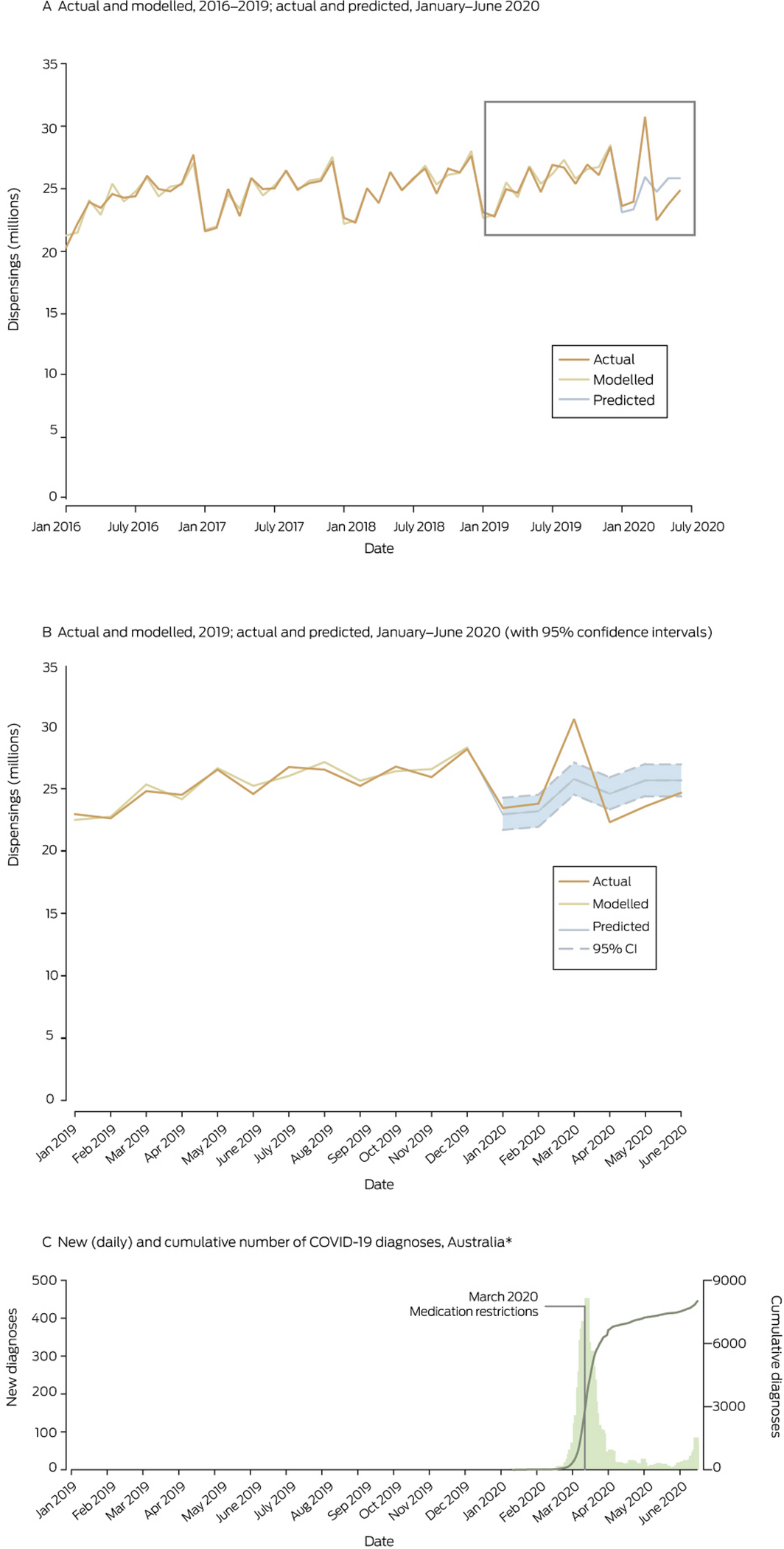
CI = confidence interval. * Source: Australian Department of Health.2
Competing interests
No relevant disclosures.
References
- Therapeutic Goods Administration. Limits on dispensing and sales of prescription and over‐the-counter medicines [media release]. 19 Mar 2020. https://www.tga.gov.au/media-release/limits-dispensing-and-sales-prescription-and-over-counter-medicines (viewed Sept 2020).
- Australian Department of Health. PBS and RPBS section 85 date of supply data. https://www.pbs.gov.au/info/statistics/dos-and-dop/dos-and-dop (viewed Sept 2020).
- Australian Bureau of Statistics. Retail trade, Australia. https://www.abs.gov.au/statistics/industry/retail-and-wholesale-trade/retail-trade-australia/latest-release (viewed Sept 2020).
- Pharmacy Programs Administrator. COVID‐19 home medicines service. www.ppaonline.com.au/programs/covid-19-home-medicine-service (viewed Sept 2020).
- Australian Department of Health. COVID‐19 temporary MBS telehealth services. Updated 23 Sept 2020. http://www.mbsonline.gov.au/internet/mbsonline/publishing.nsf/Content/Factsheet-TempBB (viewed Sept 2020).
Costs of Delivering the Hep B PAST Model of Care in Remote Australia: A Retrospective Pre–Post Study
Hoa Nguyen, Anh Le Tuan Nguyen, Paula Binks, Melita McKinnon, Emily Vintour-Cesar, Karen Wills, Nicola Stephens, Benjamin Cowie, Joshua S. Davis, Yuejen Zhao, Peter Nihill, Julie A. Campbell, Andrew J. Palmer, Jane Davies, Barbara de Graaff
Buruli Ulcer Acquired From Ringtail Possum Rescue
Daniel P. O'Brien, Naomi Clarke, Sara Bonnici, Mohammad A. Hussain
Q Fever Visceral Abscesses After Contact With Native Australian Marsupials
Samantha J. Laws, Enzo Binotto, James Stewart, Jennifer Ho, Trent Yarwood, Josh Hanson, Simon Smith
Hospital-Admitted Injection-Related Infections Among Incarcerated People Who Inject Drugs in Australia: A Retrospective Cohort Study
Andrew Palmer, Matthew Carter, Jeremy Yeo, Cecilia Shim, Jason Connor, Jeremy Hayllar, Gerald Holtmann, Naomi Moy, Elliott G. Playford, Naomi Runnegar, Paul J. Clark
The Live Attenuated Influenza Vaccine in Australia: An Additional Tool for Influenza Prevention
Cyra Patel, Alexis Pillsbury, Tran Nguyen, Xia Wang, Helen E. Quinn, Clayton K. Chiu, Allen C. Cheng, Katie L. Flanagan, Zhicheng Wang
Reflex Testing for Hepatitis D Infection: A Unique Opportunity to Reduce Hepatitis D-Related Chronic Liver Disease Deaths in Australia
Jessica Howell, Lauren Andersson, Miriam T. Levy, James O'Beirne, Leon Adams, Katharine Irvine, Avik Majumdar, Golo Ahlenstiel, Kathy Jackson, Krispin Hajkowicz, Joseph Doyle, Jane Davies, Sarah Cherian, Wayne Dimech, Alexander J. Thompson