




Volume 214 - Issue 6
Ethical and practical implications of returning genetic research results: two Australian case studies
Authors: Jane Tiller, Alison H Trainer, Ian Campbell and Paul A Lacaze
Med J Aust 2021; 214 (6): 259-262.e1. || doi: 10.5694/mja2.50842
Published online: 9 November 2020
Published online: 9 November 2020
Should medically significant genetic results be offered to research participants or their at‐risk relatives?
Australian research studies now generate genetic information on thousands of participants. Some genetic results, present in a small portion of participants (< 5%), are considered medically actionable, meaning they are associated with increased risk of adult‐onset diseases, where effective risk management, prevention or treatment exists (eg, inherited cancer or cardiac disorders).1 The National Statement on Ethical Conduct in Human Research,2 which considers genomic research at Chapter 3.3, now requires an ethically defensible plan for return (or non‐return) of genetic research results. Box 1 summarises the guidelines that are relevant to the return of genetic results to research participants.2
Returning genetic research results can be life‐saving, alerting participants to preventive steps that they would not otherwise have taken. Most participants identified in research studies have no clinical features or family history of the indicated disease, are unaware of their genetic risk, and would not qualify for publicly funded clinical criteria‐based genetic testing.
Among the international genomics community, there is growing consensus that medically actionable genetic research results should be made available to participants.3 The American College of Medical Genetics and Genomics published a list of genes related to medically actionable conditions, in which results should be returned if identified during clinical testing.1 This gene list has been used to guide the return of research results in some United States studies,4 but has not been adopted by the National Health and Medical Research Council or other Australian bodies. However, the National Statement makes it clear at 3.3.41 that “researchers have an obligation to have a process in place for the return of findings that are of proven validity and of health significance to the participant, or relative, subject to participant consent”.2
However, even where participant consent has been obtained, not all Australian studies are returning medically actionable results, due to varying ethical and practical challenges. For example, research participants may provide samples for altruistic reasons, before research analysis, without expectation of re‐contact. Should results be returned to these individuals, especially those unaffected by indicated disease? Is there a legal or ethical requirement to make results available or liability for withholding them? The National Statement provides some guidance (Chapter 3.3) regarding which results should be returned,2 but ultimately researchers determine whether to return results.
As the National Statement indicates, return of results should be limited to those genes with validity and utility (3.3.29 and 3.3.41).2 However, pathogenic variants in medically actionable genes are not fully penetrant, meaning that not all at‐risk variant carriers develop the disease.5 Risk estimates for many genes are still uncertain, complicating decisions around medical actionability and the time frame for returning results. Some participants may experience surprise or distress on learning about genetic risks. Returning results may also raise the possibility of out‐of‐pocket medical costs or increased insurance liabilities for younger participants. Genetic results should be delivered by a medical professional, with genetic counselling and clinical support provided, as noted by the National Statement (3.3.31 and 3.3.32).2 This requires time and resources, which are often limited.
Thus, despite clear guidance in the National Statement, some research studies do not return results even where results are clinically valid and of undisputed relevance to participants’ and family members’ health, and the participant has consented to receive such results. To assist with these challenges, a national service to support the return of genetic results from research studies has recently been developed6 and is now operational.
Research cohort case studies
Here, we present two case studies from Australian epidemiological research (Box 2). Lifepool,7 a large community‐based study of women in the general population, and ASPREE (ASPirin in Reducing Events in the Elderly),8 a large cohort study of healthy older people, have both commenced genetic analysis and have been faced with decisions regarding the return of genetic results. These case studies highlight the challenges and opportunities related to this complex issue. ASPREE's older population particularly raises unique challenges.9
Lifepool has shown that return of genetic results prompts preventive interventions for women with variants in high risk breast cancer genes, most of whom would not have been identified through current clinical criteria‐based testing.7 To date, Lifepool has contacted 73 women previously unaware of their high risk variants. None of the women identified with a cancer‐causing variant would have been eligible for publicly funded testing through the Australian clinical system. Most women took proactive steps to mitigate risk after receiving genetic results. Of the 73 women, 23 so far have undergone risk‐reducing surgery (bilateral oophorectomy), mitigating their cancer risk.11 This could be life‐saving, given the high lifetime risk and low survival rates for ovarian cancer associated with high risk variants. The shared nature of DNA means genetic results are also relevant to participants’ blood relatives. Beyond participants who directly received results, 63 relatives were also tested through cascade testing, 32 of whom were also found to have a high risk variant. These relatives were, on average, substantially younger than the original participants (Box 3), making this information even more valuable for prevention.
ASPREE biobank participants consented to re‐contact regarding genetic results relevant to personal or family health. In accordance with the National Statement (3.3.36 and 3.3.37),2 an ethically defensible plan outlining the return of genetic results was approved by the Alfred Hospital Human Research Ethics Committee in 2015.9 However, there is ongoing debate about the most appropriate strategy, given the age of the cohort (average, 75 years) and primary purpose of the study — an aspirin prevention trial (as opposed to genetic research study). ASPREE has returned other types of (non‐genetic) medically actionable research results, including abnormal magnetic resonance imaging, blood pathology and cognitive assessments. However, genetic results have been treated differently, with unique challenges.
Many older ASPREE participants who carry medically actionable variants have seemingly outlived their increased risk, displaying no signs of indicated disease at 75 years of age and older.12 Is the information still medically actionable? Do participants still want to know? Should results be returned for the benefit of younger, potentially high risk family members? What about ASPREE participants who are in cognitive decline or deceased? Is ASPREE obliged to contact these individuals, or their relatives, to provide genetic results?
Despite having detected genetic information through research analysis that is clinically valid and of clear relevance to personal or family members’ health, ASPREE has not yet commenced returning genetic results, seeking to achieve an appropriate harm–benefit balance.9 The applicable Human Research Ethics Committee recently discussed a possible strategy of offering results via an opt‐in model, where participants register interest following a newsletter notification. Although well intended, this approach is problematic. First, only a fraction of participants would receive or read the newsletter article, limiting the number who would be informed. Second, only about 1% of the cohort will have a medically actionable variant, meaning the likelihood that those participants will have opted‐in is very small. Finally, ASPREE participants have already consented to re‐contact on the basis of medically actionable genetic results, so re‐consent is not required. The proposed opt‐in model compromises equity in ensuring high risk participants are contacted and offered results ethically.
The consequences of a passive approach to returning results are notable. For example, two male ASPREE participants were found through the study analysis to have high risk breast cancer variants. Neither participant had any relevant personal cancer history. Analysis of collected family history data showed that both had daughters (who have a 50% chance of having the same pathogenic variant) who developed breast cancer under the age of 50 during the ASPREE trial. These women did not have a family history of breast cancer required to prompt clinical genetic testing through clinical services. Yet their fathers’ results, if known, may have prompted genetic testing or high risk breast cancer screening for the daughters. This information was clinically significant and relevant to family health, despite its questionable health benefit to the male participants. Although the time for prevention has passed for those participants’ daughters, ASPREE must now consider the return of results to other participants with medically actionable results.
Currently, there is no Australian legal requirement to inform research participants of medically actionable genetic results — any imperative to offer results is ethical. Whether any ethical imperative extends to preventing disease in participants’ relatives is unclear,13 although it is contemplated by the National Statement (3.3.32 and 3.3.41).2
A concern arising when considering return of results in ASPREE is that elderly research participants may not want to know about genetic results. However, other studies suggest that most research participants do want to receive genetic information, even if only for their family members’ benefit.14,15 A recent international survey on preferences for genetic results14 showed no significant difference between elderly and younger groups. Evidence suggests that older participants may be more interested in genetic results, especially if family members may benefit.14
Another challenge arises where participants with medically actionable genetic results are deceased or in cognitive decline. In these circumstances, the benefit of returning results to next‐of‐kin is for relatives. Several Australian research studies return genetic results purely for family members’ benefit, demonstrating the acceptability of this approach. The Australian Ovarian Cancer Study commenced returning genetic results of deceased women to next‐of‐kin more than ten years ago.16 Recently, the TRACEBACK study archived DNA samples of women who died from ovarian cancer, to identify genetic risk variants and notify at‐risk relatives.17 These programs conduct genetic testing on DNA of deceased people who cannot derive personal benefit, for the benefit of at‐risk relatives.
Conclusion
There is a growing consensus on the ethical imperative to offer research participants medically actionable genetic results. Studies show high acceptability for receiving genetic results, and the preventive health benefits are clear. Although the National Statement provides guidance, questions remain regarding the legal obligations and disclosure methods, particularly when research participants lack the capacity to make decisions about receiving genetic information. As genetic information becomes more pervasive and valuable to preventive medicine, the return of medically actionable genetic results will become increasingly important from ethical, legal and medical perspectives.
Box 1 – National Statement on Ethical Conduct in Human Research: guidelines relevant to return of genetic results2
|
Guideline |
Content |
||||||||||||||
|
|
|||||||||||||||
|
3.3.26 |
In considering whether to return results of research, researchers should distinguish between individual research results and overall research results. Researchers should consider how these results will be provided to participants, how the process of returning results will be managed, and the risks of the return of individual research results and overall research results. |
||||||||||||||
|
3.3.27 |
Return of findings and results relating to an individual participant depends on the contextual relevance of the findings; some genomic research findings must be returned, some findings may be returned, and some findings should not be returned. |
||||||||||||||
|
3.3.29 |
Once there is sufficient evidence and agreement that a finding or result is clinically significant, participants should be advised that research results or findings that may be returned will first need to be confirmed according to applicable guidelines; eg, at a National Association of Testing Authorities accredited laboratory. |
||||||||||||||
|
3.3.31 |
Any plan to return individual research results should include linkage with a clinical service and access to genetic counselling. The plan should specify any expertise to which the project team might require access. |
||||||||||||||
|
3.3.32 |
The return of results or findings of significance for the health of the participant or relative is the responsibility of the appropriate clinical service or, where such a service is not available, the participant's clinician in consultation with the research team. |
||||||||||||||
|
3.3.36 |
Researchers must prepare and follow an ethically defensible plan to manage the disclosure or non‐disclosure of genomic information of potential importance for the health of research participants or their relatives. |
||||||||||||||
|
3.3.37 |
The ethically defensible plan must be approved by a Human Research Ethics Committee. |
||||||||||||||
|
Step 1: Determination of whether findings will be returned |
Genomic research falls into three categories:
|
||||||||||||||
|
3.3.41 |
Where there will be any return of findings to participants, they should be advised as to which findings will be returned and which will not be returned, as follows:
|
||||||||||||||
|
|
|||||||||||||||
|
|
|||||||||||||||
Box 2 – Research cohort case studies
|
Lifepool study7 |
ASPREE study8 |
||||||||||||||
|
|
|||||||||||||||
|
Australian study aiming to improve women's health, particularly with respect to breast cancer |
Randomised, placebo‐controlled Australian trial for daily low‐dose aspirin, and ongoing observational cohort study of ageing |
||||||||||||||
|
Participants |
|||||||||||||||
|
|
||||||||||||||
|
Consent for genetic testing and return of results |
|||||||||||||||
|
|
||||||||||||||
|
Genetic testing conducted |
|||||||||||||||
|
|||||||||||||||
|
Genetic results of relevance |
|||||||||||||||
Following notification of women with high risk results:
|
|
||||||||||||||
|
|
|||||||||||||||
|
ASPREE = ASPirin in Reducing Events in the Elderly. |
|||||||||||||||
Box 3 – Distribution of age among family members accepting cascade testing through a familial cancer centre (FCC) compared with index cases identified through Lifepool6
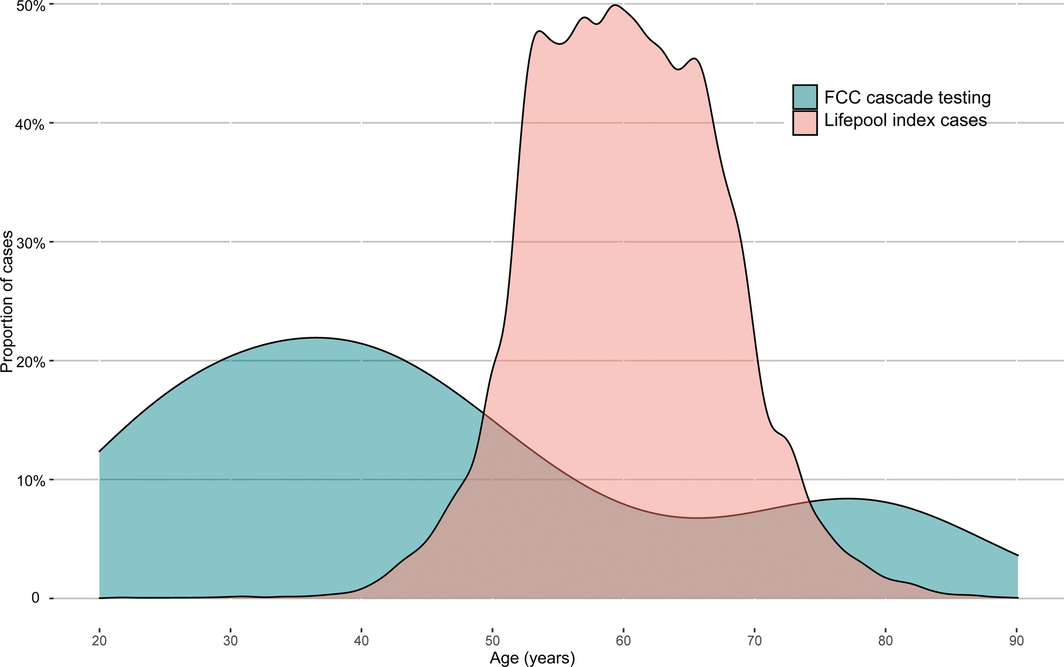
Although index cases identified through Lifepool often approach the age at which genetic risk is less relevant, a large proportion of the family members identified are considerably younger, at an age where preventive benefits can be maximised.
Competing interests
No relevant disclosures.
Acknowledgements
Paul Lacaze is the primary investigator and Jane Tiller is an investigator on the ASPREE genomics sub‐study. Ian Campbell is the lead investigator and Alison Trainer is an investigator on the Lifepool study. We acknowledge the contributions of the Lifepool research team, the ASPREE research team and the genetics department at Royal Melbourne Hospital.
References
- Kalia SS, Adelman K, Bale SJ, et al. Recommendations for reporting of secondary findings in clinical exome and genome sequencing, 2016 update (ACMG SF v2.0): a policy statement of the American College of Medical Genetics and Genomics. Genet Med 2016; 19: 249.
- National Health and Medicine Research Council, Australian Research Council, Universities Australia. National Statement on Ethical Conduct in Human Research 2007 (updated 2018). Canberra: Commonwealth of Australia, 2018. https://www.nhmrc.gov.au/about-us/publications/national-statement-ethical-conduct-human-research-2007-updated-2018 (viewed Aug 2020).
- Knoppers BM, Joly Y, Simard J, Durocher F. The emergence of an ethical duty to disclose genetic research results: international perspectives. Eur J Hum Genet 2006; 14: 1170–1178.
- Schwartz ML, McCormick CZ, Lazzeri AL, et al. A model for genome‐first care: returning secondary genomic findings to participants and their healthcare providers in a large research cohort. Am J Hum Genet 2018; 103: 328–337.
- van Rooiji J, Arp P, Broer L, et al. Reduced penetrance of pathogenic ACMG variants in a deeply phenotyped cohort study and evaluation of ClinVar classification over time. Genet Med 2020; 22: 1812–1820.
- Forrest LE, Young M‐A. Clinically significant germline mutations in cancer‐causing genes identified through research studies should be offered to research participants by genetic counselors. J Clin Oncol 2016; 34: 898–901.
- Rowley SM, Mascarenhas L, Devereux L, et al. Population‐based genetic testing of asymptomatic women for breast and ovarian cancer susceptibility. Genet Med 2019; 21: 913–922.
- McNeil JJ, Woods RL, Nelson MR, et al. Baseline characteristics of participants in the ASPREE (ASPirin in Reducing Events in the Elderly) Study. J Gerontol A Biol Sci Med Sci 2017; 72: 1586–1593.
- Lacaze P, Ryan J, Woods R, et al. Pathogenic variants in the healthy elderly: unique ethical and practical challenges. J Med Ethics 2017; 43: 714–722.
- Gareth ED, Nisha K, Yit L, et al. MRI breast screening in high‐risk women: cancer detection and survival analysis. Breast Cancer Res Treat 2014; 145: 663–672.
- Domchek SM, Friebel TM, Singer CF, et al. Association of risk‐reducing surgery in BRCA1 or BRCA2 mutation carriers with cancer risk and mortality. JAMA 2010; 304: 967–975.
- Lacaze P, Sebra R, Riaz M, et al. Medically actionable pathogenic variants in a population of 13,131 healthy elderly individuals. Genet Med. 2020; 22: 1883–1886.
- Knoppers BM, MnH Zawati, Sénécal K. Return of genetic testing results in the era of whole‐genome sequencing. Nat Rev Genet 2015; 16: 553–559.
- Allen NL, Karlson EW, Malspeis S, et al. Biobank participants’ preferences for disclosure of genetic research results: perspectives from the OurGenes, OurHealth, OurCommunity project. Mayo Clin Proc 2014; 89: 738–746.
- Middleton A, Morley KI, Bragin E, et al. Attitudes of nearly 7000 health professionals, genomic researchers and publics toward the return of incidental results from sequencing research. Eur. J. Hum. Genet 2016; 24: 21–29.
- Hallowell N, Alsop K, Gleeson M, et al. The responses of research participants and their next of kin to receiving feedback of genetic test results following participation in the Australian Ovarian Cancer Study. Genet Med 2013; 15: 458–465.
- Ovarian Cancer Australia. TRACEBACK research project. https://www.ovariancancer.net.au/page/148/traceback-research-project (viewed Aug 2020).
Linked content
-
InSight+: “Medically actionable” genetic results: challenges for researchers
Provenance: Not commissioned; externally peer reviewed.
Newborn Screening: Equity for Aboriginal and Torres Strait Islander Families in the Context of Emerging Genomics
Gail Garvey, Sarah Norris, Joanne Scarfe, Louise Lyons
When ‘Liver Enzymes’ Are Not Hepatic: Late-Onset Pompe Disease
Shauna Madigan, Georgina England, Wayne Rankin
Genomic Newborn Screening: Verdict From an Australian Citizens’ Jury
Emma Frost, Zornitza L. Stark, Kristen Nowak, Louise Healy, Sarah Norris, Stacy M. Carter
Genomic Testing Access for Hearing Loss Must Catch Up to the Evidence
Emma McGonigal, Andrew V. White, Valerie Sung, Karen Liddle, Lilian Downie, Emily Shepard
Population-Based Melanoma Screening Using Integrated Risk Scores in Australia: A Narrative Review to Determine Readiness
Courtney K. Wallingford, Chloe Mighton, Tamara Dawson, Anne Cust, H. Peter Soyer, Yvonne Bombard, Tatiane Yanes, Aideen McInerney-Leo
Genomic Newborn Screening: Commodity or Public Good?
Christopher Gyngell, Sebastian Lunke, Danya Vears, Zornitza L. Stark